Remeber:
For ultrasonic waves and ultrasonic sensors or actuators we have not defined a lumped parameter system, we have just defined the two quanitites for flow and effort and the generated impedance that binds the two. So for ultrasonic systems we have:
- Flow quantity:
- Effort quantity: (stress) for solids, (preassure) for liquids.
- ==Acustic Impendance== :IMPORTANTE ==We can also define the acustic impedance in another, more useful way==:IMPORTANTE ==This formula is valid for both solids and liquids==.
Here we have:
- : density of the material, measured in .
- : longitudinal velocity of a wave inside a certain material .
- Remeber also that and are reciprocal:Where:
- represents “==how fast the wave changes form==”.
- is the longitudinal propagation velocity.
- Both are velocities, and as such are expressed in .
- Power: (effort quantity flow quantity):
IMPORTANTE Here’s the value of the acustic impedance for the PZT:The unit of measure for the acustic impedance is
Formulas that we need to arrive at this conclusion:
- From the “Elastic Waves and Acustic Waves” lecture:And from the same lecture we have the wave equation:
- We can simplifiy it if we consider it for planar waves in isotropic material:Since for planar waves we have that:
- From the “Generic Ultrasonic Wave Function” lecture, we use a a simple longitudinal wave function:
- From the “Generic Ultrasonic Wave Function” lecture:
Here are the passages: (NOTE: These are my calcuation, they can be wrongNOT_SURE_ABOUT_THIS )
- From the “Elastic Waves and Acustic Waves” lecture:
- We assume a planar waves that propagates in isotropic materials, so we can use a simplified version of the hooke’s law:
- Since we are talking about a planar wave we will have that:So we can rewrite as:
- We now define as we have done in the “Generic Ultrasonic Wave Function” lecture a simple longitudinal wave function:This time we don’t consider the backward part of the formula, we assume that this wave only propagates forward.
- If we derive over we obtain: Where .
And if we derive it over we obtain:Since depends on .- So we can say:
- Similarly using we can say: Or, if we integrate from both parts over :
- So using :
- We know form the “Generic Ultrasonic Wave Function” lecture that:And if we calculate:
- So we can rewrite as:For simplicity i write as , since we have defined the impedance as: Now we know that it is equal to, and we define it as a positive value:We have demonstrated it starting from a solid, but the same formula is true also for liquids.
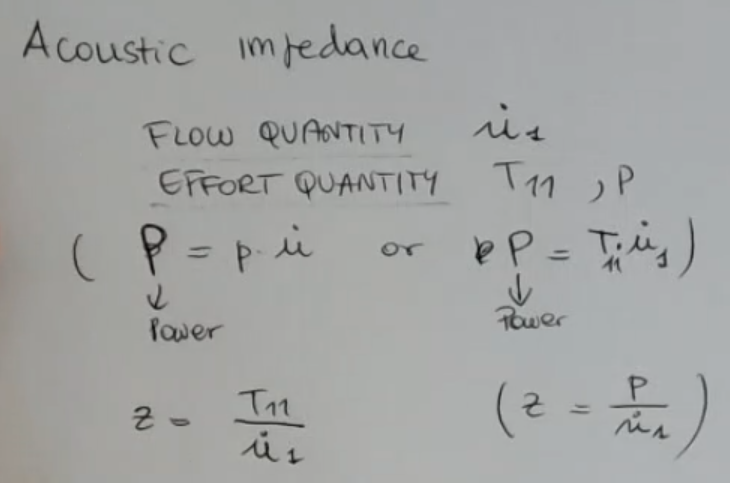
- So acoustic impedance is like a generalized impedance.
- The flow quantity (represented as a current) is the speed of the particles, which are vibrating and give the propagation of the wave.
- Whereas the effort quantity (represented as a voltage) is the stress (), or in fluids the pressure ().
- So the power () of the wave would be for us the product of this two quantity.
Let’s take for example now a simple plane wave, defined using an ultrasonic wave function:
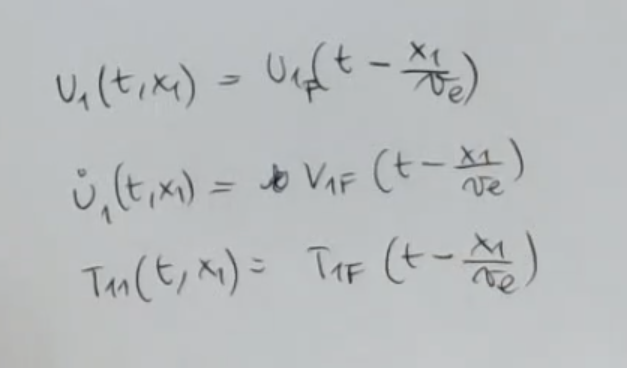
- So you will have uniform speed, preassure and stress.
- NOTE: represents “how fast the wave changes form”, the propagation speed is still .
So we can say, using Hooke’s law:
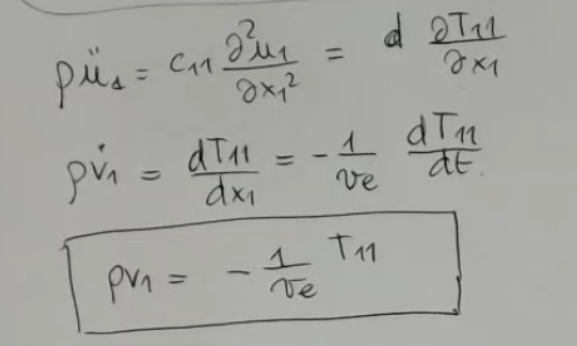
- We change the derivative since integating over time or space is similar, except it is scaled.
So the impedance is equal to:
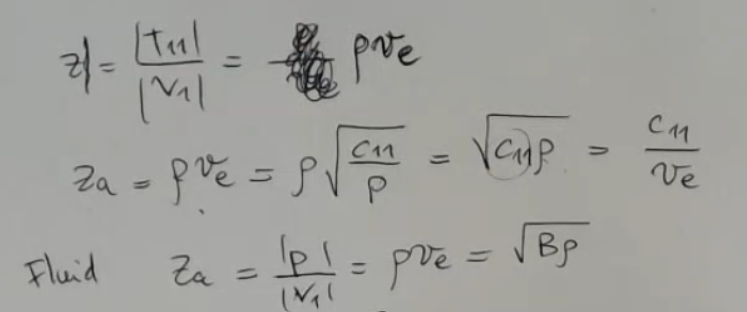
- is the density as usual.
- So the impedance can be written in this two ways.
- : Bulk modulus ( in the formula is volume)