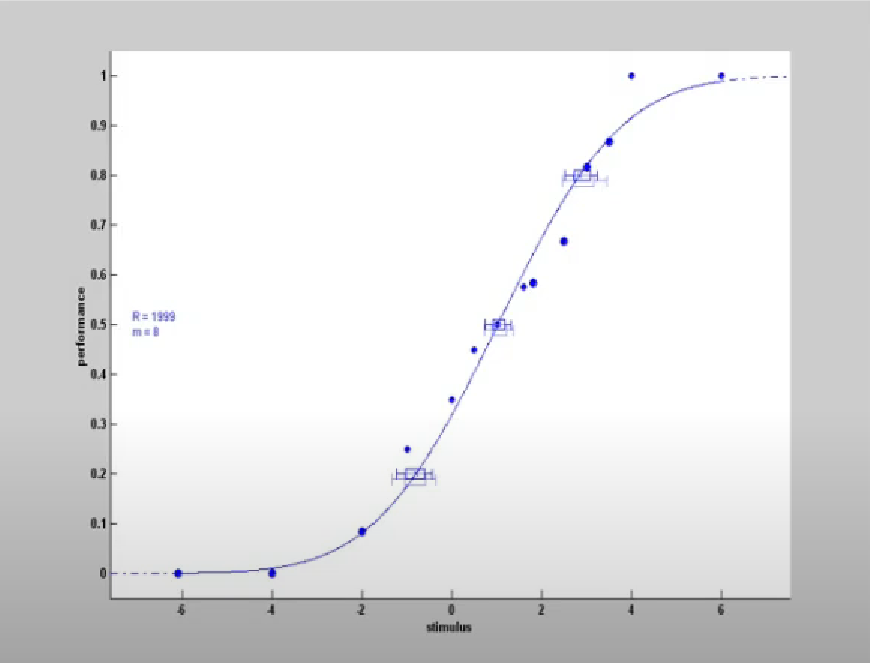
In a discrimination experiment when the observer can’t perceive any difference, we expect the proportions of greater and less responses to be about equal (~ex.: 0.5 point off the 50% threshold).
This point is called PSE: Point of Subjective Equality.
In this point the value of the comparison stimulus, over a large number of trials, is subjectively perceived as equal to the standard stimulus.
The difference between PSE and St is called Constant Error (CE) and reflects some uncontrolled factor’s systematic influence on the measurements being taken: Since PSE represents a complete lack of discrimination, and because 0 and 1 greater than responding is perfect discrimination. The intermediate proportion points of .25 and .75 have been used to find the DT.
We can determine the DT upper and lower, that after are averaged to obtain the final value. The steepness of the PF (Psychometric Function) depends on the observer’s differential sensitivity (step slopes yield small DT).
The slope of PF is something used interchangeably as measures of sensitivity.
~Ex.: Psychometric Curve: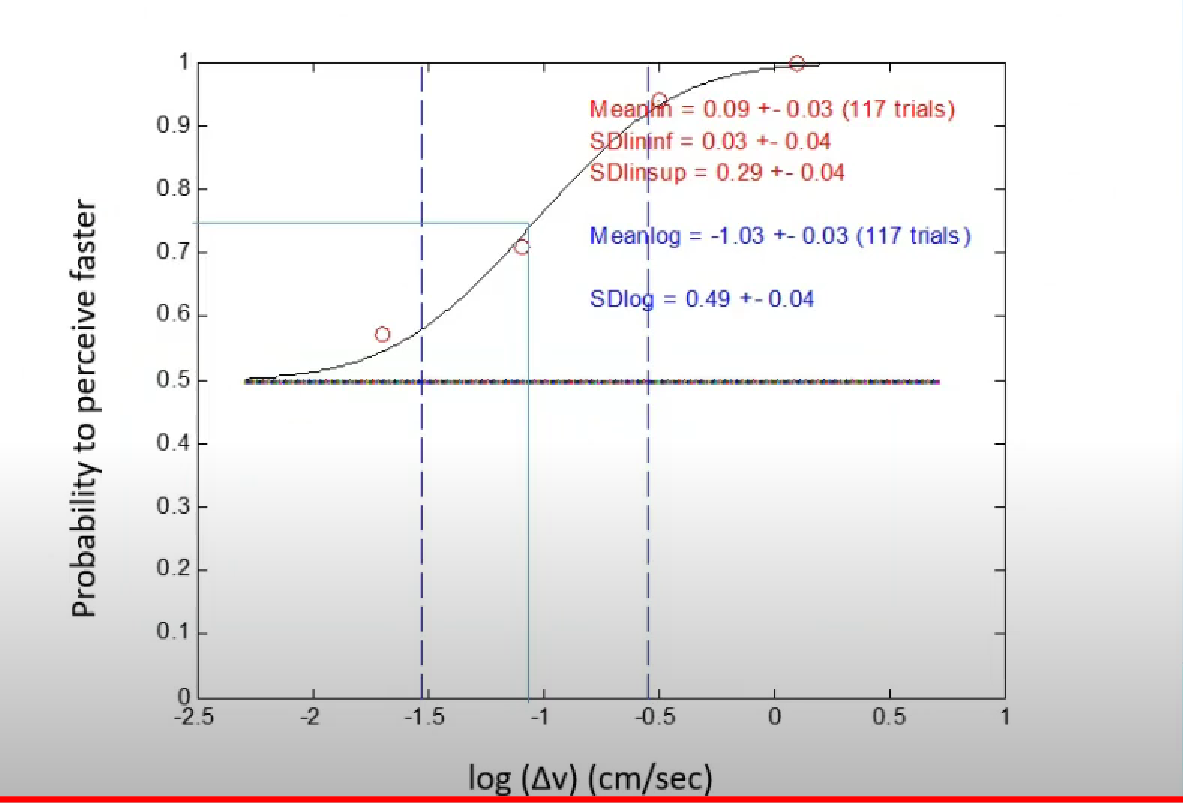
- ~Ex.: Psychometric function: