The method of limits is perhaps the most frequently used technique for determining sensory threshold.
The method is less precise than the method of constant stimuli but is far less time consuming and is therefore used much more extensively.
When we have to choose the values for applying the method of constant stimuli, the few minutes taken to estimate the location of the threshold would be well spent by this method.
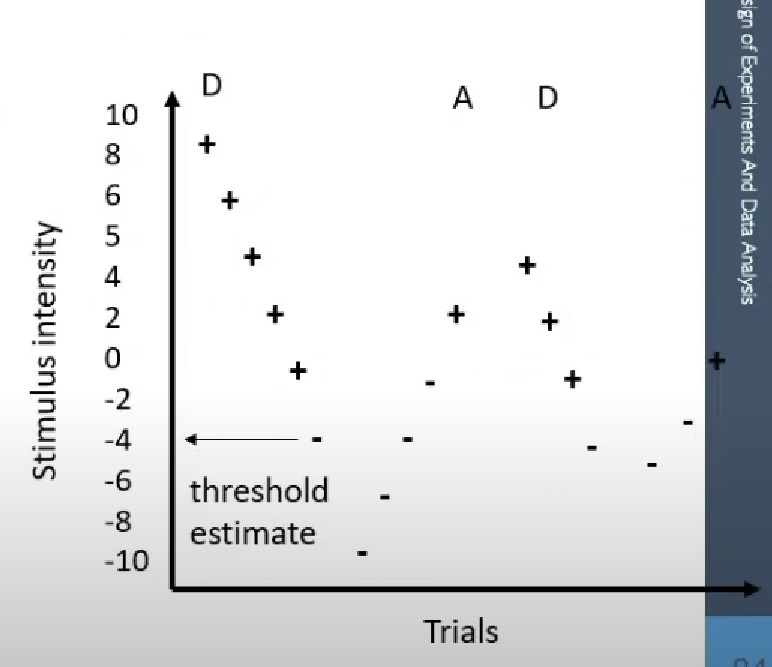
The experiments starts by presenting a stimulus well above or well below threshold; on each successive presentation, the threshold is approached by changing the stimulus intensity by a small amount until the boundary of sensation is reached.
The stimuli are manipulated in either an ascending series or a descending series.
- If the series is ascending we start with a weak stimuli and increase it until the observer reports its presence, the experiment is stopped.
- Instead if the series is descending we start with the presence of the stimuli and decrease it until the observer cannot perceive it anymore.
These two type of experiments are called respectively:
- Ascending limit
- Descending limit
- Error of Habituation
- Making the same response also when the threshold is reached.
- Can be reduced with clear instruction, demonstration and practice runs.7
- Error of Expectation
- May anticipate the arrival of the stimulus.
- Can be reduced by changing series and starting intensity.