Remember:
CDS - Hopf Bifurcation General Formula
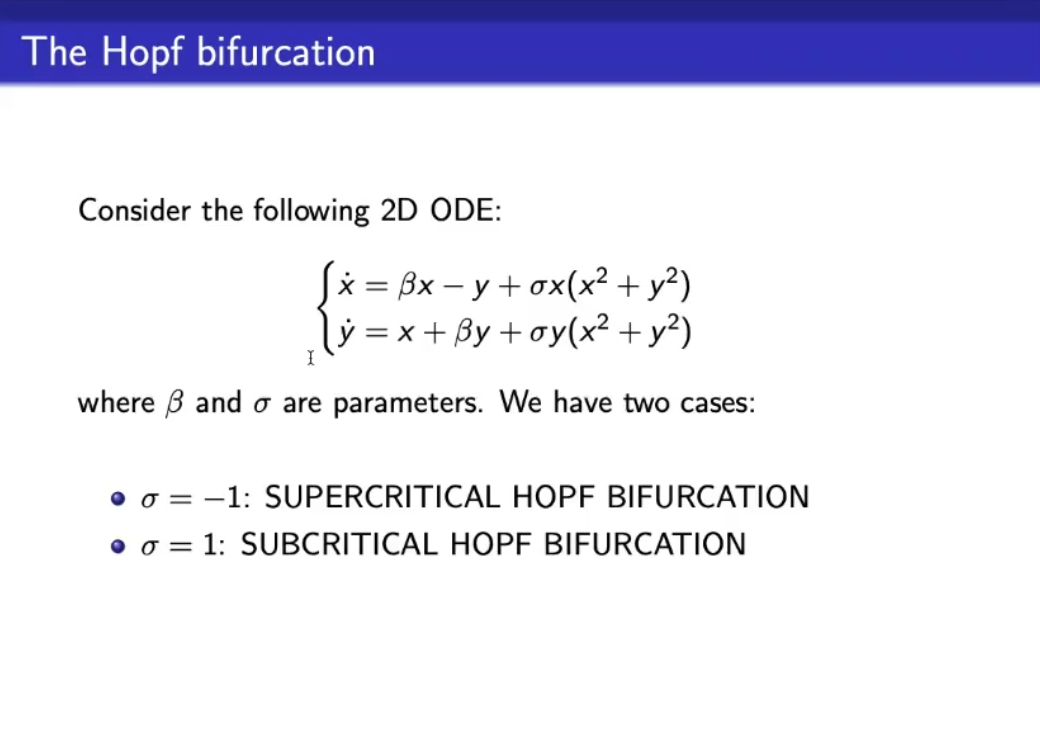
The basic example of the Hopf Bifurcation:Where and are parameters and we have that:
Link to original
- , we will have the SUPERcritical hopf bifurcation.
- , we will have the SUBcritical hopf bifurcation.
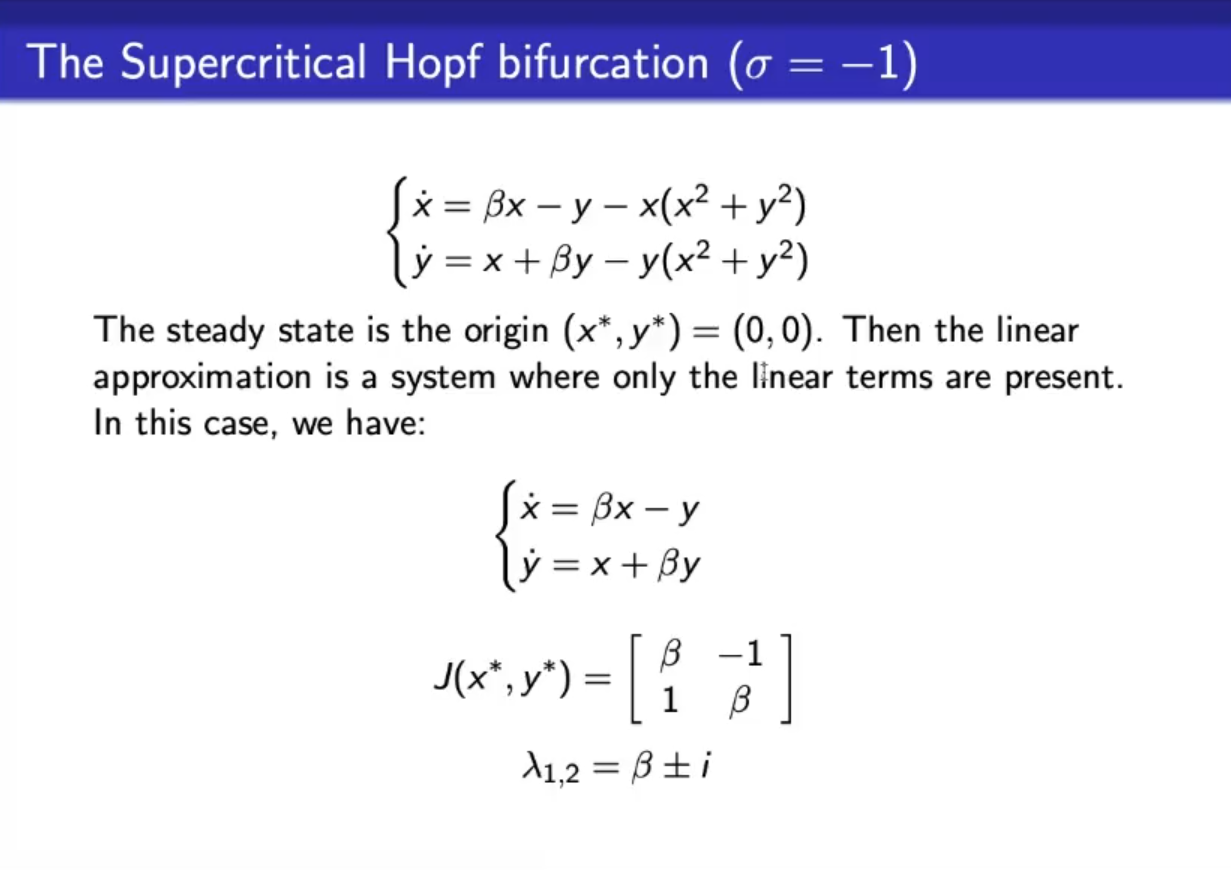
Supercritical Hopf Bifurcation : For the linear approximation, the steady state is:
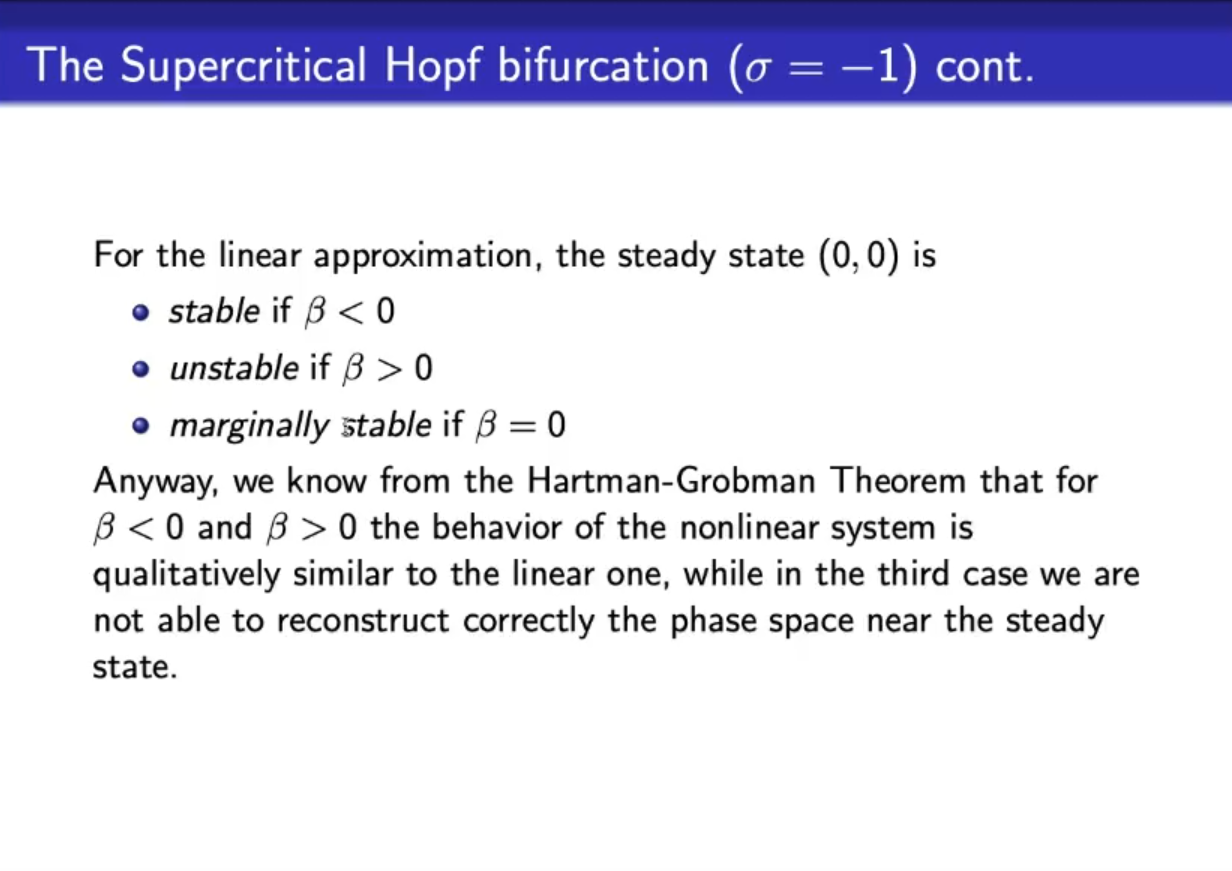
- stable if .
- unstable if .
- marginally stable if .
For the Hartman-Grobman Theorem we know that when the system is NOT marginally stable, so for (in this case) the behaviour of the non-linear system is qualitatevly similar to the linearized one. While for , since the system is marginally stable, meaning at least one of the eigenvalues is null or has real part , then the steady state is not hyperbolic, so we are not ablo to reconstruct correctly the phase space near the steady state.
The bifurcation diagram:
Here some example for the flow given different values of and different initial conditions:NOT-IMPORTANT
Here’s what happens more in detail:NOT-IMPORTANT
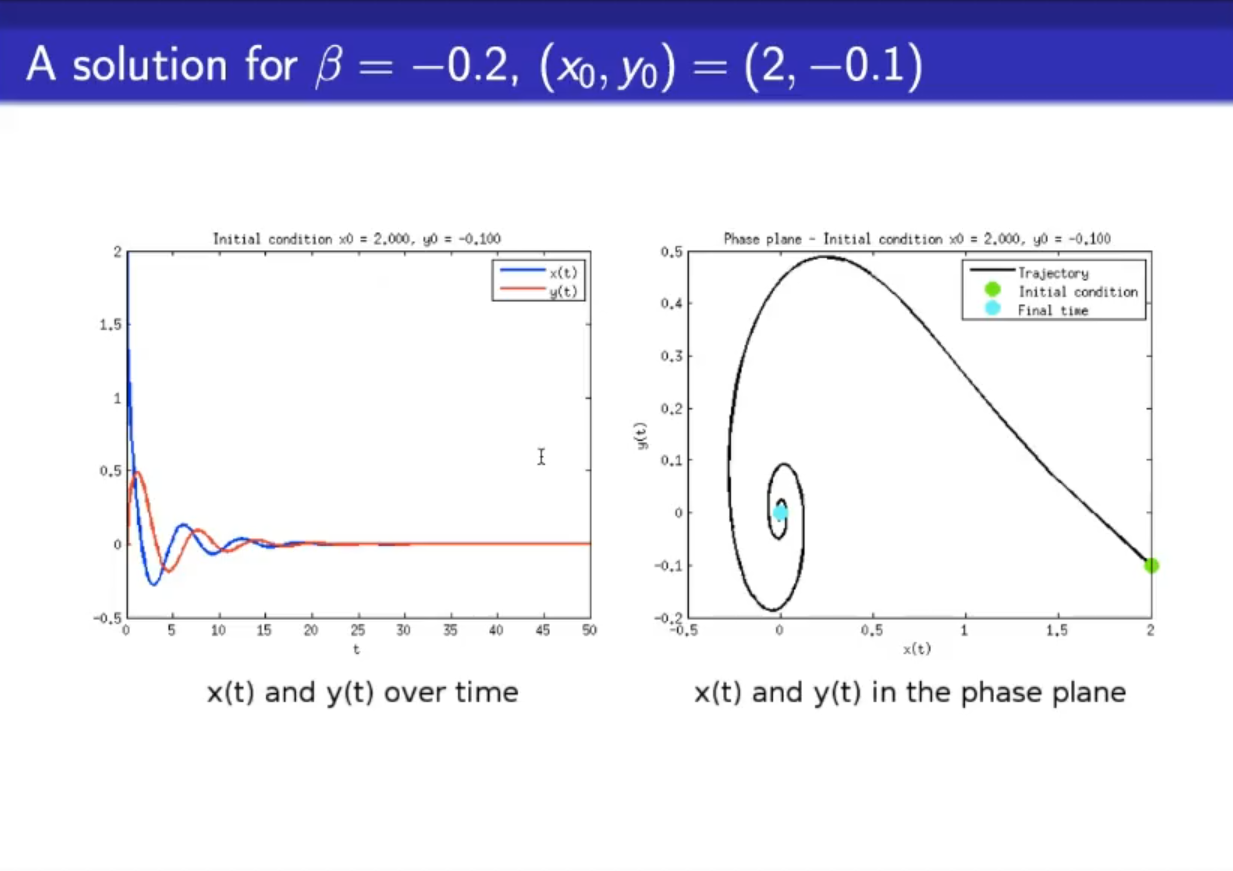
- For a negative value of :
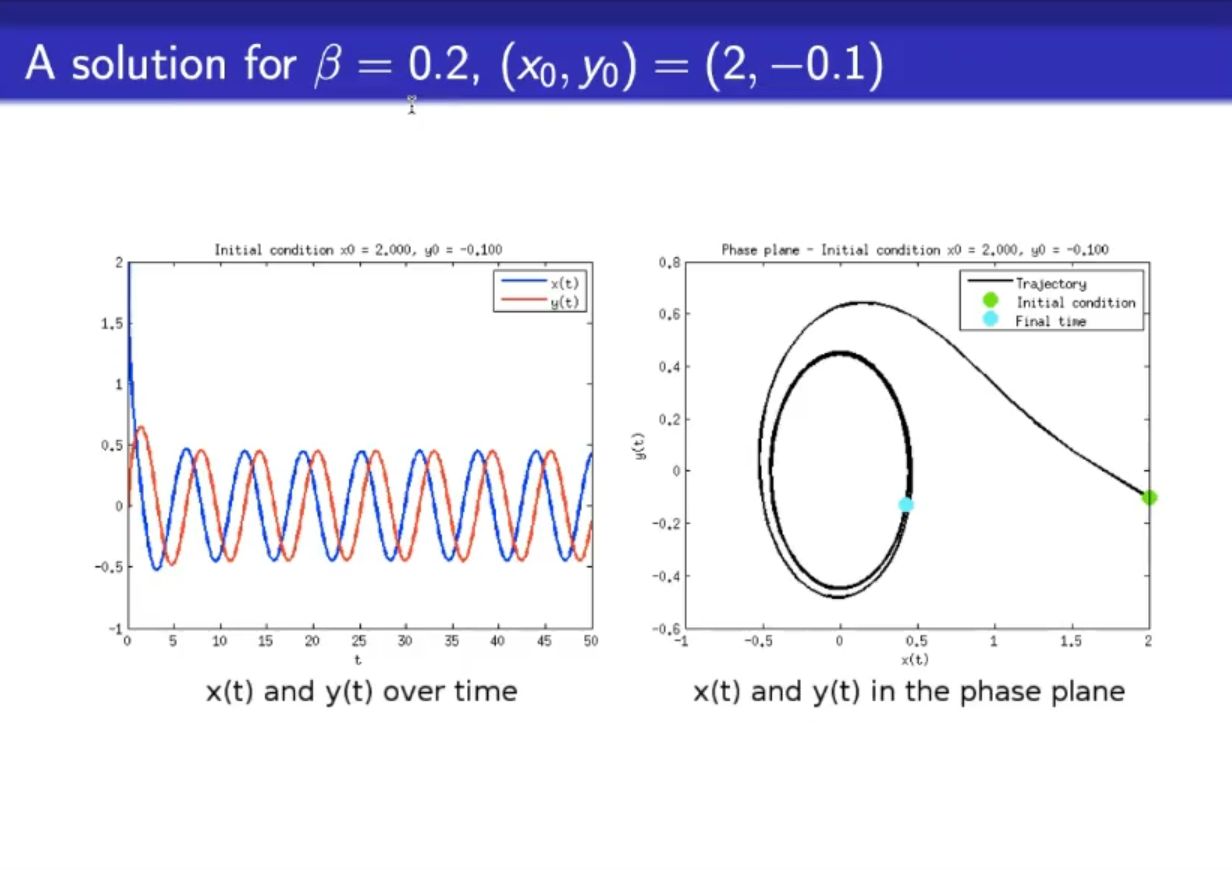
- For a positive value of :
- This is a “real” example of a limit cycle.
- For a positive value of : , like before, but this time the initial conditions this time are inside the limit cycle.
- NOTE: the size and shape of the limit cycle is the same (even if it does not look like it), look at the scale of the graphs.
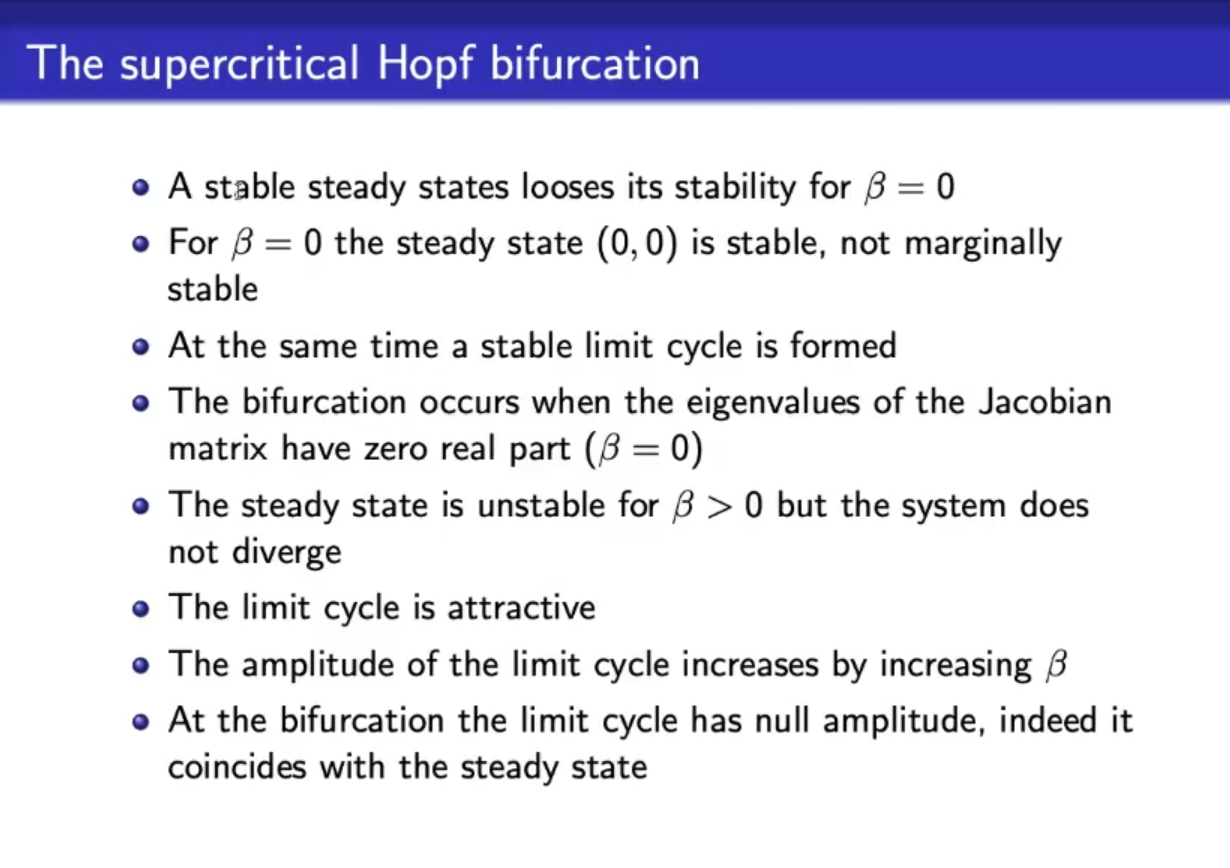
- The amplitude/size of the limit cycle depends on .
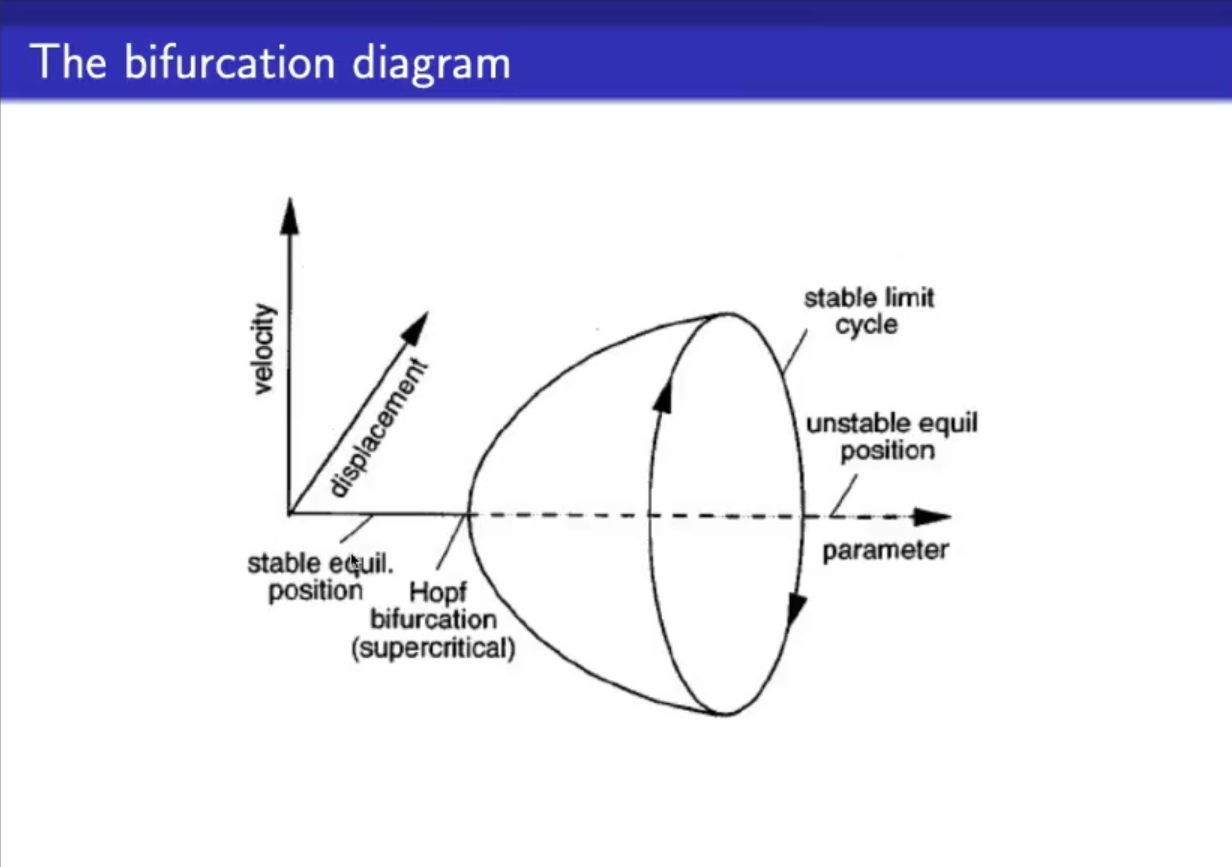
- The limit cycle is part/called an attracting set.