Remember:
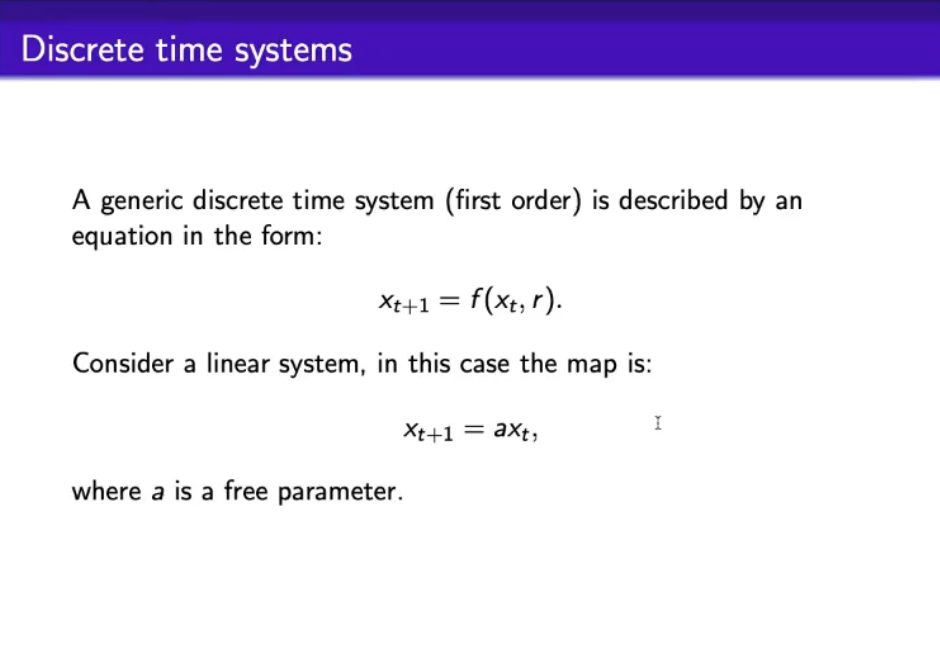
Discrete Time System:The linear case will be of the form:Where is a free parameter, also: .
- The solution to this system is a sequence of values .
- A discrete time system is also called a map.
- We will only see monodimensional maps, so ( is a scalar and not a vector).
- We will see a logistic map, that shows deterministic chaos, and it is a monodimensional system.
- is called geometric progression, the solution (sequence) of this linear case is:
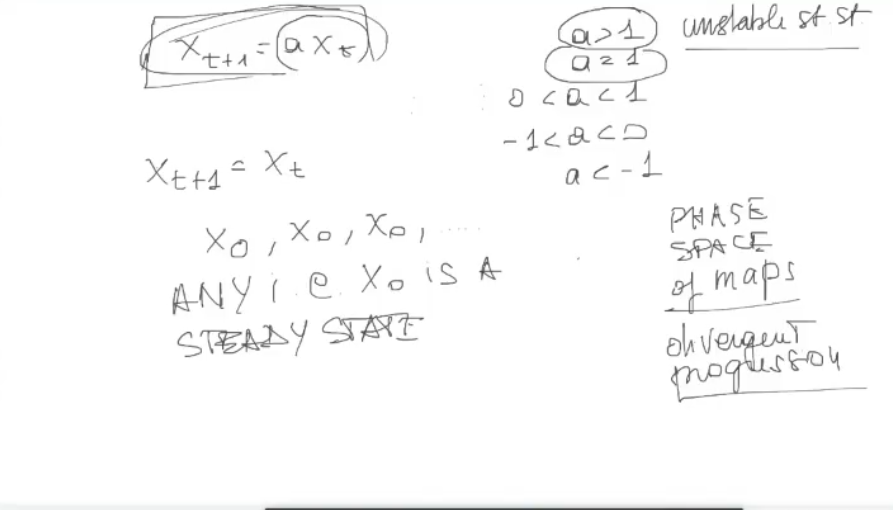
‘Steady States’ for Discrete Time Systems: find the value such that, This is the condition to have no motion of the state over time. For the linear case the steady states will be: , meaning that the steady state will be: and .
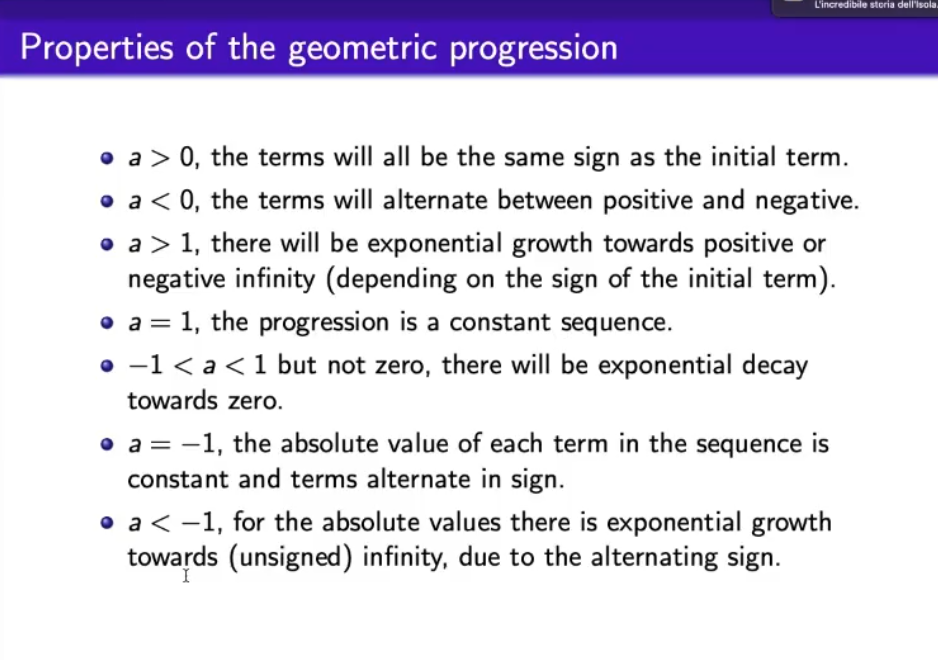
Properties of the geometric progression:
- Sign:
- : the terms will all be the same sign as the intial term.
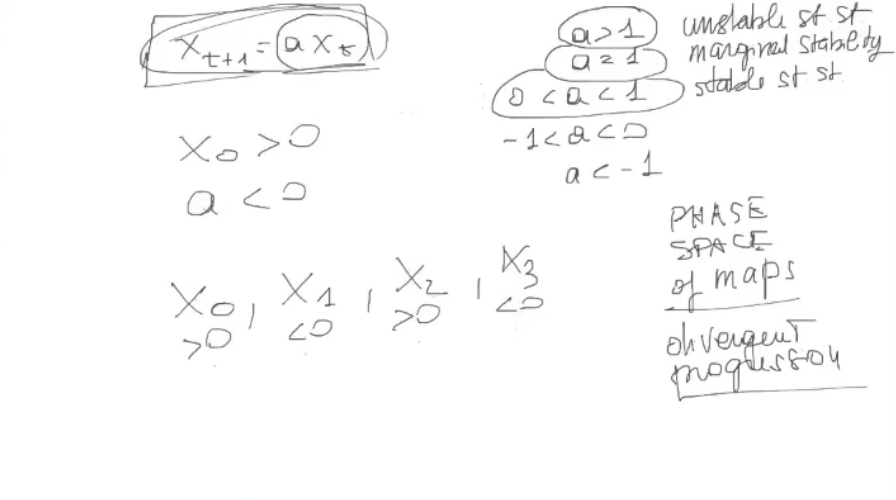
- : the terms will alternate between positive and negative.
- Growth/Decay:
- : there will be exponential growth.
- : there will be exponential decay.
- : the “amplitude” will remain the same.
Stability of the Steady State, we will take into consideration the geometric progression:
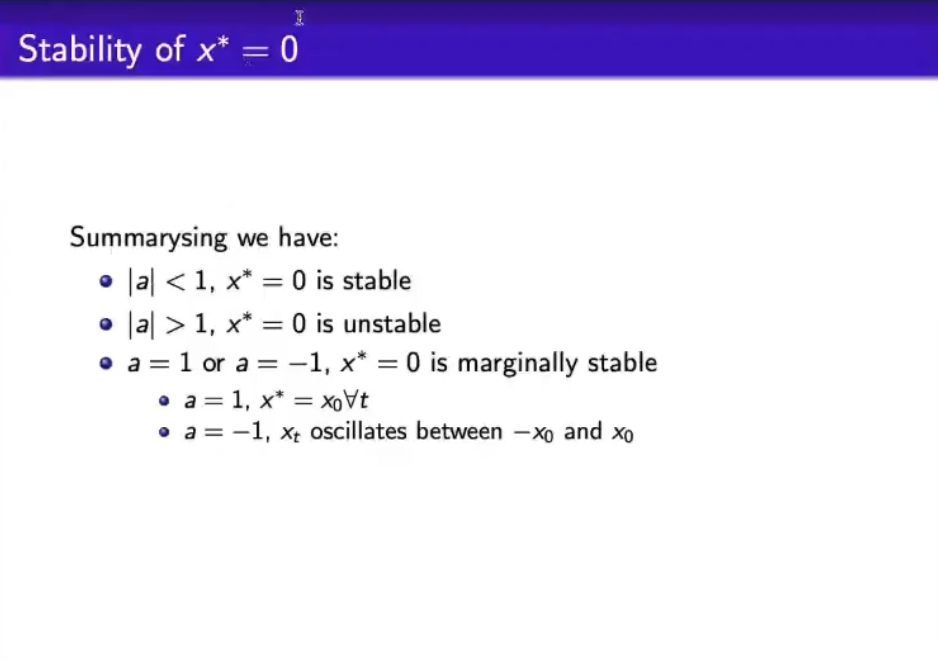
- For , will be a stable steady state.
- For , will be an unstable steady state.
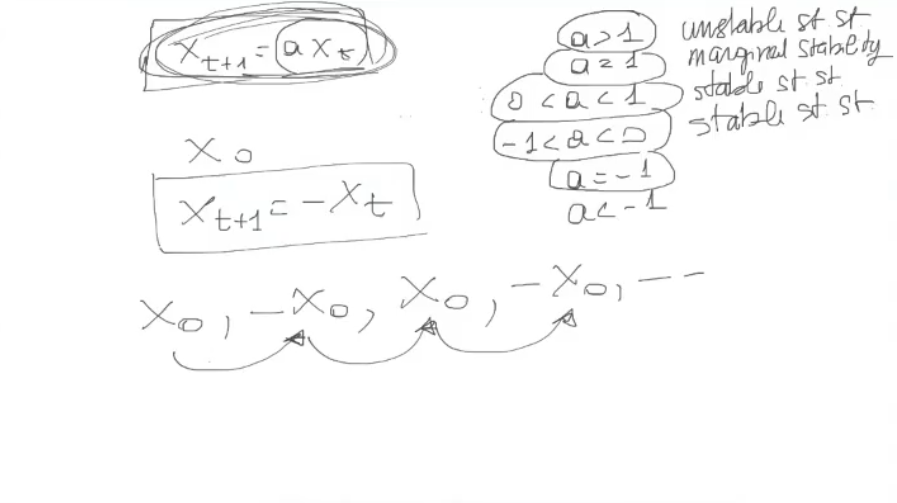
- For is marginally stable.
- For all possible value of are steady states.
- For is the only steady state.
Phase Space of Maps:
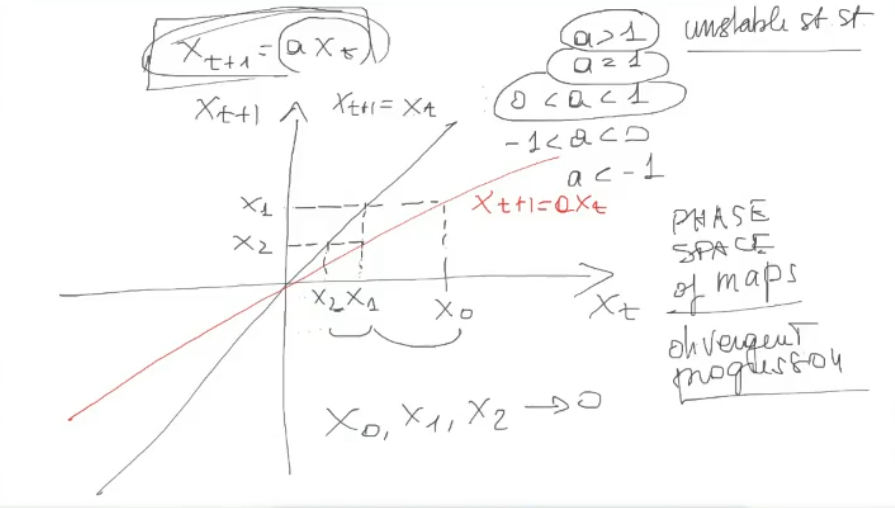
On the bisector line we have that all . (not-sure-about-this representing the “all possible steady states”)
~Ex.: :
We can report how the system evolves with a positive inital condion :
And also for a negative inital condition:
For : Any is a steady state:
If we represent like before the line (which is the bisector), and in red the line representing the function: , as we can see, for , the two lines coincide.
For , we have a convergent progression, toward :
For rember that we have an alternation of the sign:
For , again, we have a convergent progession
For , we have again a marginal stability like for , but only is a steady state.
For instead we have a divergent progression, towards (or unsigned infinity):
IMPORTANT These graphical representations are called “cobweb”, and it is similar to how we represent the flow for continous dynamical system. As you can see in the discrete case, we now have “jumps” from one value to another.
- The solution to this system is a sequence of values .
- A discrete time system is also called a map.
- We will only see monodimensional maps, so ( is a scalar and not a vector).
- We will see a logistic map, that shows deterministic chaos, and it is a monodimensional system.
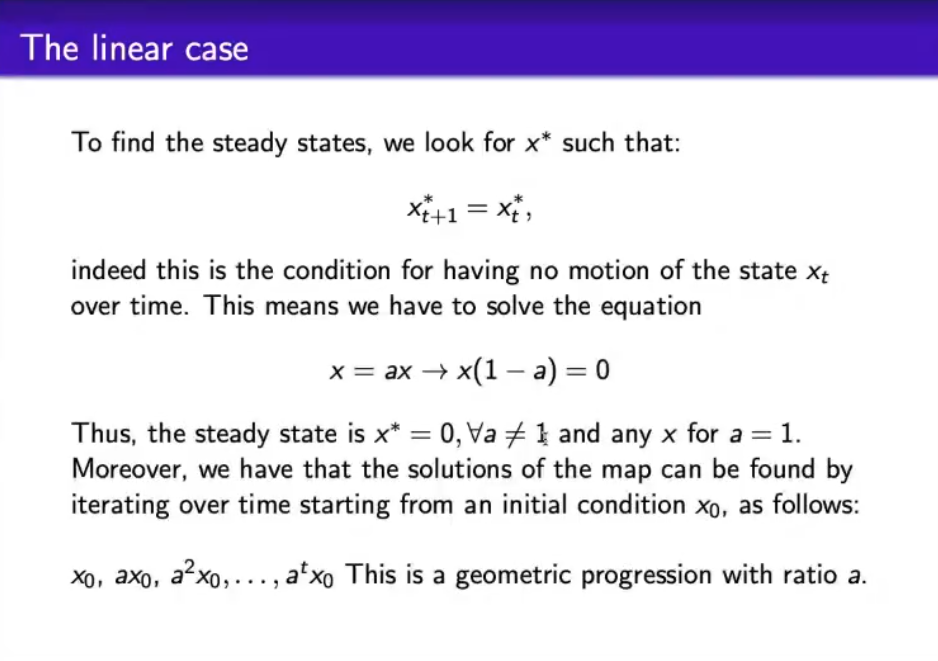
- When we reach a steady state, the state will remain the same, so: .
- is called geometric progression.
- is the initial term.
- This plot is defined as the phase space of maps.
- On the bisector line we have that all .
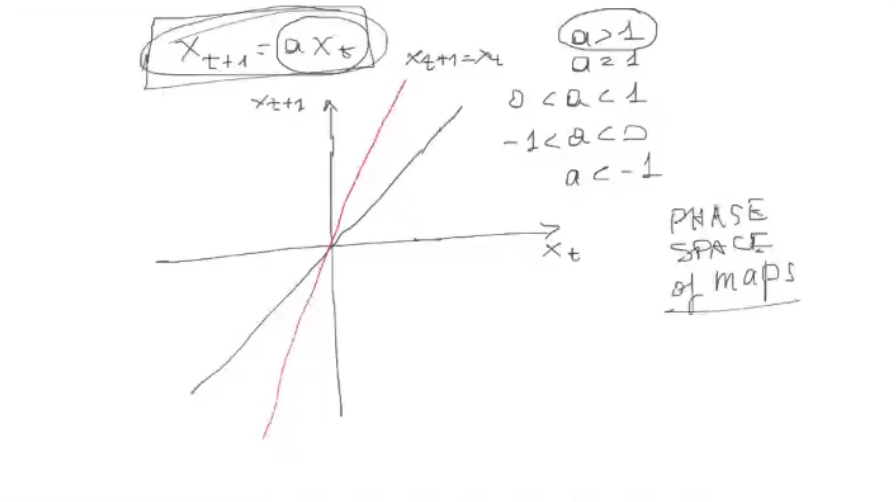
- Here we have reported (red line) the function: , for .
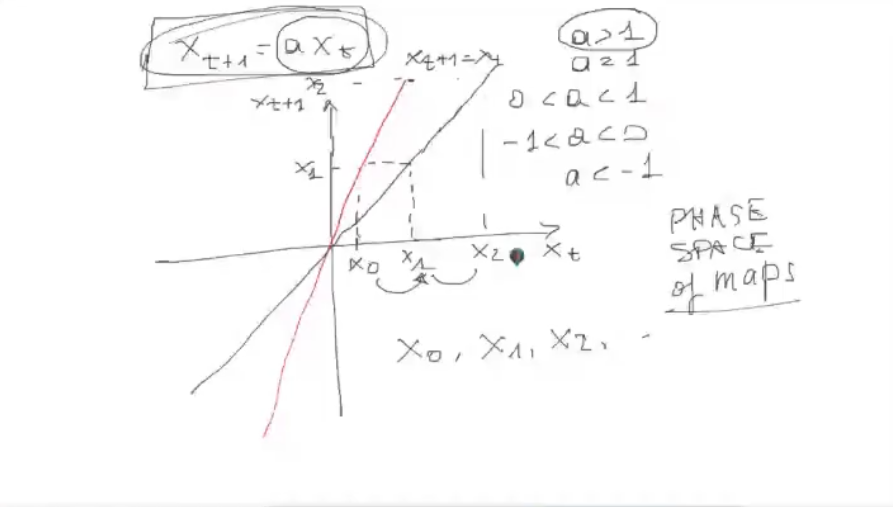
- We can report how the system evolves with a positive inital condion .
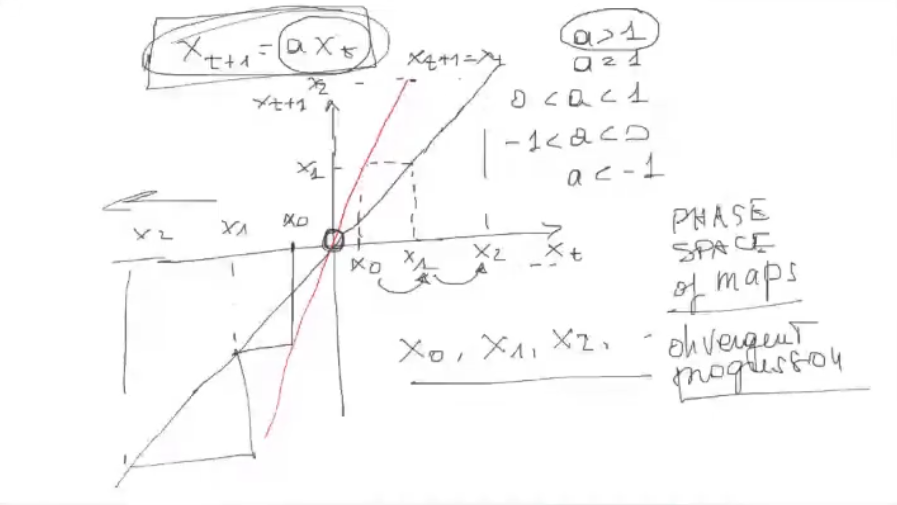
- And also for a negative inital condion.
- In both cases we have divergent progression.
- For , any is a steady state.
- If we represent like before the line (which is the bisector), and in red the line representing the function: , as we can see, for , the two lines coincide.
- For , we have a convergent progression, toward .
- For rember that we have an alternation of the sign, let’s see how.
- Again a convergent progession.
- For .
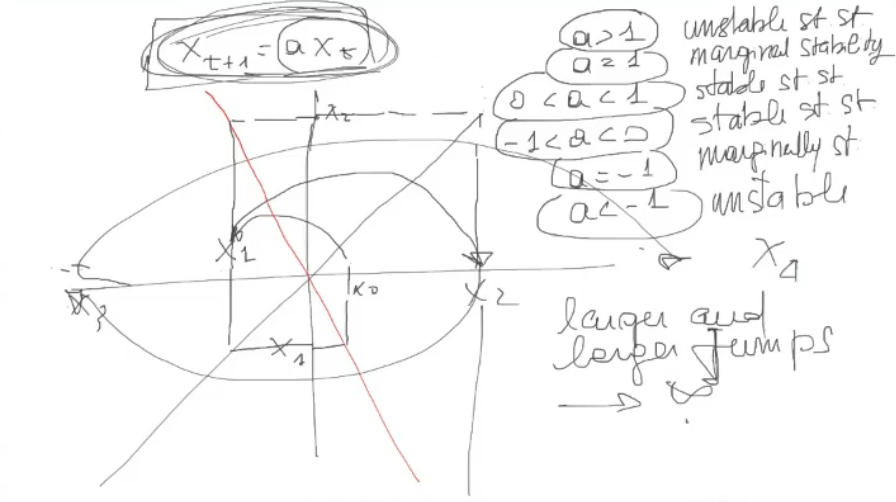
- For instead we have a divergent progression, towards (or unsigned infinity).
- These graphical representations are called “cobweb”, and it is similar to how we represent the flow for continous dynamical system.
- As you can see in the discrete case, we now have “jumps” from one value to another.