Remember:
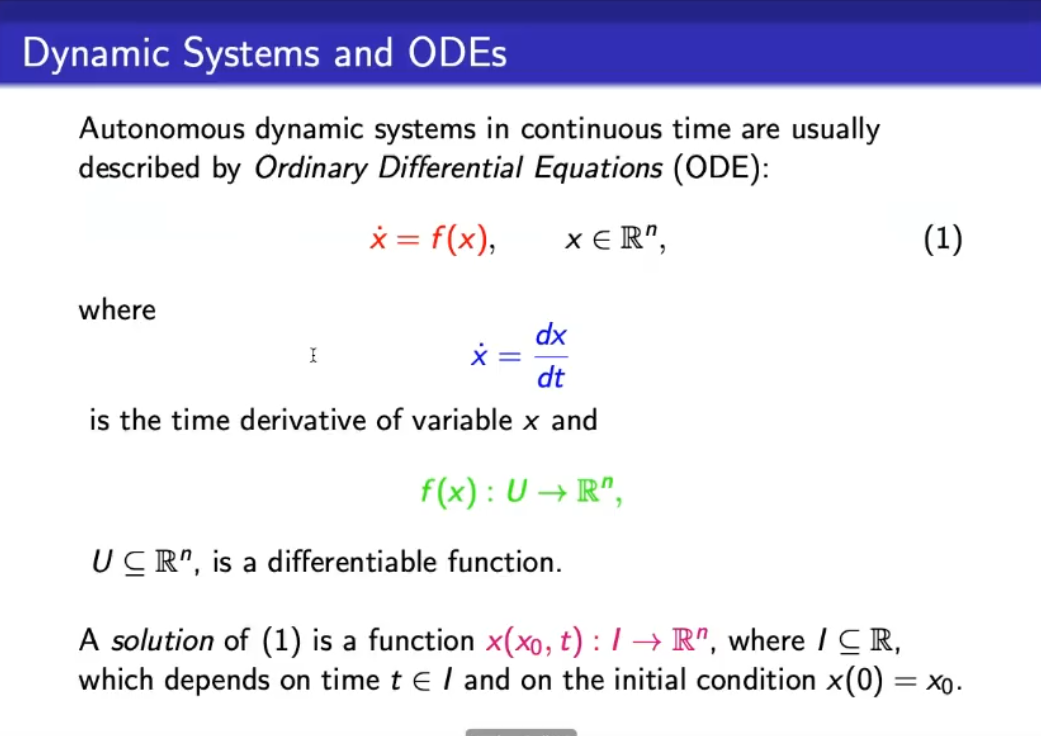
Definition of ODE (Ordinary Differential Equation):Where:And: is a differentiable setnot-sure-about-this
Definition of solution: Where:
- are the “initial condtitons”, and are fixed, choosen at priori.
- is time, , and , and in this case is a variable.
We are not interested/we don’t care about solving for analytically, we will not find the formula, at most we will solve it numerically, that means, solving using numerical data, giving and actual values. #IMPORTANT
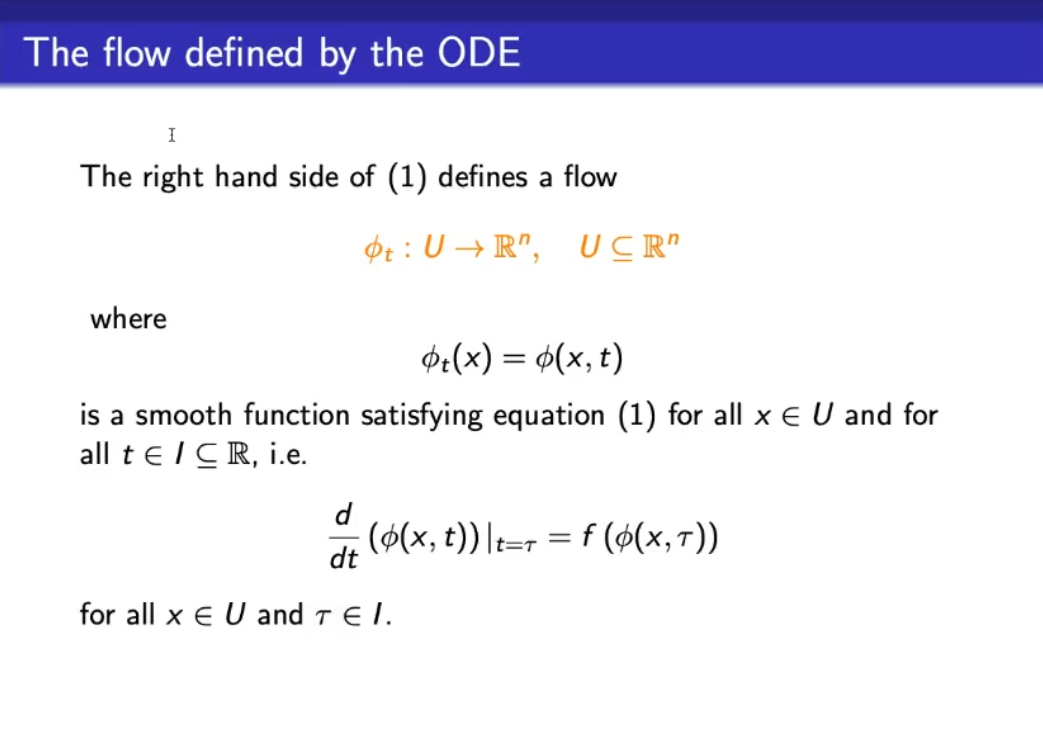
Definition of ‘flow’:Where:
- is the space where is defined.
- is just a fancy way of writing .
- Consider the flow as an “image” of the function for some and initial state , where: .
Here we can see how the flow is represented:
In first picture we use a single initial condition. In the second we use many initial conditions, to see how the system evolves, each inital condition corresponds to a curve of the entire flow. The arrows on the curves represent the time.
A single ODE like we have seen before with , can also be seen as a system of equation, like so:Where: are all scalars (meaning ). is called the phase space, (also called phase plane if ).
Here’s the example in which :
- In the first graph we represent the dynamics and
- is called
- is called
- In the second graph we represnt the flow, however it misses the arrows that indicate the flowing of time.
- If we were to take we would need a 3D graph to represent flow.
- ==The first graph represents the dynamics (and is always represented as a 2D graph), the second phase plane or more in general it is called the phase space==.
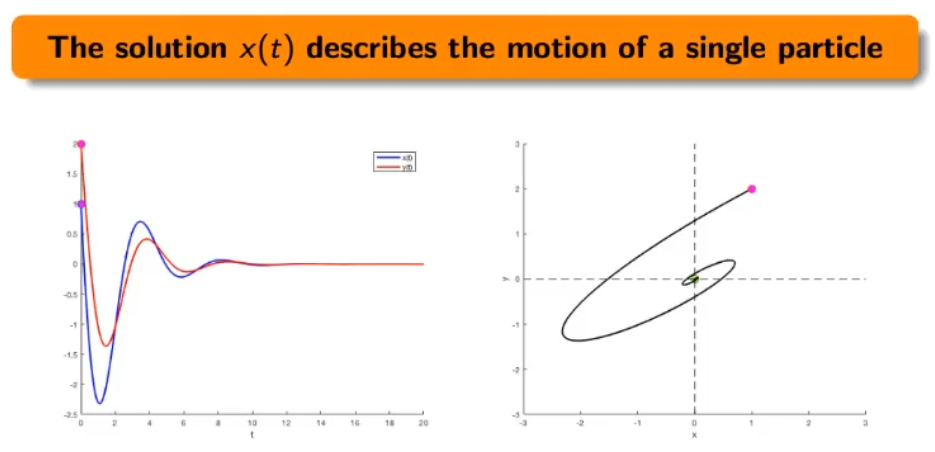
If we take many different initial conditions:
When we talk about convenitionally we the motion of a familiy of particles, so many particles not just one.
- We are not interested/we don’t care about solving for analytically, we will not find the formula, at most we will solve it numerically, that means, solving using numerical data, giving and actual values.
- Consider the flow as an “image” of the function for some and initial state , where: .
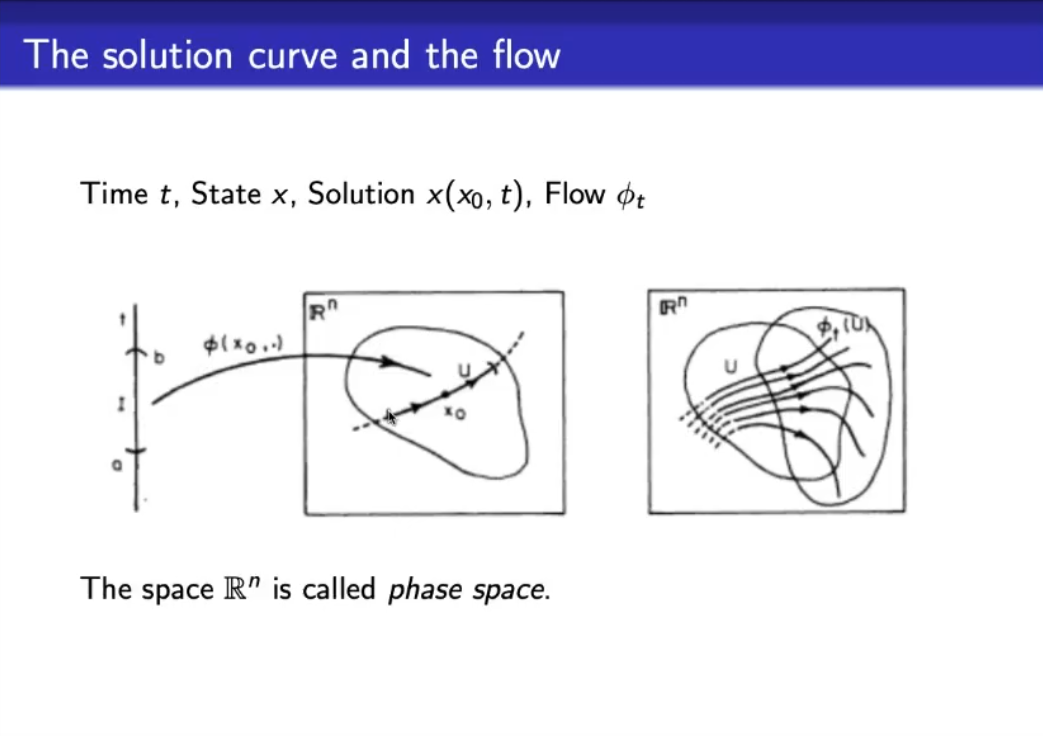
- In first picture we use a single initial condition, in the second we use many initial conditions, to see how the system evolves.
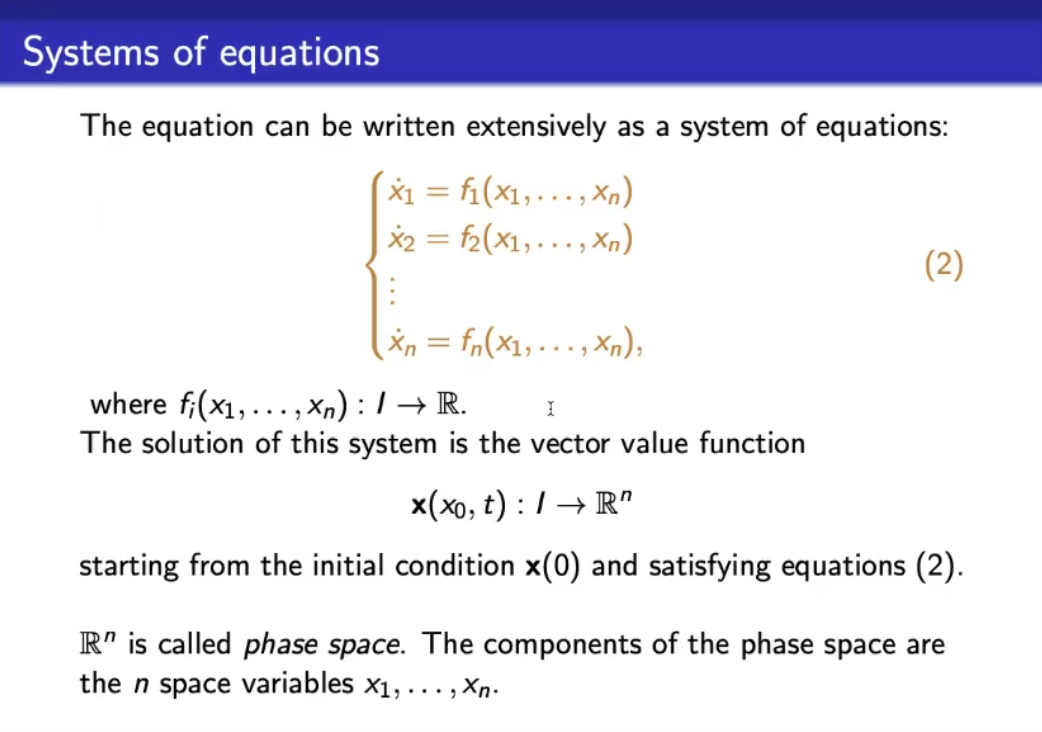
- , so as well, are vectors, while the time is a scalar, so .
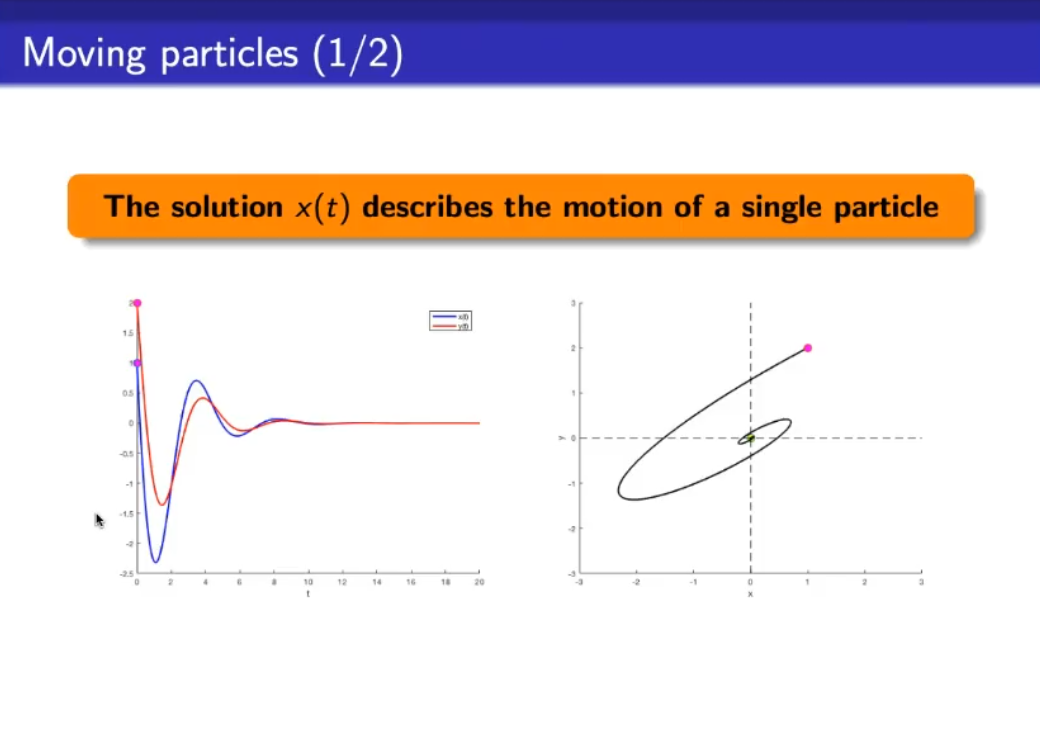
- Here’s the example in which
- In the first graph we represent and
- is called
- is called
- In the second graph we represnt the flow, however it misses the arrows that indicate the flowing of time.
- If we were to take we would need a 3D graph to represent flow.
- The first graph is called/represents dynamics, the second phase space.
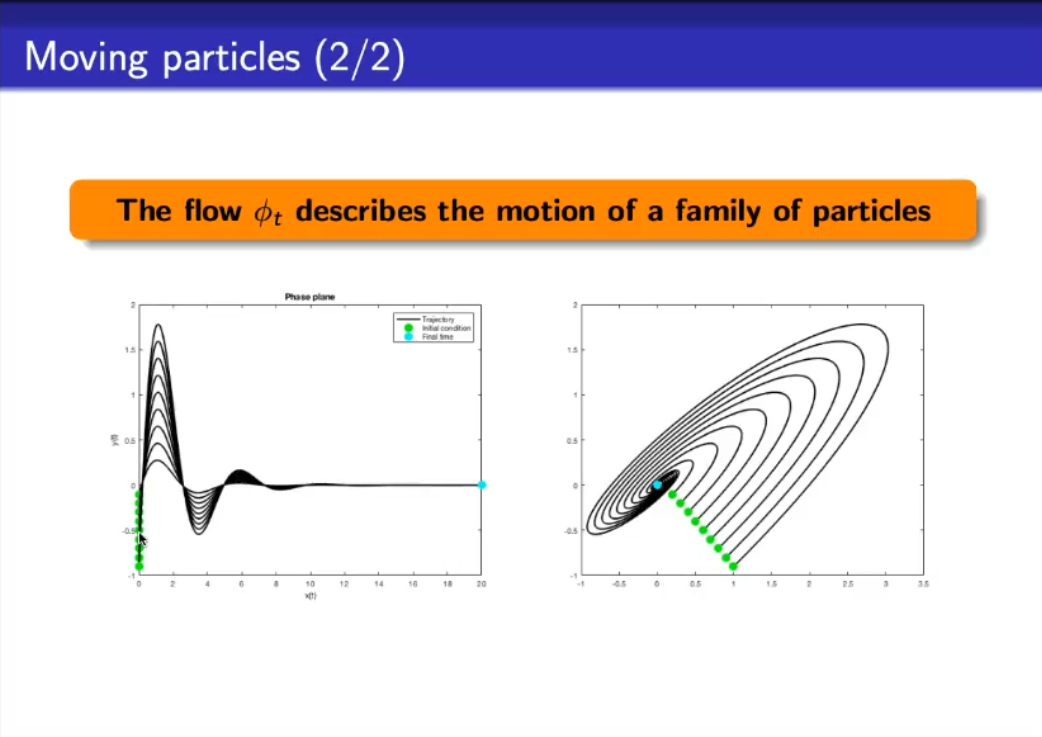
- If we take many different initial conditions