Remember:
Saddle-Node Bifurcation:
~Ex.:
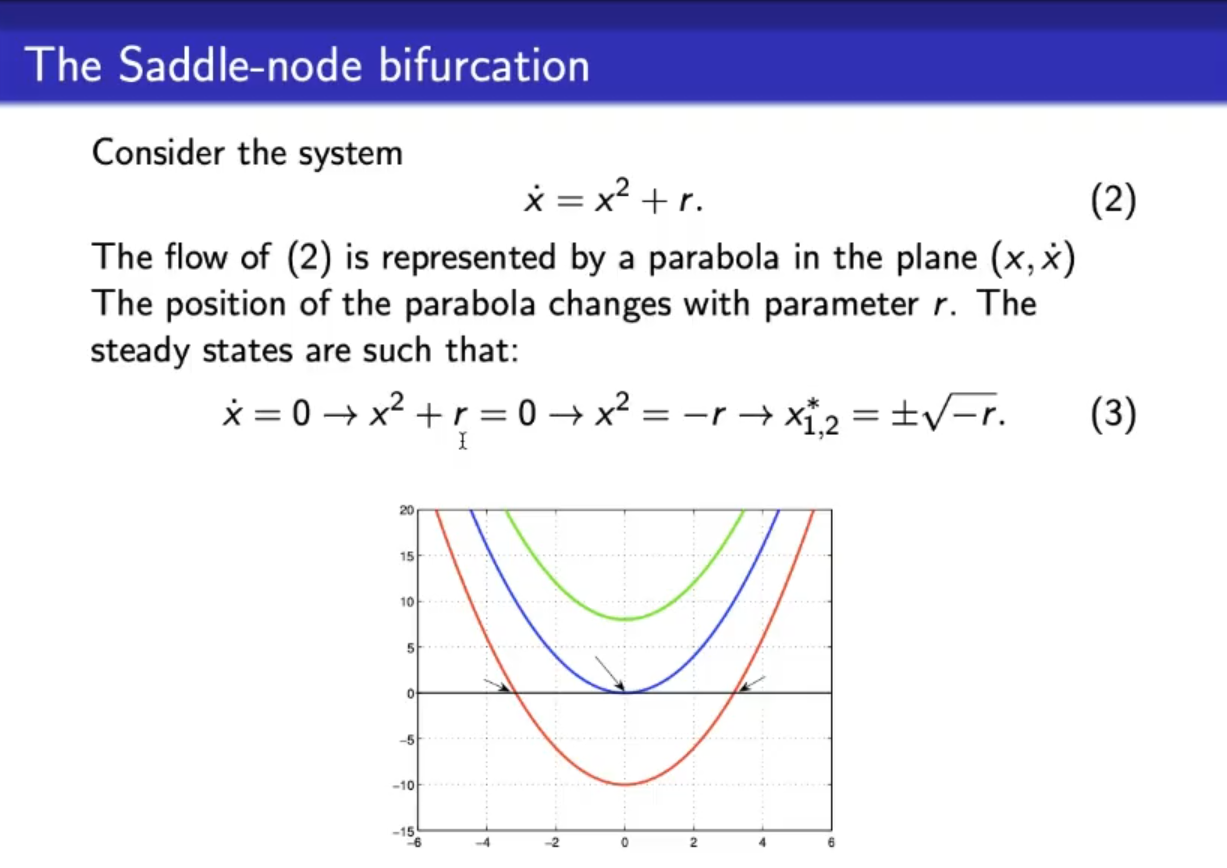
- This graph is NOT the “bifurcation diagram”, we will see it later.
- The arrows in the diagram represnt the steady states, depending or we may have , (actually “coinciding” steady states) or steady states.
- If we analyze this steady states, like we have seen in the previous lectures, we can see that (looking at the red curve), we have 1 stable ss and 1 unstable ss.
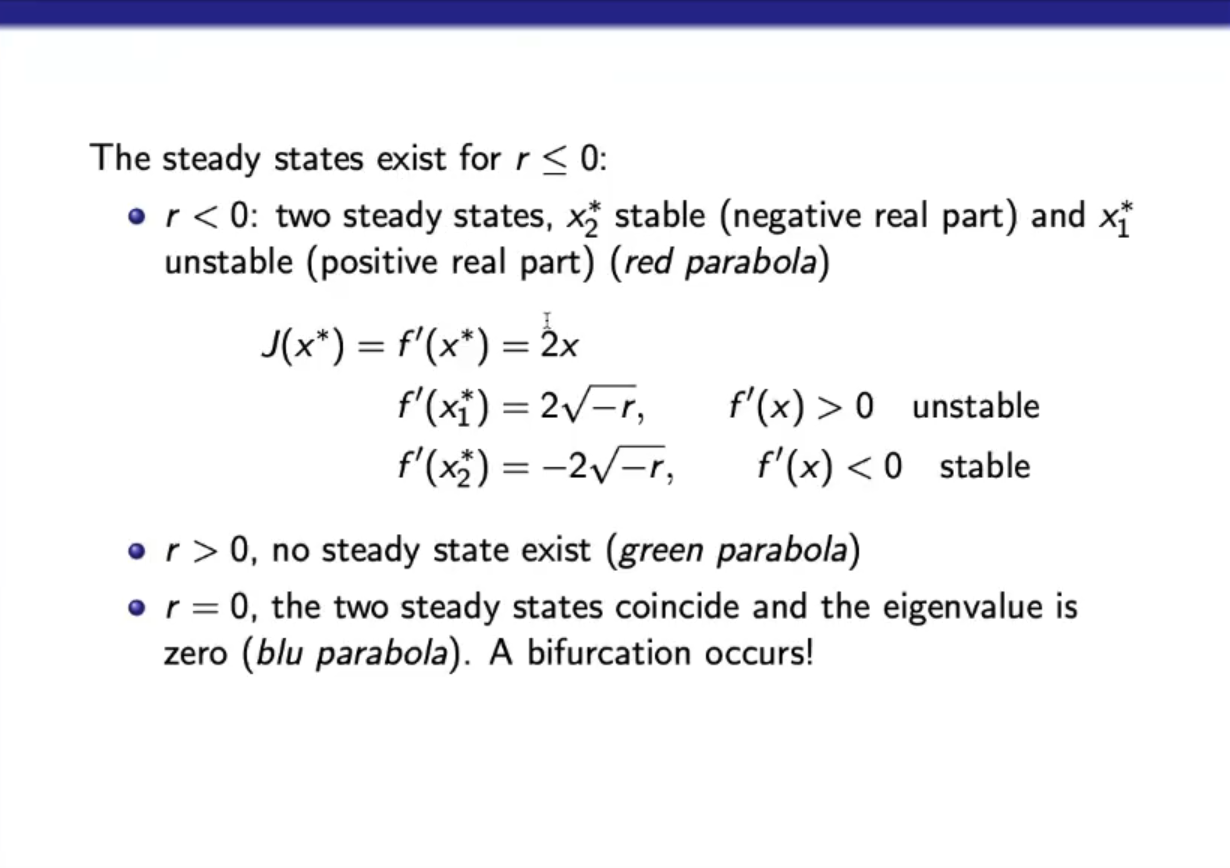
- So for we have a bifurcation.
- Also not that for we have a marginal system/we are in a marginal systuation.
You can imagine the two steady states (for the red curve, that are 1 stable and 1 unstable) uniting giving un a mix between a stable and unstable ss, however this does not mean that it’s a marginal ss, more on that later.
Let’s see how we analyzed the steady states on the red parabola: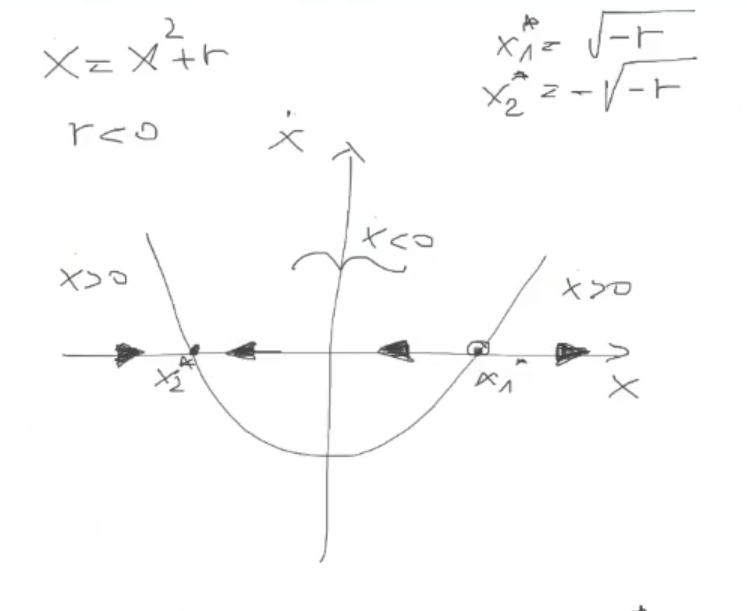 If we perform the linearization: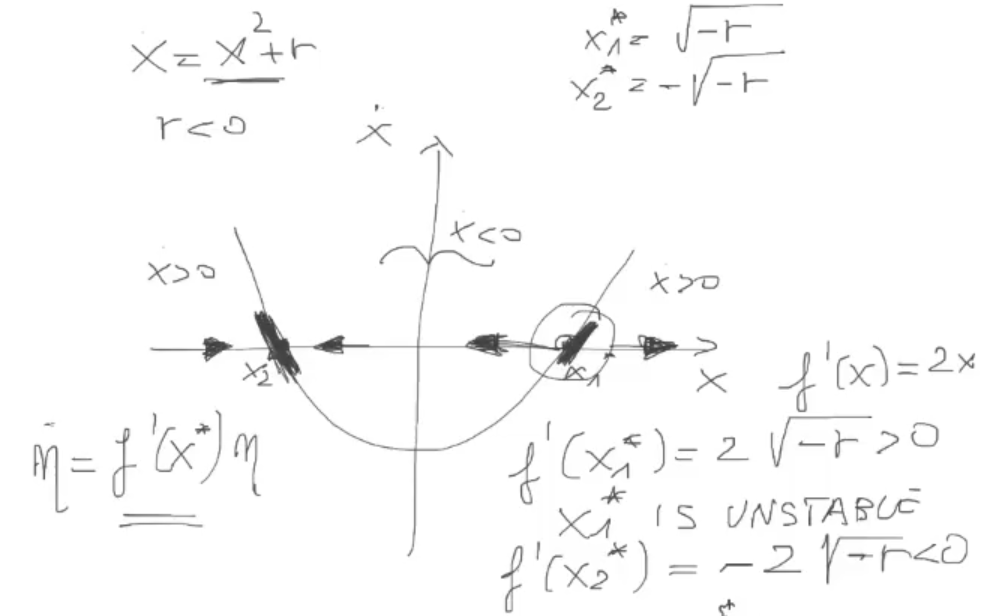
REMEMBER: in a non-linar system you may have no steady state, while in a linear system you have at least 1 ss.
For :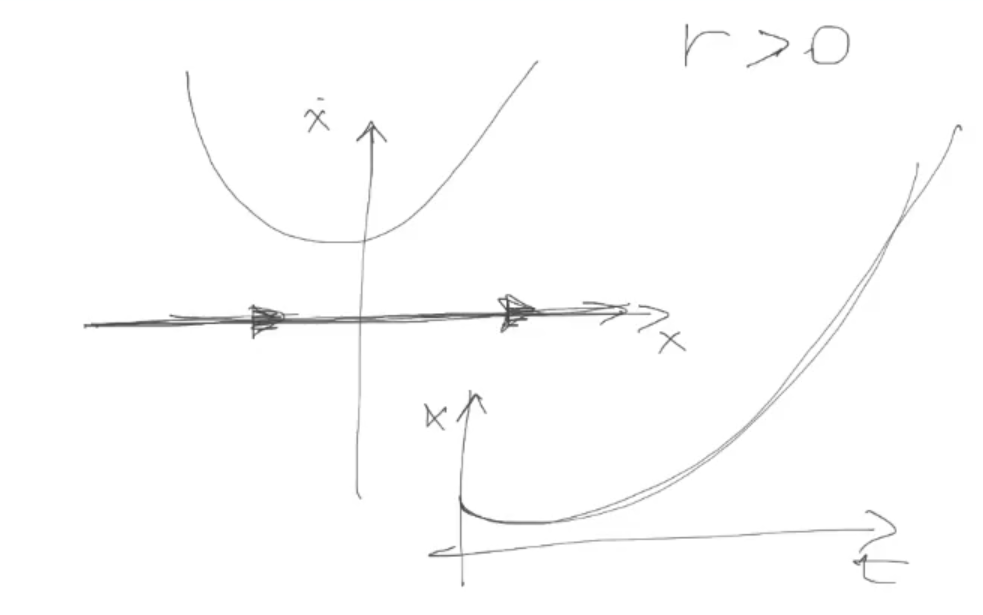 We have no steady states.
For , the approximation is marginally stable: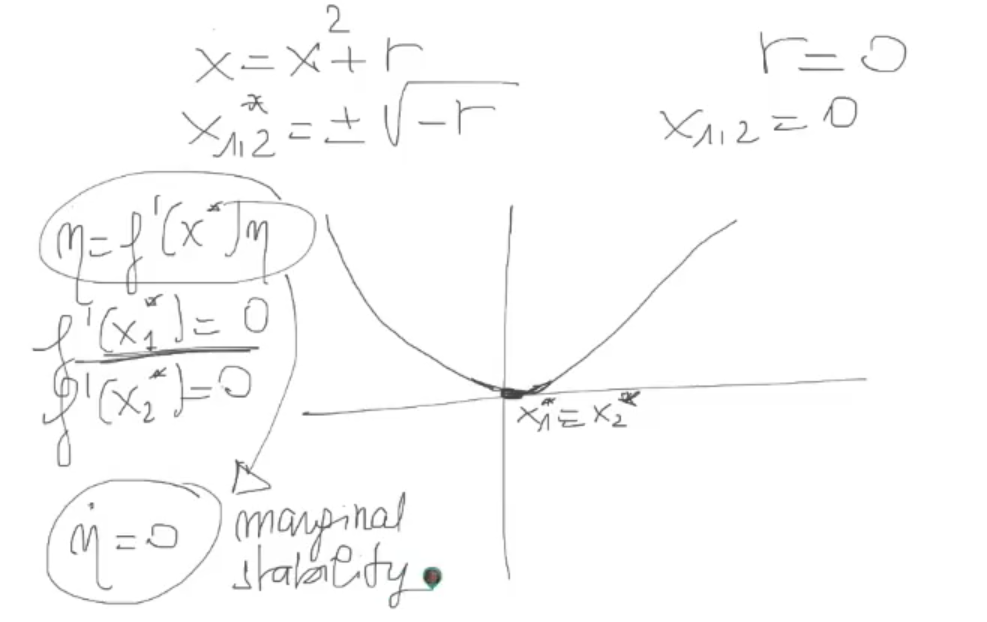 But the actual steady state is NOT!: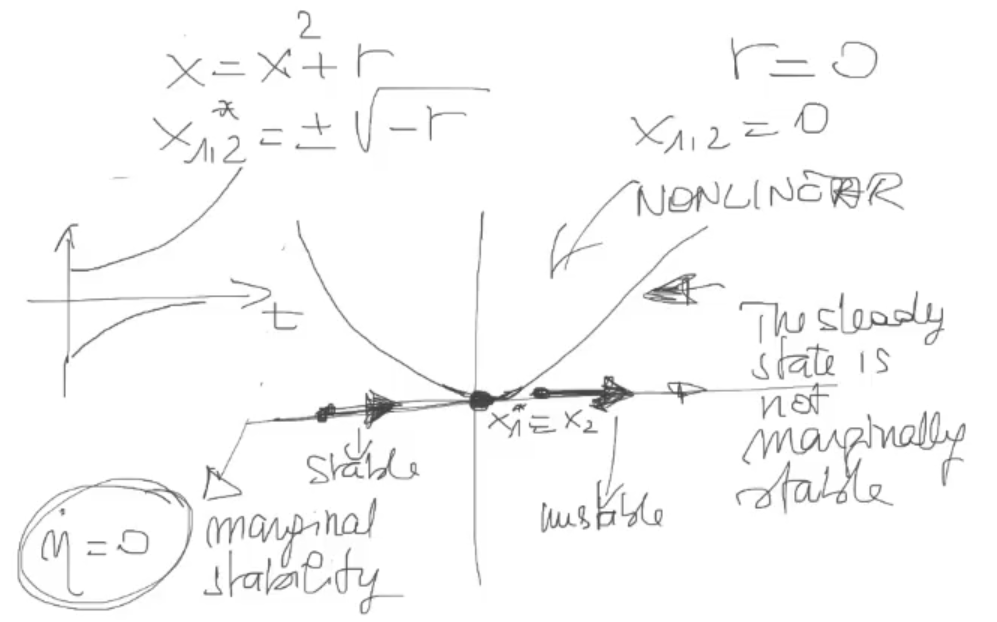
- If we take an inital condition on the left than we will have a stable system.
However it we take an inital condition on the right than we will have an unstable system.
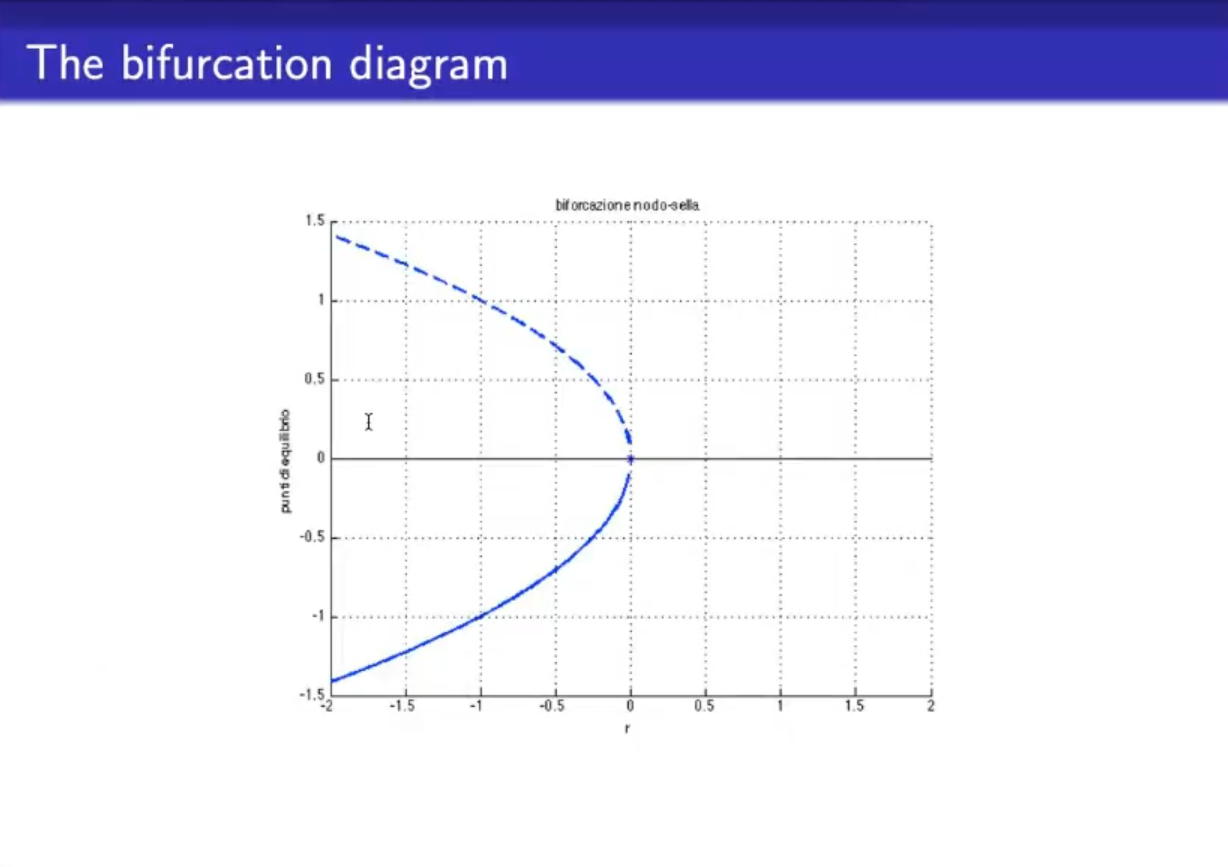
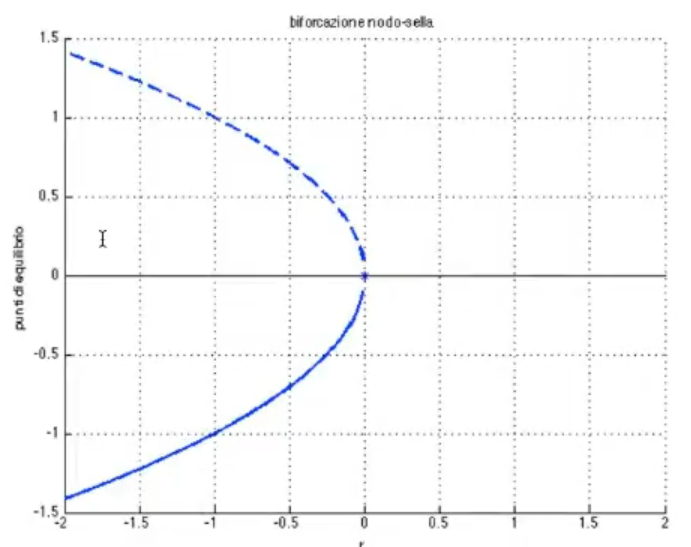
- This is the “bifurcation diagram”.
- The x-axis represents the values of the parameter .
- The y-axis represents the values of the steady states.
- A continuos line represents a stable ss.
- A dotted line represents an unstable ss.
- For we have a bifurcation, and specifically this is a “saddle-node bifurcation”, since we have 1 stable and 1 unstable steady states that collpase.