Remember:
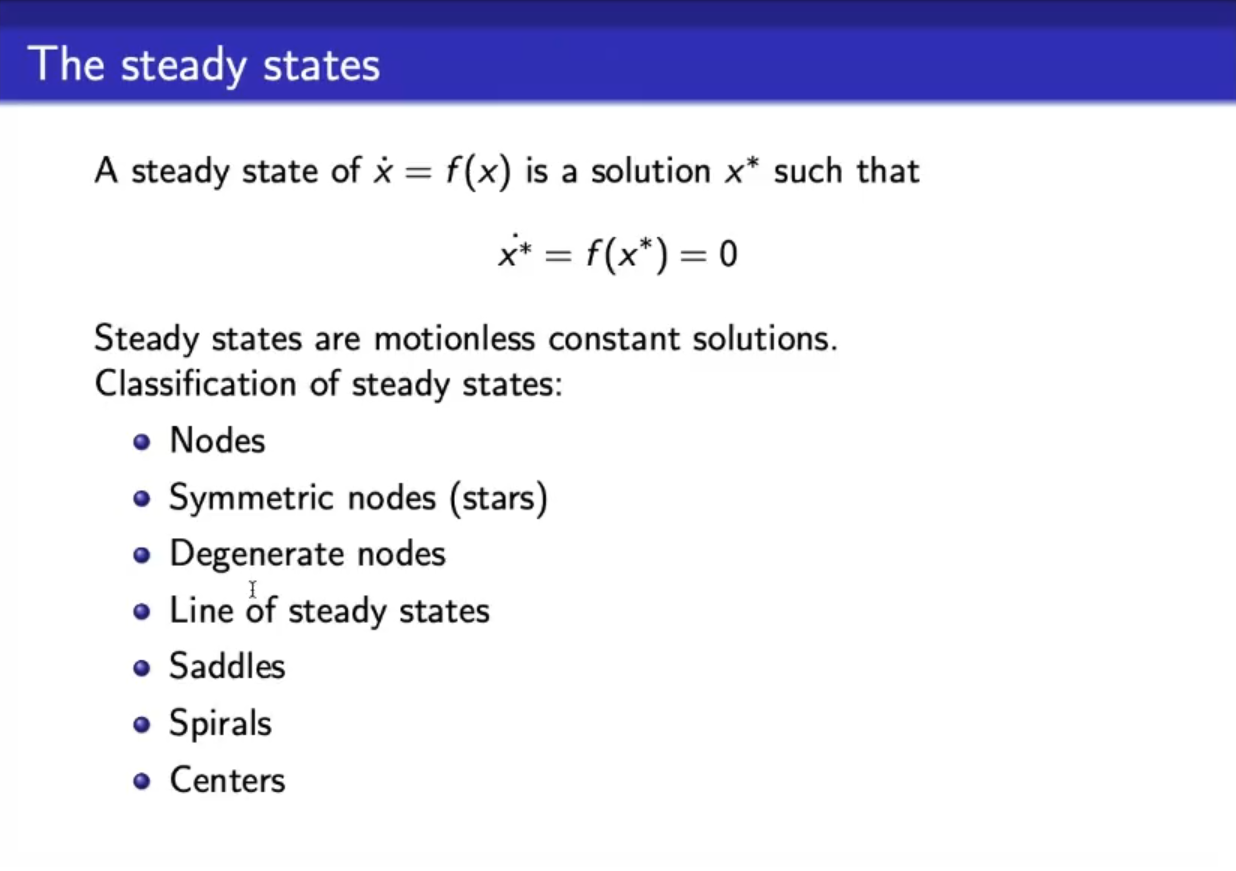
Definiton of ‘Steady State’: Given the ODE equation/system:The steady states are all soltuions such that:Steady states are motionless constant solutions.
Classification of Steady States: We have seen some of them drawn in 2D in some examples (ref 1, ref 2)
- Nodes.
- Stars or symmetric nodes.
- Degenerate nodes. (Different from stars, we will see them in a following example)
- Lines of Steady States
- Saddles.
- Spirals.
- Centers.
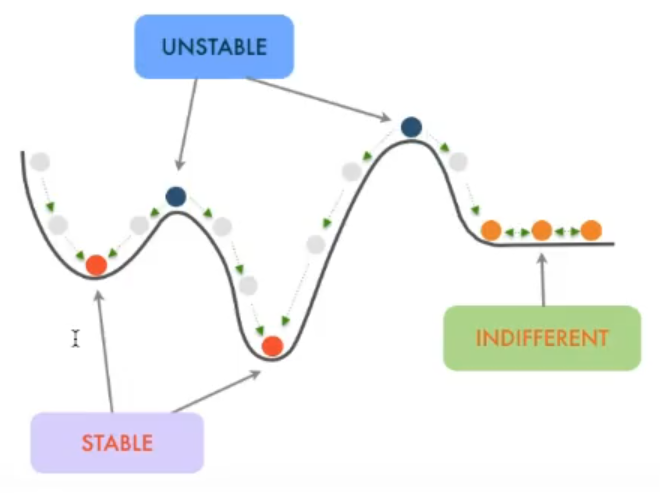
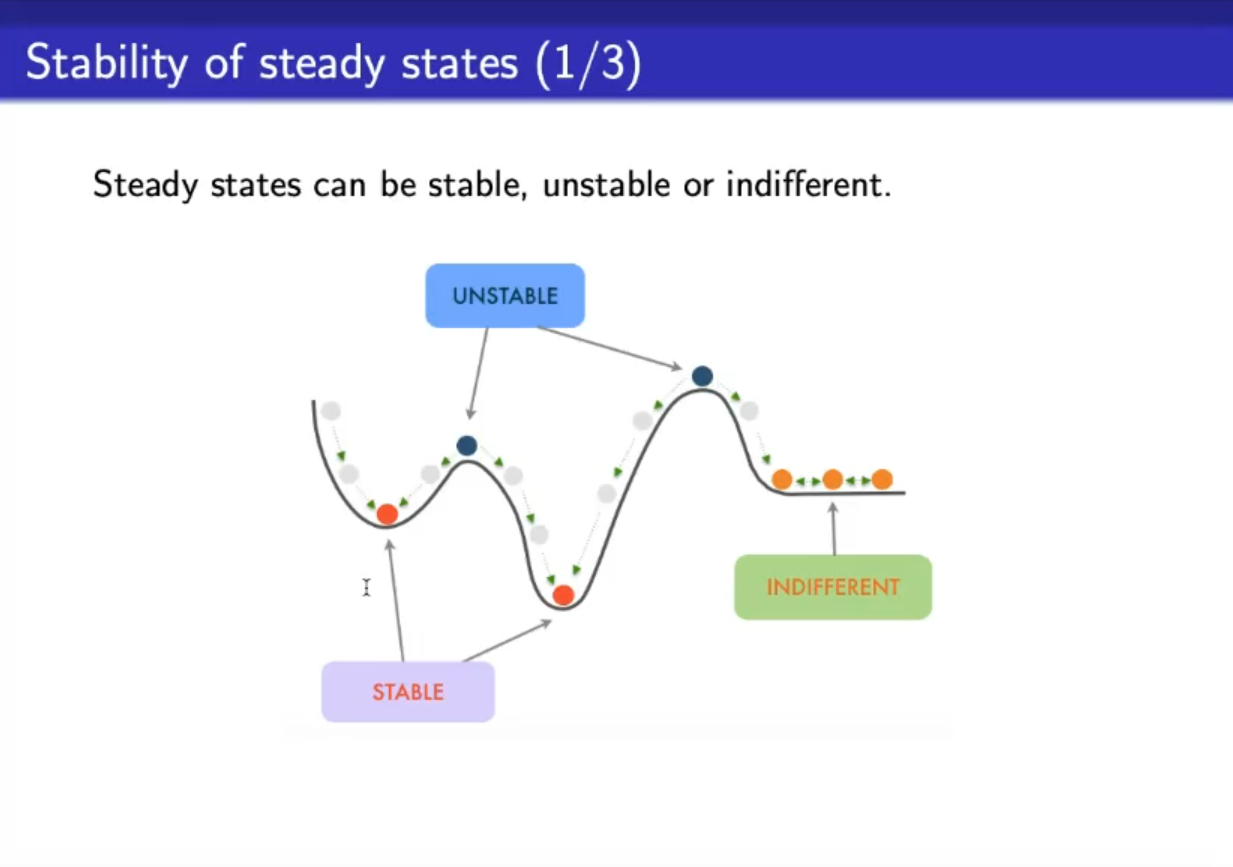
Steady states can be stable, unstable or indifferent (marginally stable):
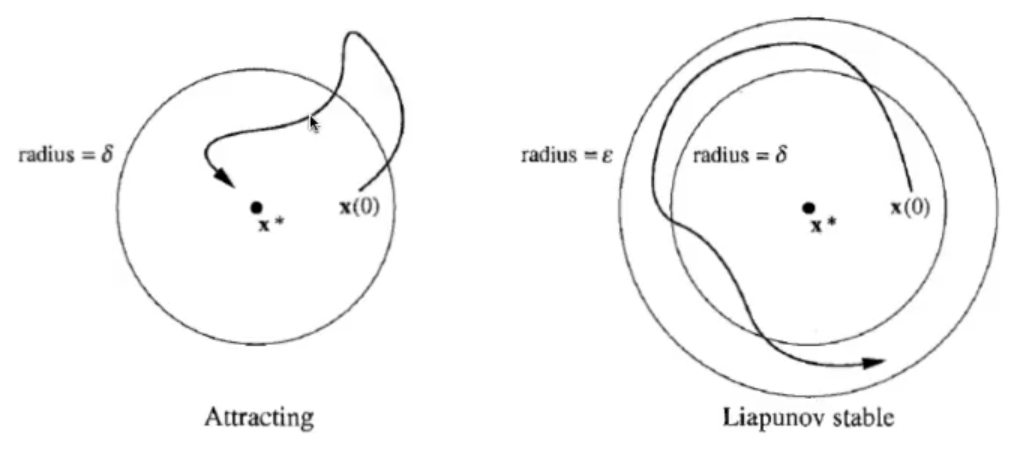
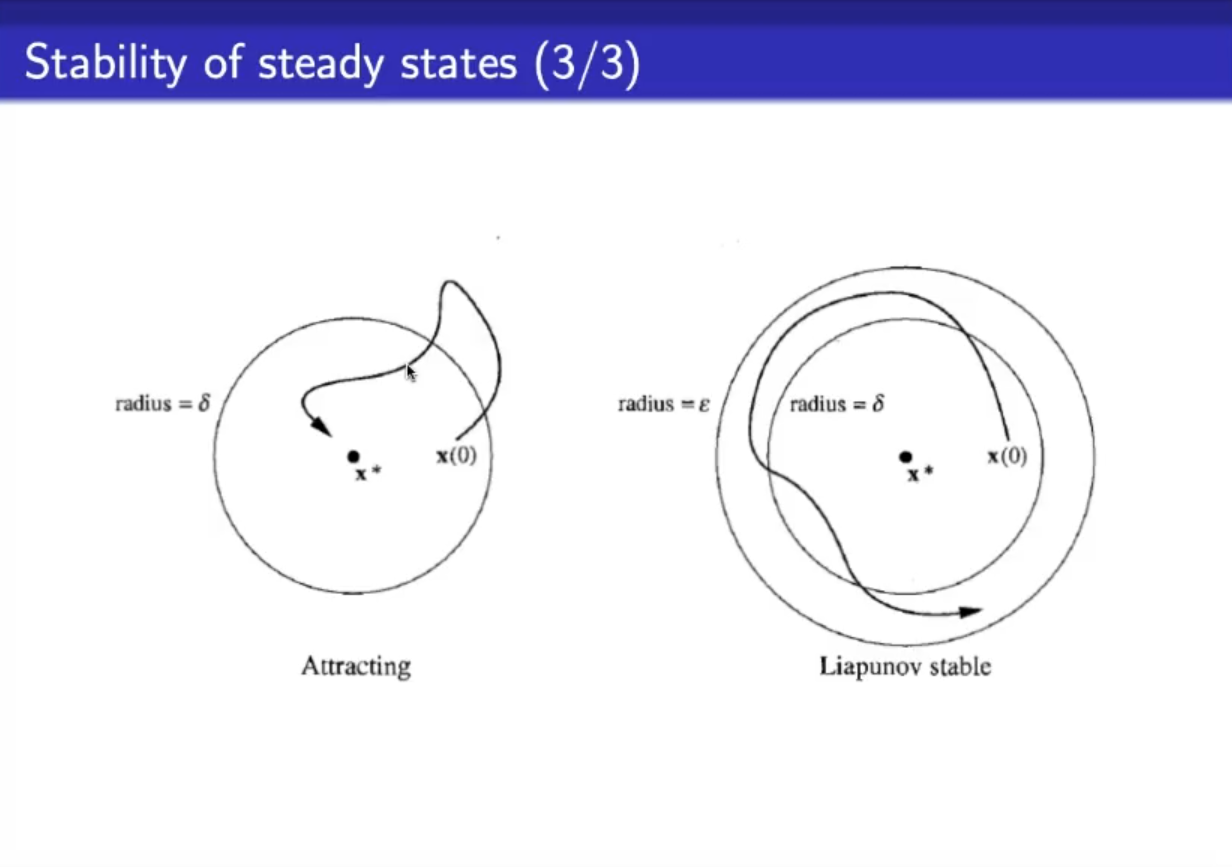
Definition of ‘Attracting Steady State’: A steady state is attracting if all trajectories near , approach it as . If attracts all trajectories then it is defined globally attracting.
Definition of ‘Lyapunov Stable Steady State’: A steady state is Lyapunov stable if all trajectories that start sufficently close to , remain close to it forever.
If a steady state is both attracting and lyapunov stable, then it is called asymptotically stable.
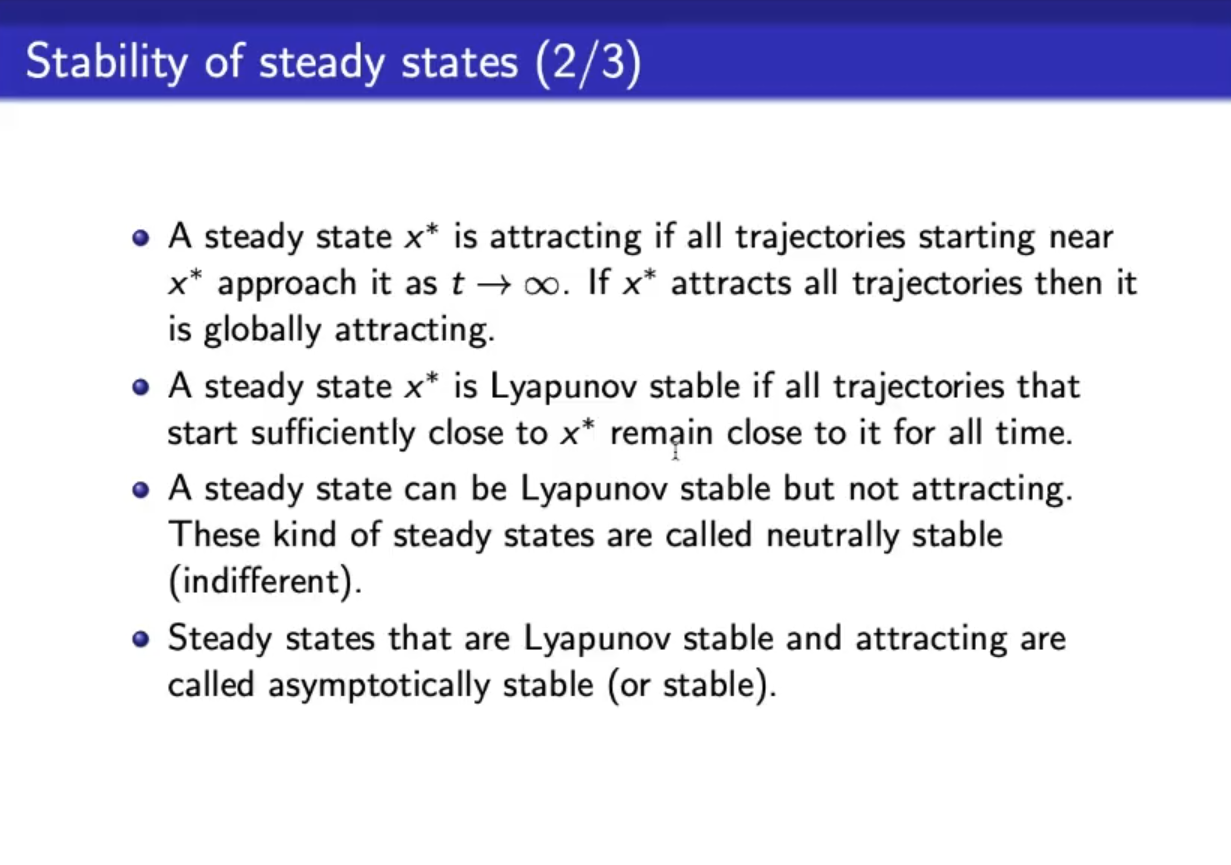
Here’s a figure to understand the difference between attracting and lyapunov stable steady states:
- Remeber that is a vector, in the previous case: , so we need to find the solutions such that:
- Definition of “attractive ss”, “Lyapunov stable ss”, “neutral ss” and “asymptotically stable ss”
- We have seen “Lyapunov stable ss” previosly for the oscillating pendulum, without friction* (blac circular lines in the phase space).
- marginally stable ss are an example of Lyapunov stablity
- for asymptotic stability we need to say that the flow will always get closer to the ss, notice how in this example for attracting ss the flow first moves away the ss