How I think the Linearization/Linearize System should be defined:
(My Notes / My Take / My Thoughts, TAKE THEM WITH A GRAIN OF SALT!) (Under this section you’ll find the professor’s notes.)
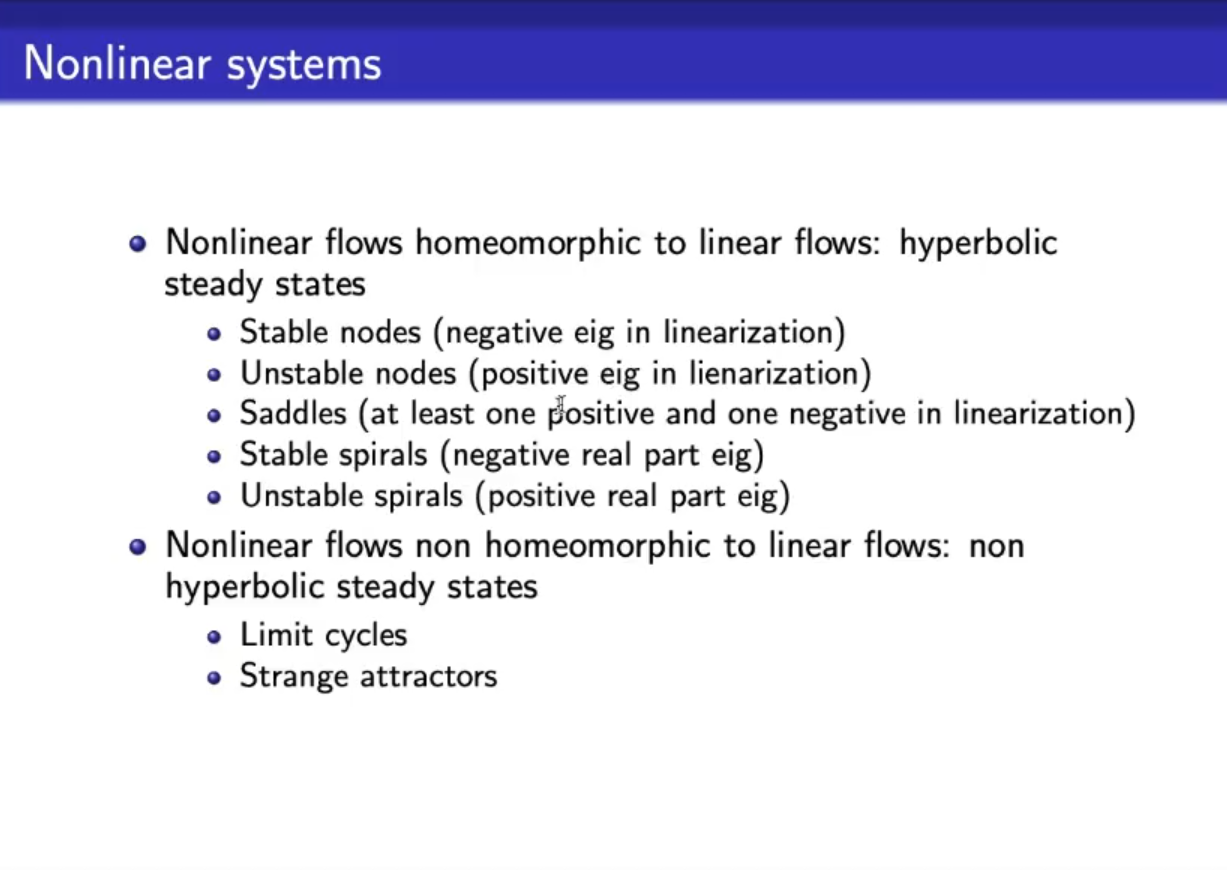
In non-linear systems we can find these types of steady states:
- For hyperbolic we have an homeomorphism with respect to the linear system case:
- Stable nodes (negative eig. in linearization)
- Unstable nodes (positive eig. in linearization)
- Saddles (at least one positive and one negative in linearization)
- Stable spirals (negative real part eig. in linearization)
- Unstable spirals (positive real part eig. in linearization)
- While for non-homeomorphic steady states, we cannot say anything about the geometry and stability.
Notice in the Lorenz system for , so in the chaotic regime, the Jacobian Matrix in the Jacobian matrix will have this form:The eigenvalues for are equal to: , , .
The eigenvalues for and are equal to: , , . So as you can see the system presents strange attractors, but the eigenvalues are non-zero, meaning the steady are hyperbolic (for ). So even limit cycles and strange attractors can be found for hyperbolic steady states. What we cannot find are lines of steady states, and circles, since “we cannot analyze the marginality”, meaning that we cannot be sure that a system is marginal if its linearization is marginal (Hartman-Grobman Theorem).
Remember:
(Professor’s Notes)
- In case of hyperbolic steady states, not only the property of stability of the steady states are similar in the non-linear and linearized system, but also the geometry nearby.
- Also in the non-linear case we can distinguish between stable and unstable manyfolds (or subspaces).
In non-linear systems we can find these types of steady states:
- For hyperbolic we have an homeomorphism with respect to the linear system case:
- Stable nodes (negative eig. in linearization)
- Unstable nodes (positive eig. in linearization)
- Saddles (at least one positive and one negative in linearization)
- Stable spirals (negative real part eig. in linearization)
- Unstable spirals (positive real part eig. in linearization)
- For non-hyperbolic steady states:not-sure-about-this
- Limit cycles.
- Strange attractors.
Stable/unstable nodes, saddles, and stable/unstable spirals can be succefully analyzed via linearization, while limit cycles and strange actractors cannot.
Hyperbolic steady states: the associated linearization does not have any -eigenvalues, meaning the all eigenvalues are , or in case that they are imaginary, their real part is .IMPORTANT
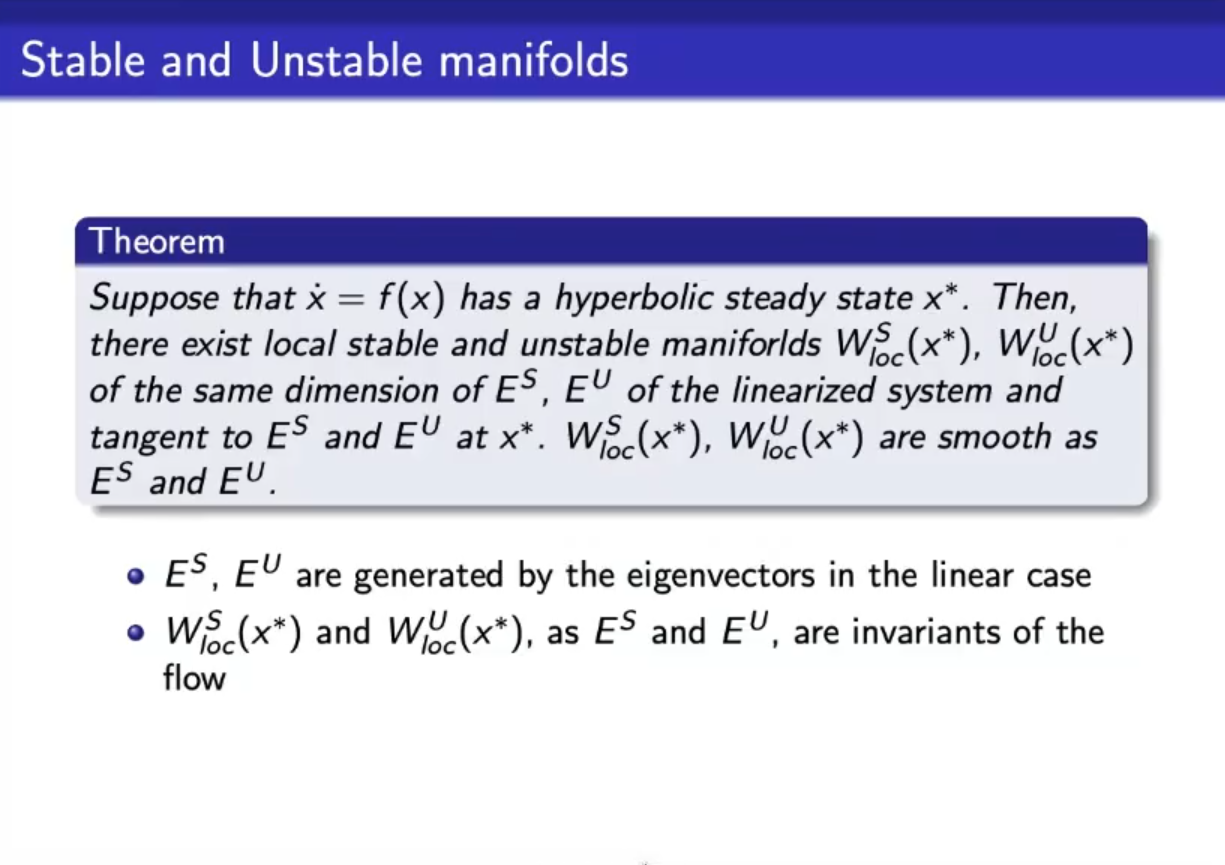
NOT-IMPORTANT (I don’t think we have ever used and mentioned this theorem) Theorem ‘Stable and Unstable Manifolds’
- A manyfold is a generalization of a subspace in a nonlinear space.IMPORTANT
- : unstable (~Ex.: )
- : stable (~Ex.: )
- The manyfolds are tangent to specifically at the stady state , this means:
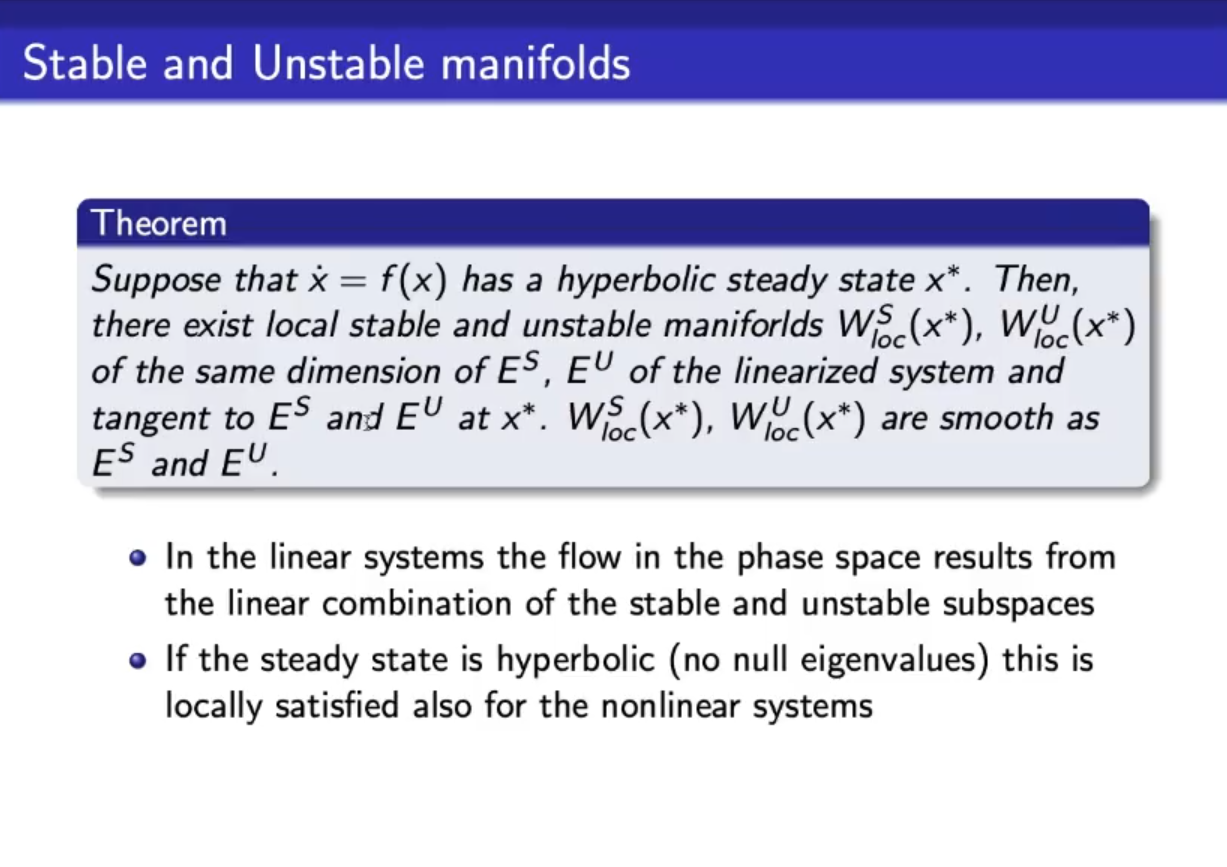
- We can approximate a non-linear system into a linear system, and we get similar information regarding the stability of the stady states (if the ss is hyperbolic).
- In linear systems, the subspaces and generate/span the whole phase space, meaning that any vector is a linear combination of the vector spanning and .
For example, if you have only stable subspaces ⇒ then you will have only stable steady states.
== and are generated respectivly by negative and positive eigenvalues/eigenvectors==.
- In case of hyperbolic steady states, not only the property of stability of the ss are similar in the non-linear and linearized system, but also the geometry nearby.
- Also in the non-linear case we can distinguish between stable and unstable manyfolds (or subspaces).
- stable/unstable nodes, saddles, and stable/unstable spirals can be succefully analyzed via linearization.
- limit cycles and strange actractors cannot.
- hyperbolic ss: the associated linearization does not have any -eigenvalues, meaning the all eigenvalues are , or in case that they are imaginary, their real part is .IMPORTANT
- A manyfold is a generalization of a subspace in a nonlinear space.IMPORTANT
- : unstable
- : stable
- The manyfolds are tangent to specifically at the stady state , this means:
- We can approximate a non-linear system into a linear system, and we get similar information regarding the stability of the stady states (if the ss is hyperbolic).
- In linear systems, the subspaces and generate/span the whole phase space, meaning that any vector is a linear combination of the vector spanning and .
For example, if you have only stable subspaces ⇒ then you will have only stable steady states.
== and are generated respectivly by negative and positive eigenvalues/eigenvectors==.