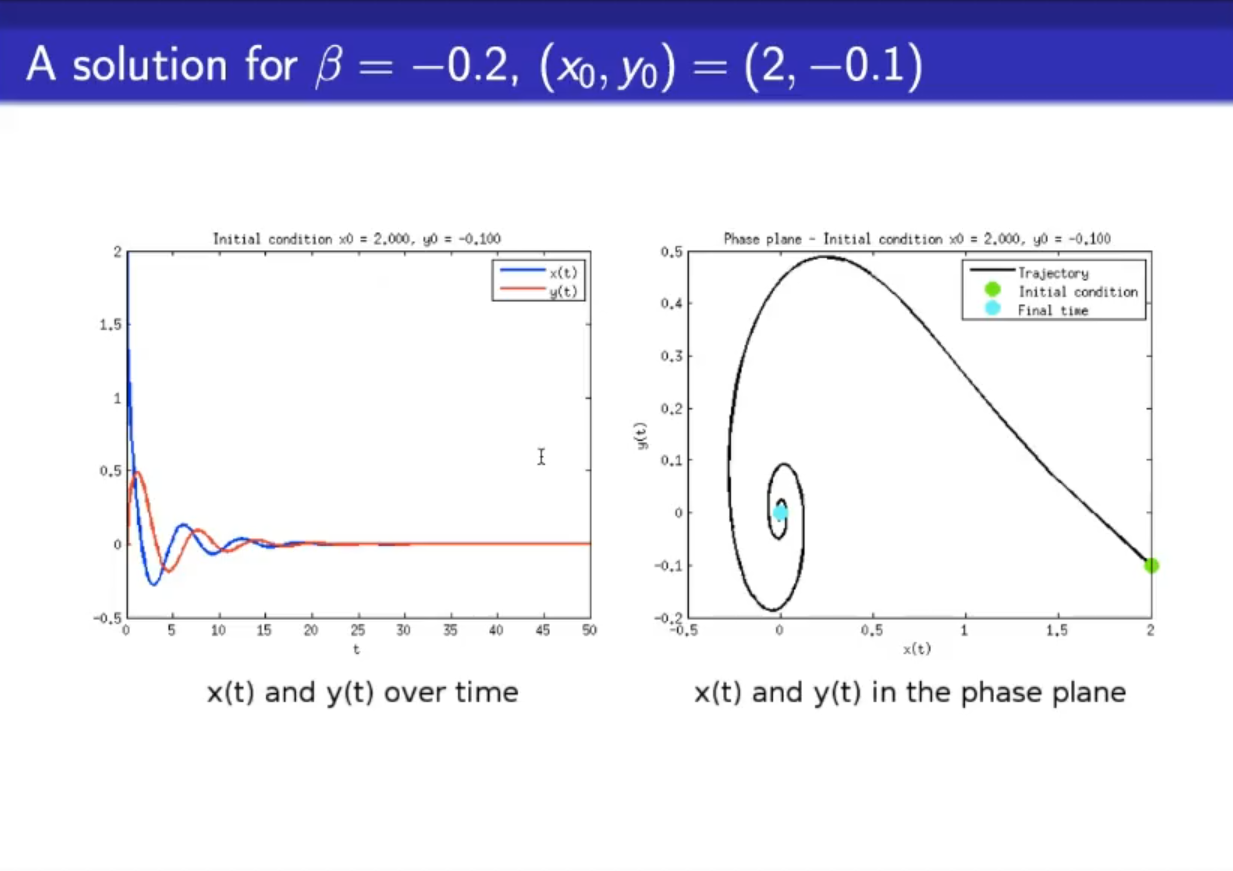
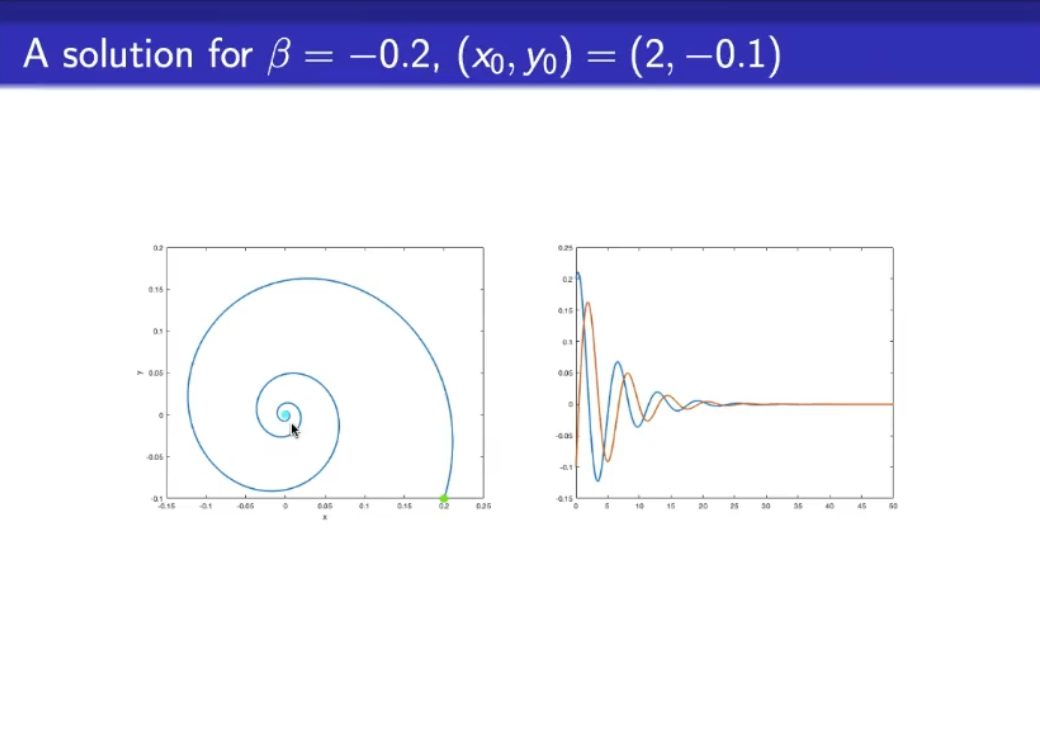
- For a negative value of :
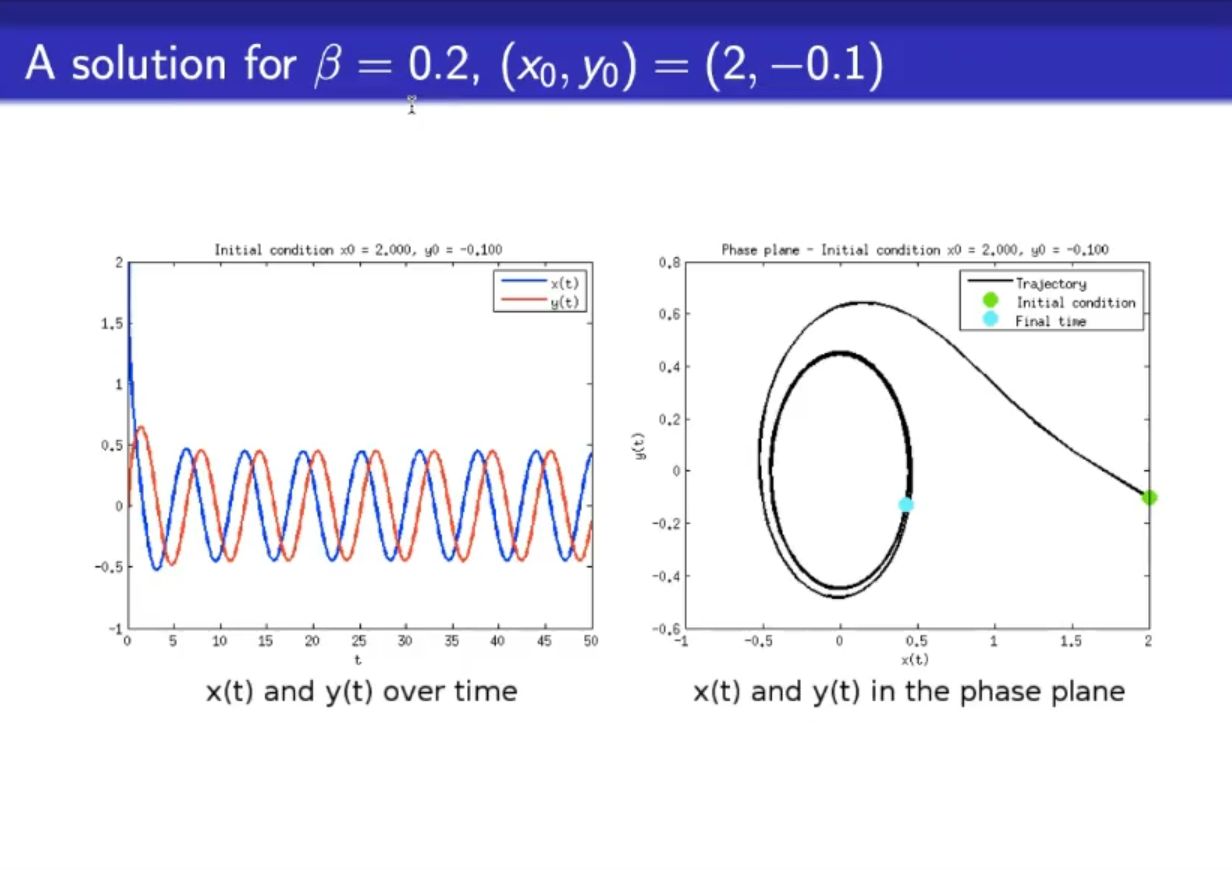
- For a positive value of :
- This is a “real” example of a limit cycle.
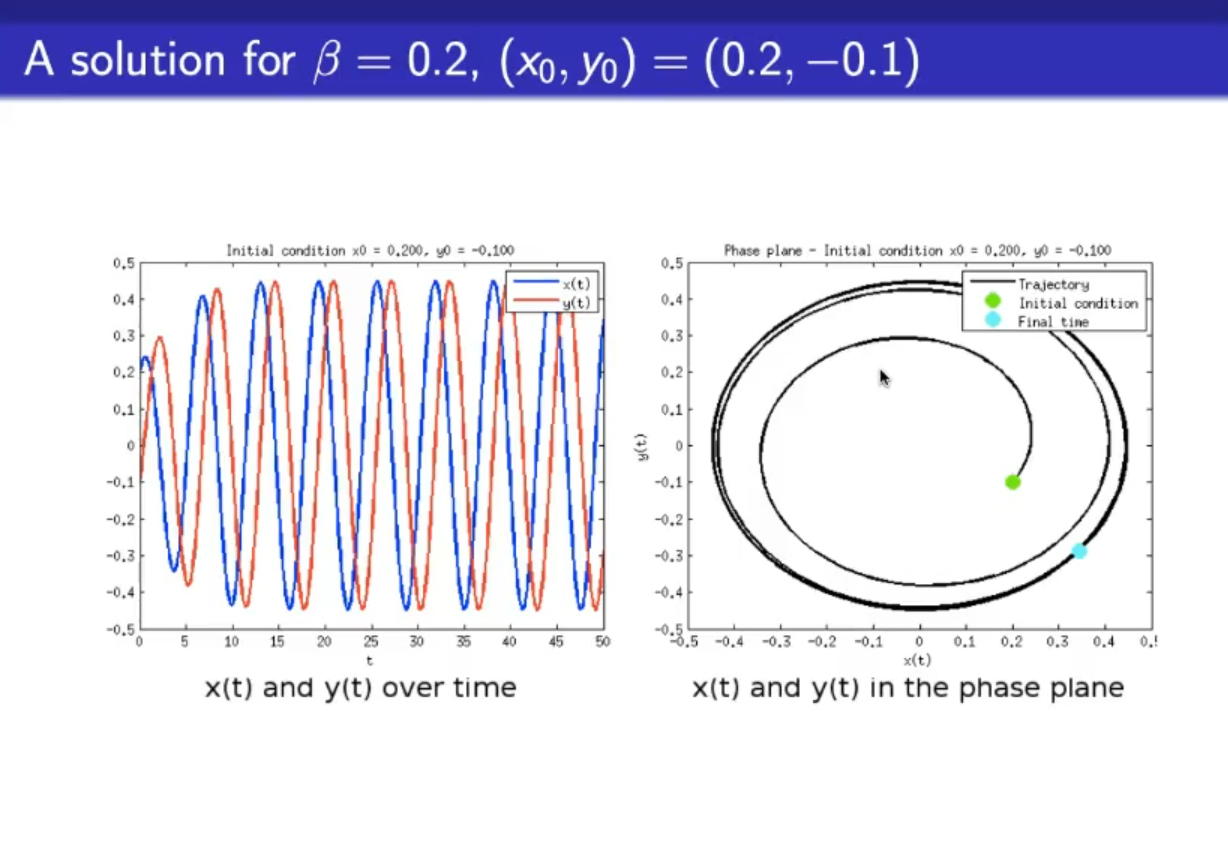
- For a positive value of : , like before, but this time the initial conditions this time are inside the limit cycle.
- NOTE: the size and shape of the limit cycle is the same (even if it does not look like it), look at the scale of the graphs.
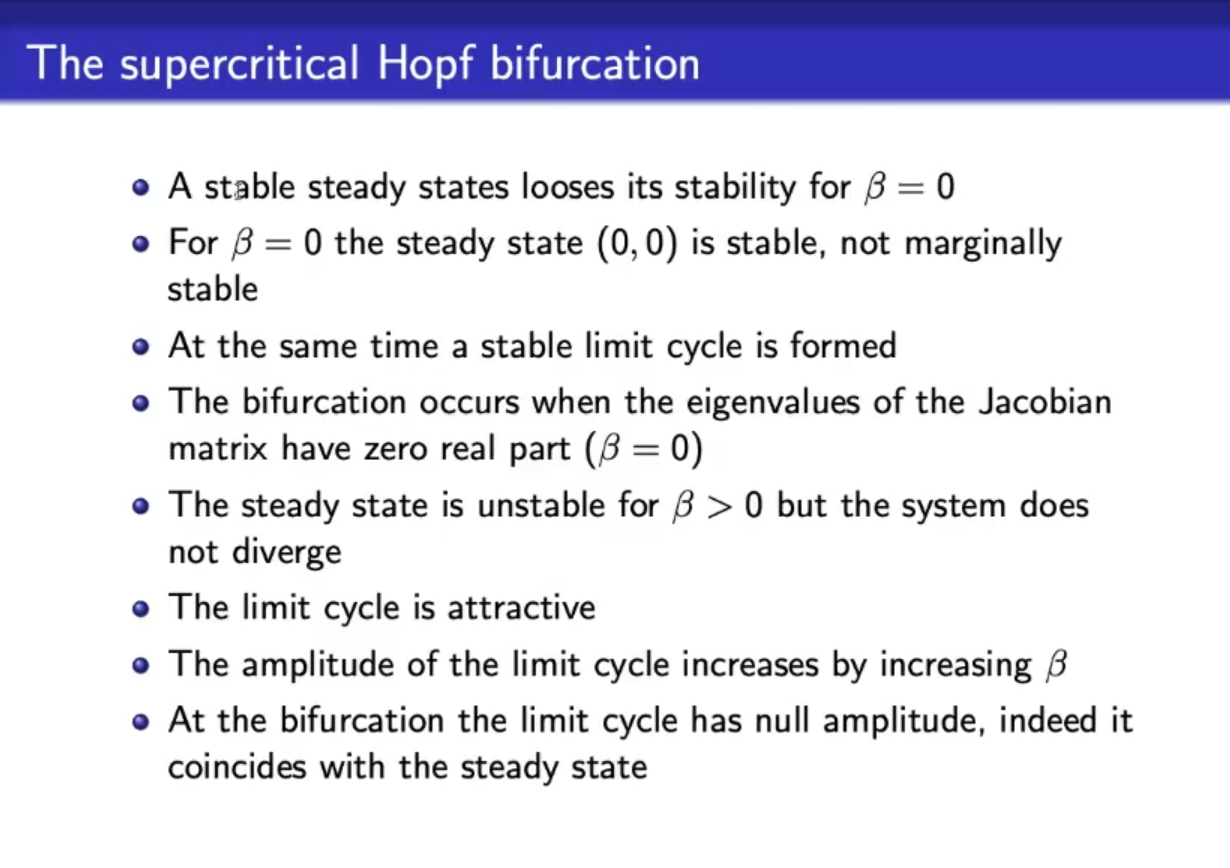
- The amplitude/size of the limit cycle depends on .
- The limit cycle is part/called an attracting set.
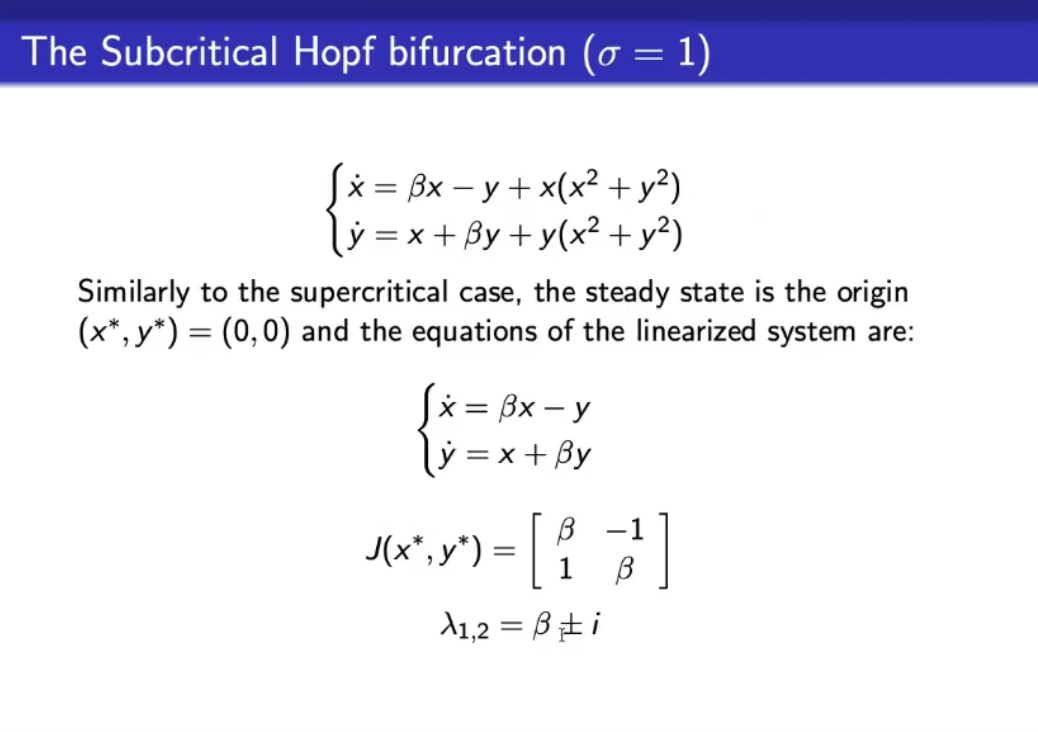
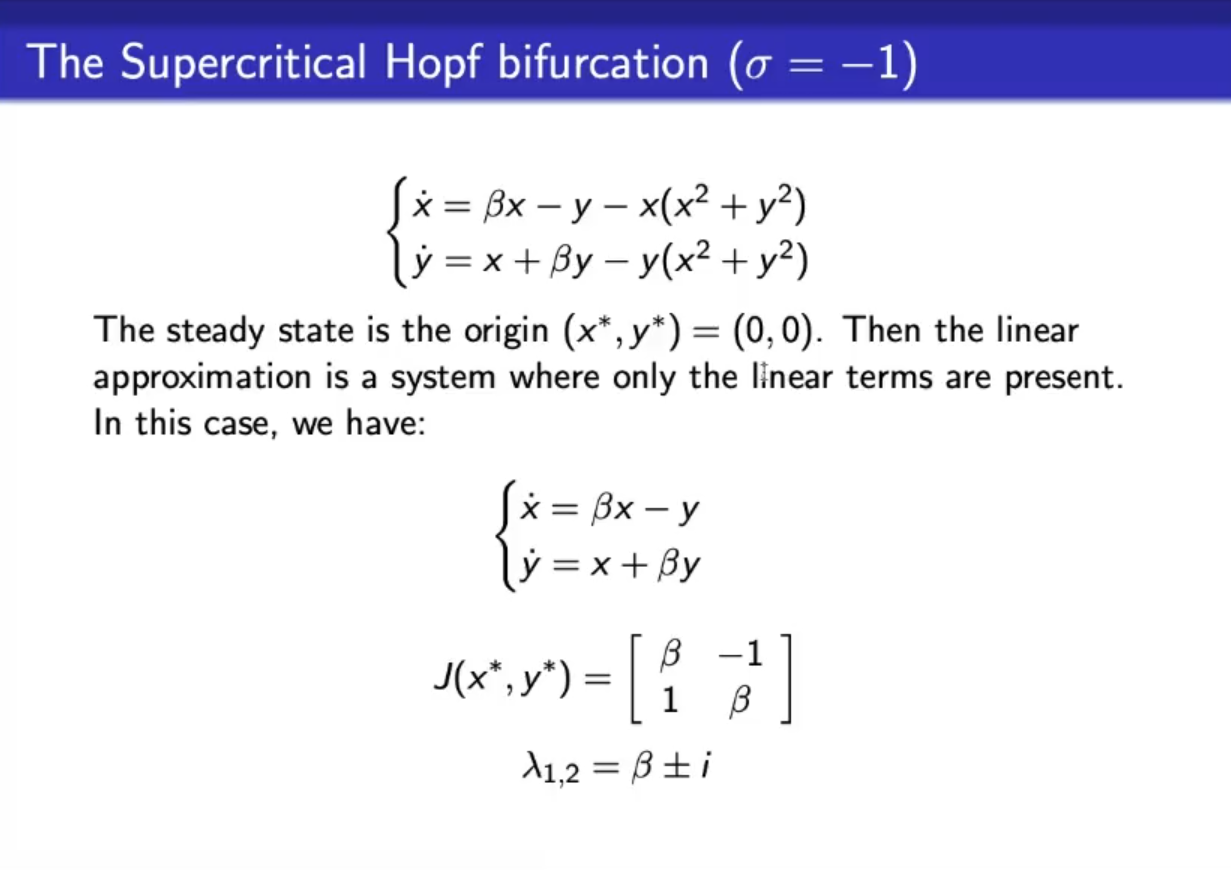
- The same eigenvalues as for
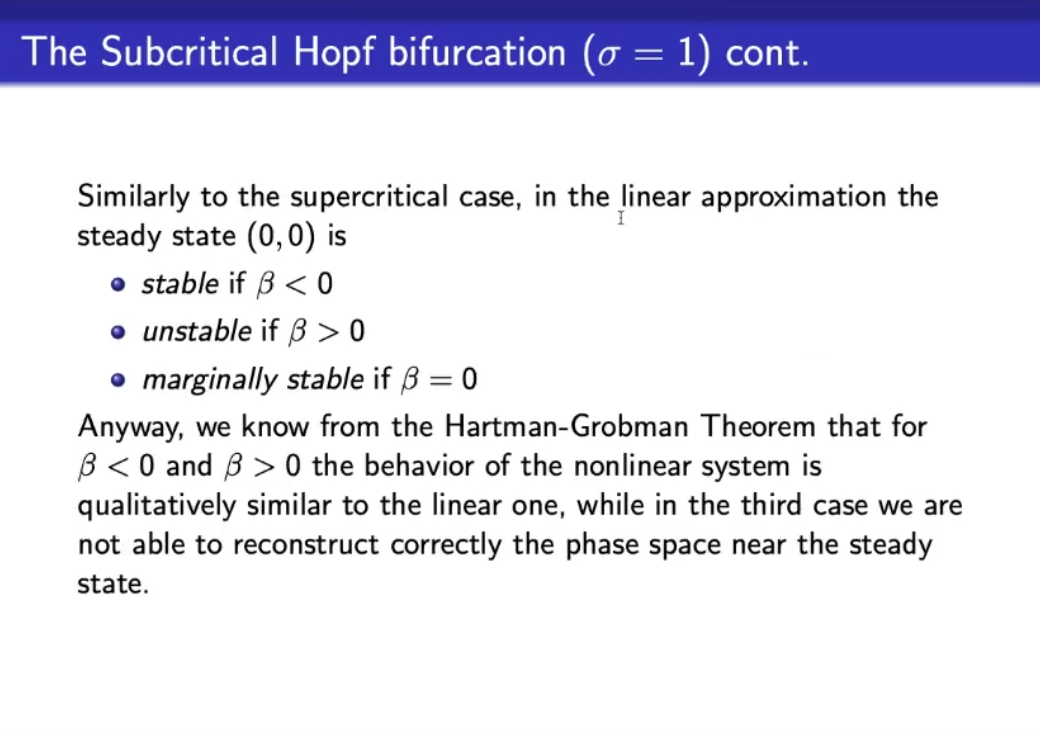
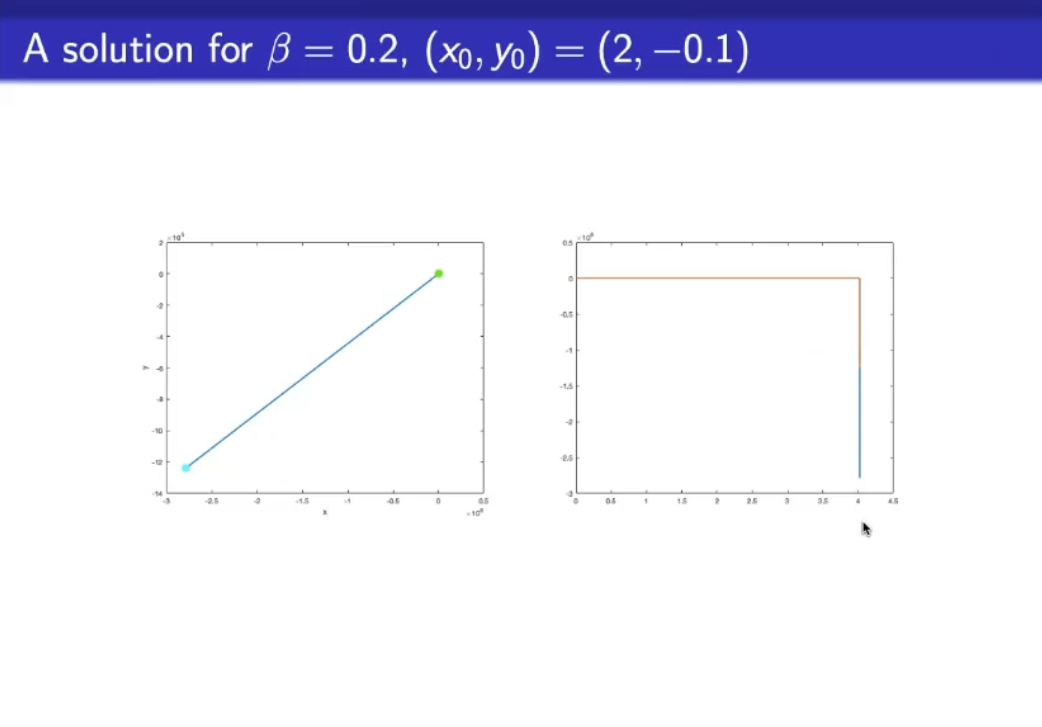
- In this case we have a divergence.
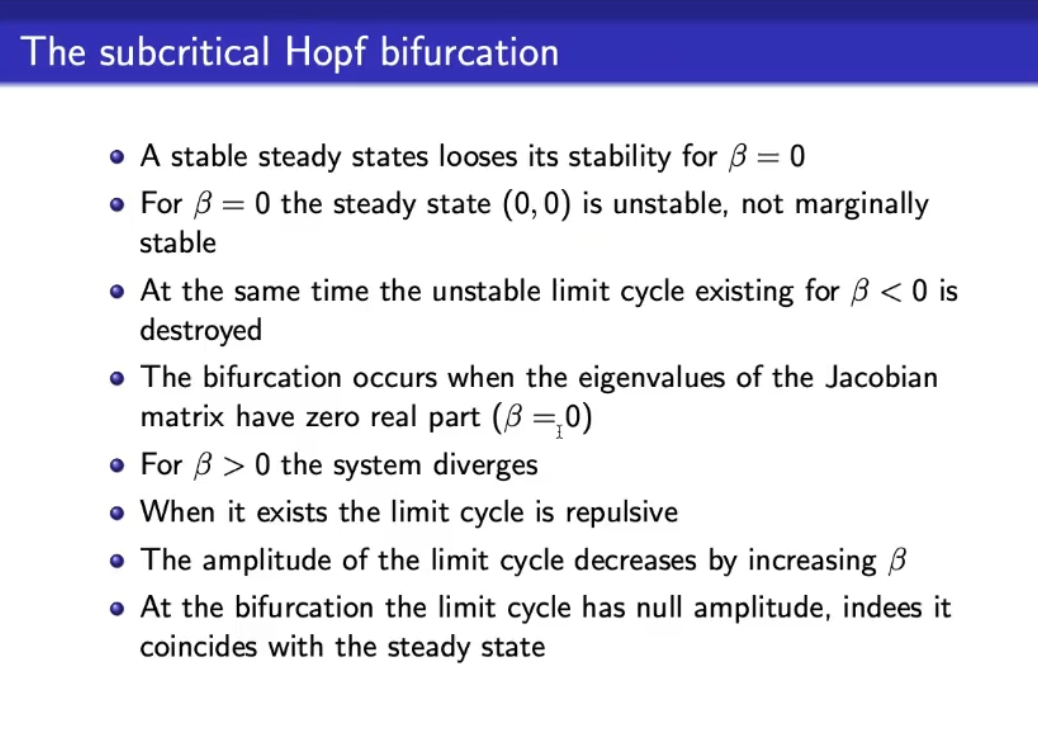
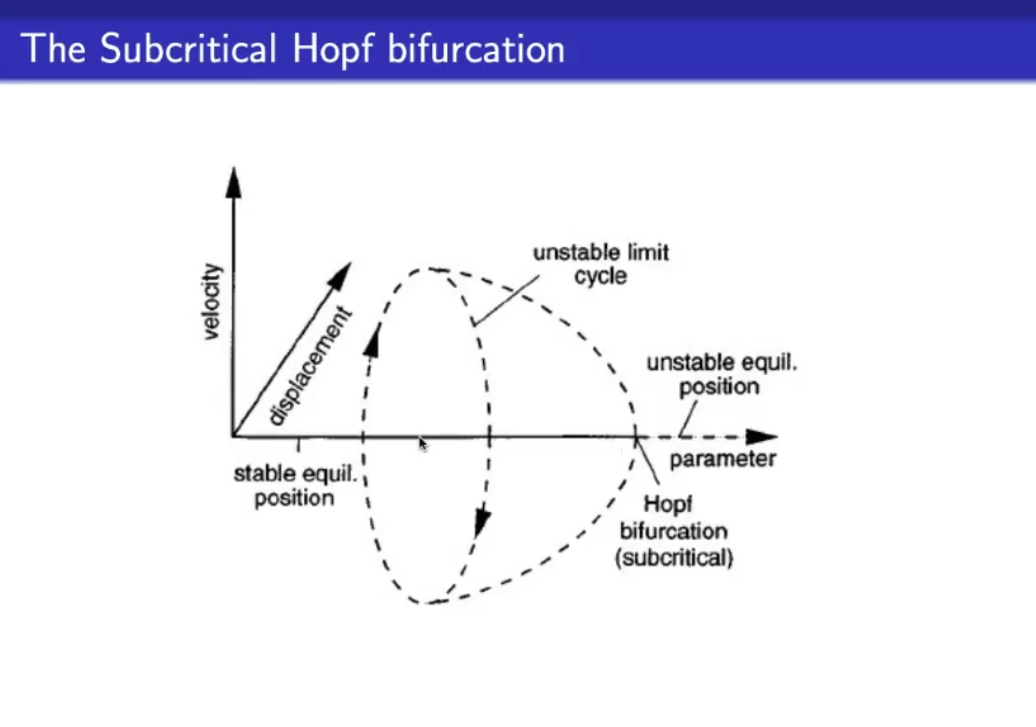
- If you choose inital condition outside of the unstable limit cycle (or better a “repuslive limit cycle”), then you have a divergence.
- We say that for positive value we have “full instability”, and for negative value we have “local stability” (inside the limit cycle).
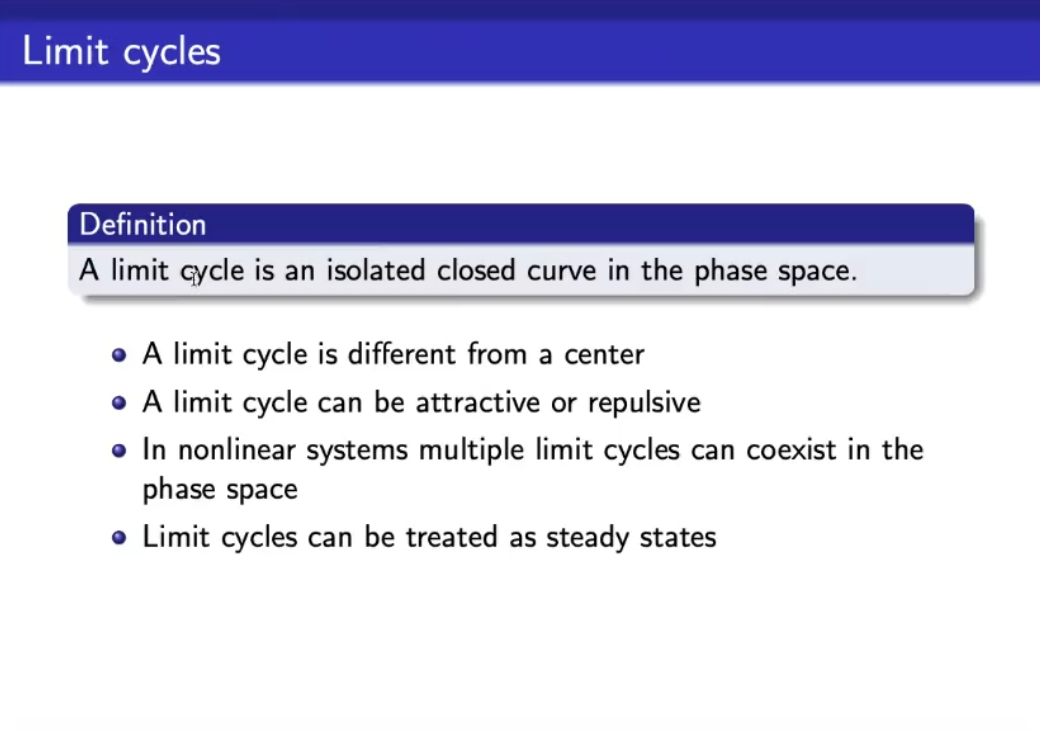
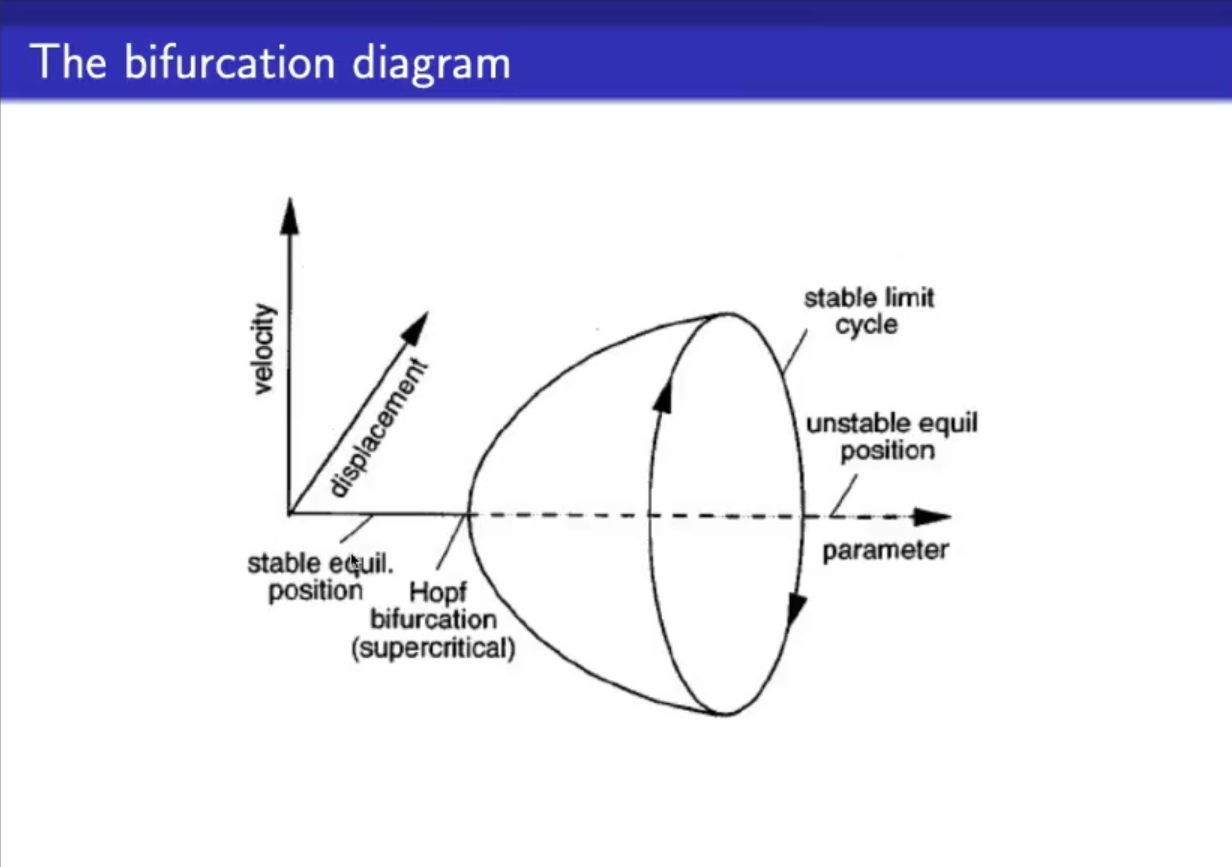
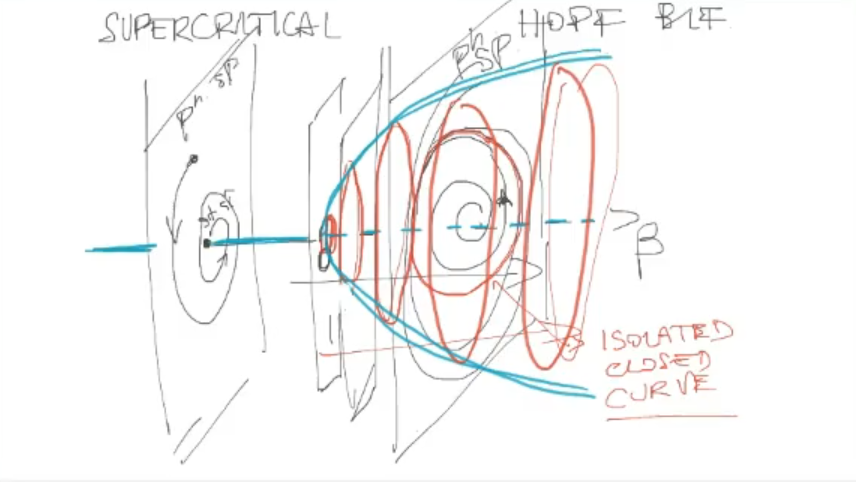
- In the supercritical hopf bifurcation we found an attractive limit cycle.
- In the subcritical hopf bifurcation we found a repuslive limit cycle.
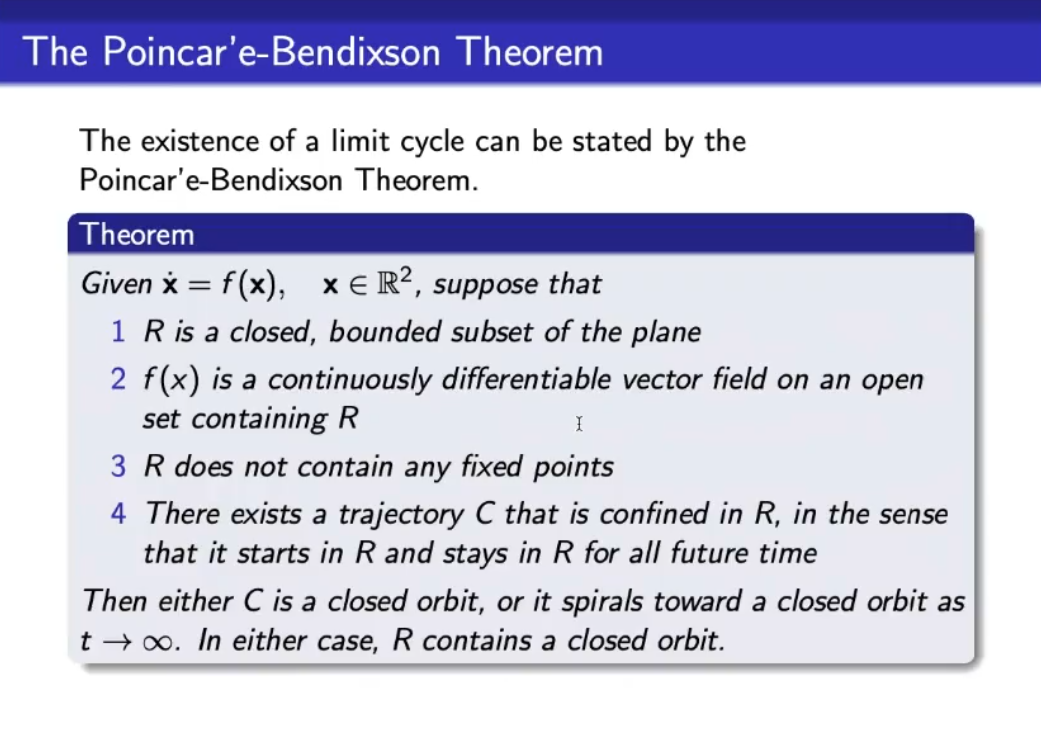
Let’s try with an example: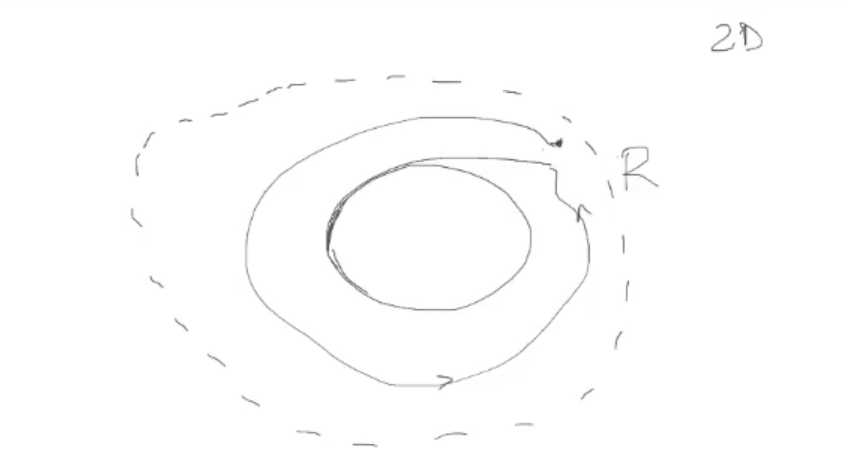
- Suppose we have an initial condition that given infinite time always stays in a substet , and in this subset there are NO steadys states, then the Poincar’è-Bandixosn Theorem assures us that the system will converge to a limit cycle.
- NOTE: the hopf bifurcations both presents steady states (in ), however for those cases we can still use this theorem, we just “remove” a closed curve near the ss, like so:
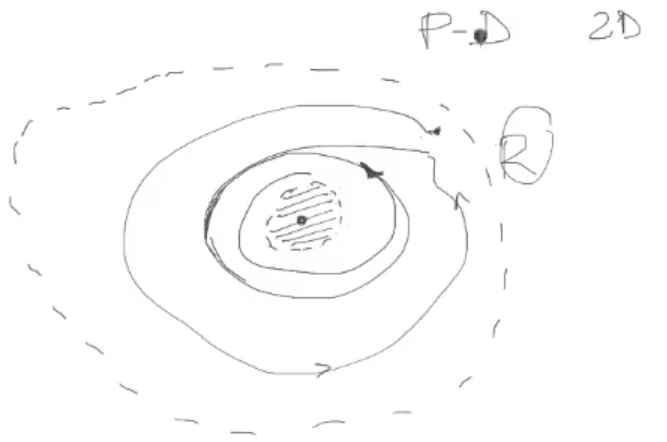
- But now is an open subset ????not-sure-about-this
Now let’s try to visualize better the meaning behind the bifurcation diagram: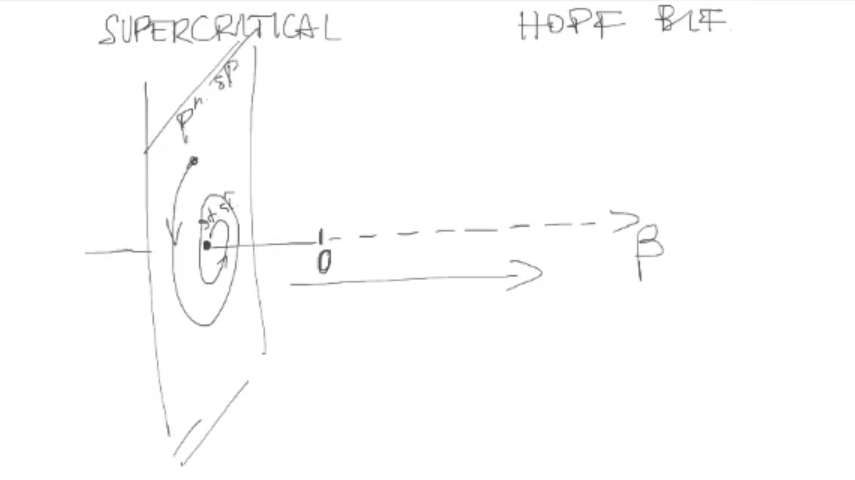
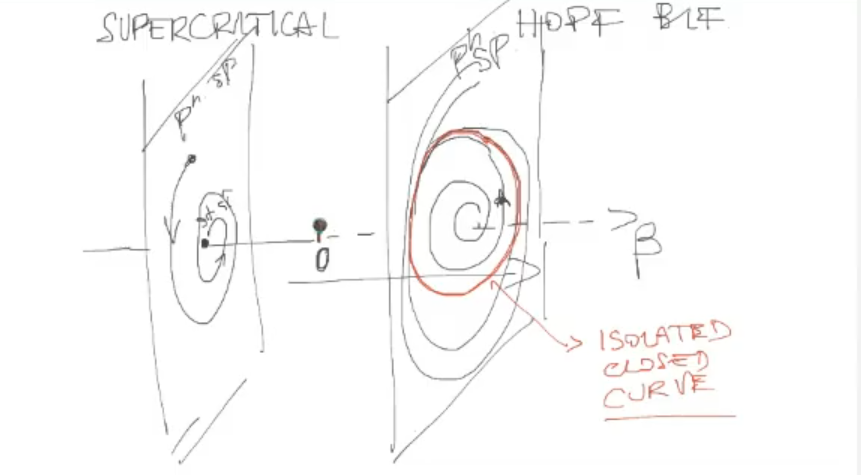 Each point of the bifurcation diagram represents a phase plane/phase space (with infinite inital conditions), and the lines (dotted and continue) represents the stabilities/attracting set of the phase plane: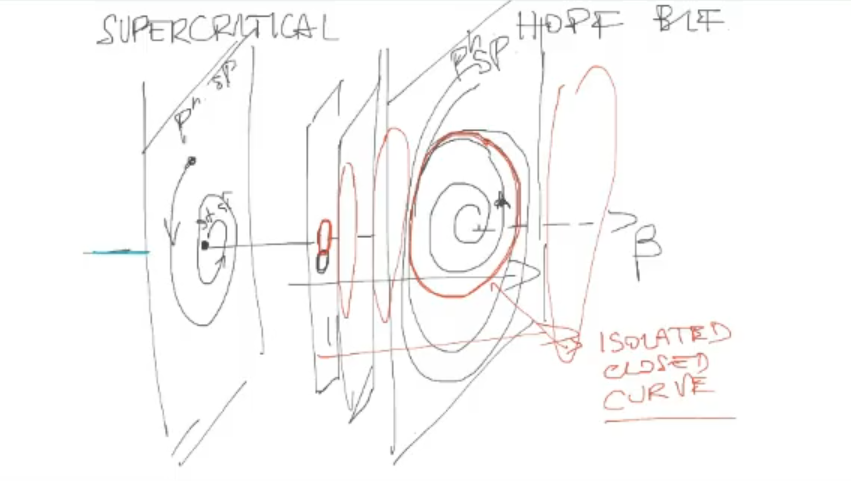
For the subcritical case: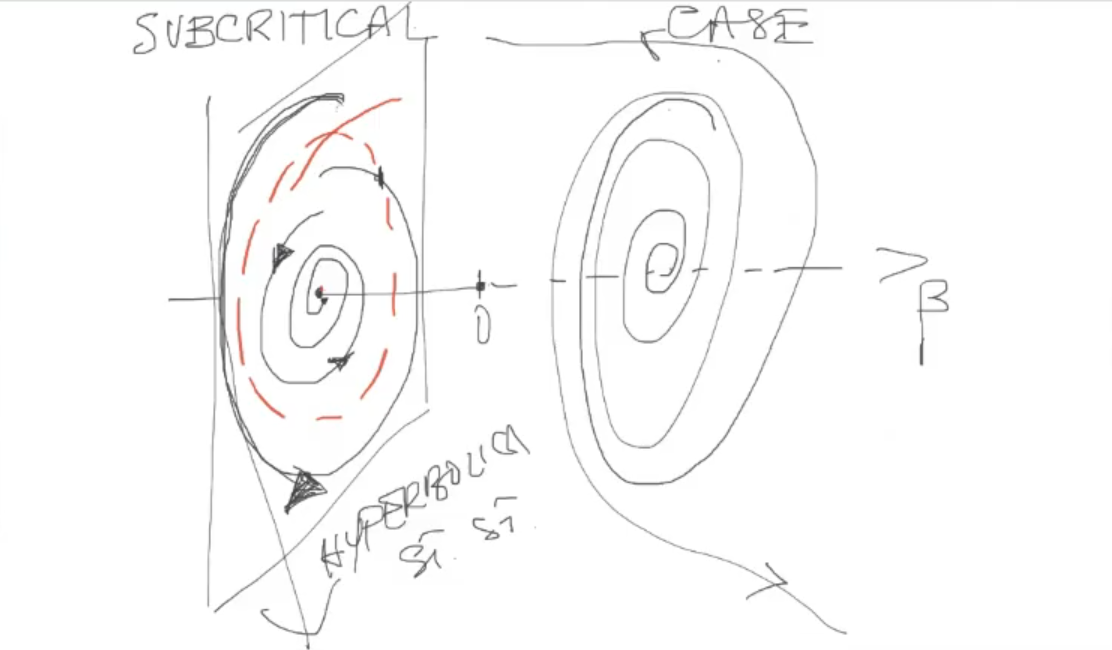
Let’s see also the two hopf biffurcation side by side: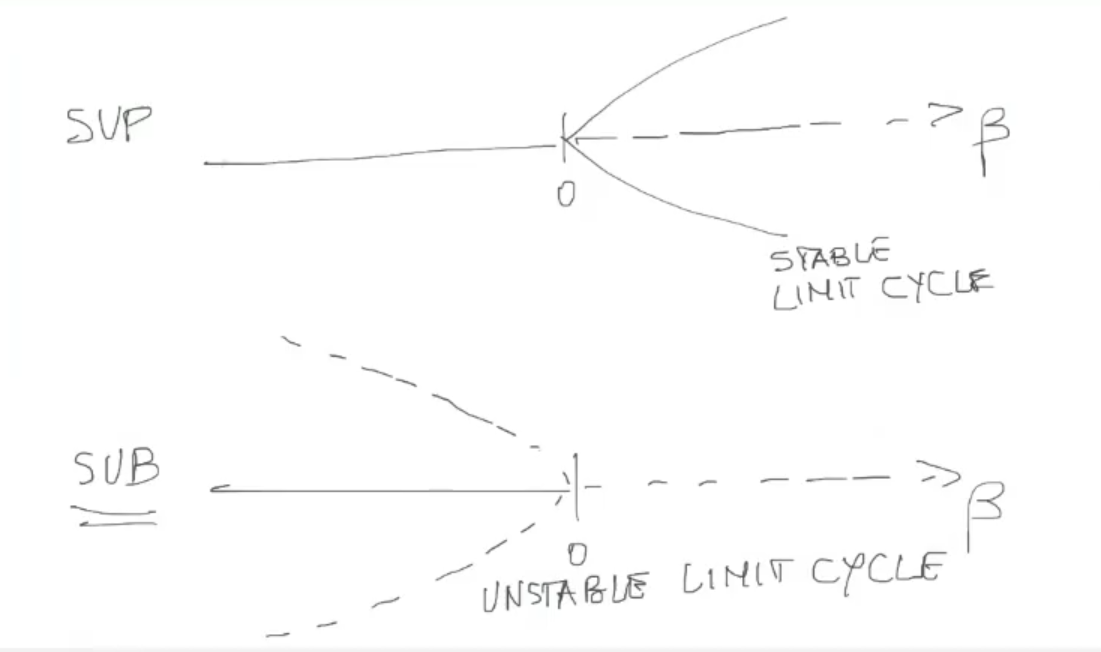
- NOTE: since the eigenvalues were the same also the “x-axis” is the same both for the “SUPercritcal” and “SUBcritical”, what chages is the limit cycle.
- NOTE: this graphs is 2D, it should be 3D!
We may find different cases, for different values, here’s another example: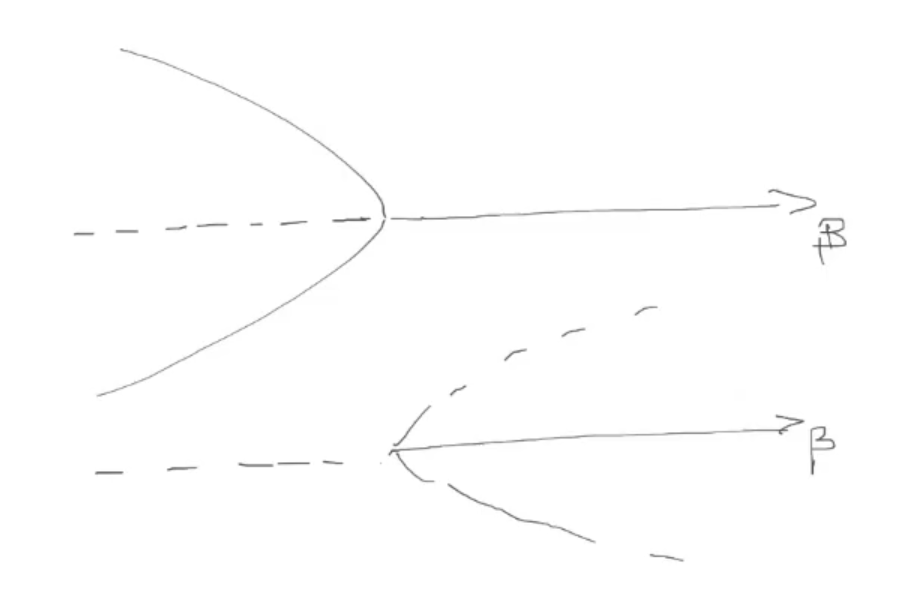
- However if the limit cycles is stable when the ss is unstable, it is still considered a supercritical hopf bifurcation.
- And if the limit cycles is unstable when the ss is stable, it is still considered a subcritical hopf bifurcation.
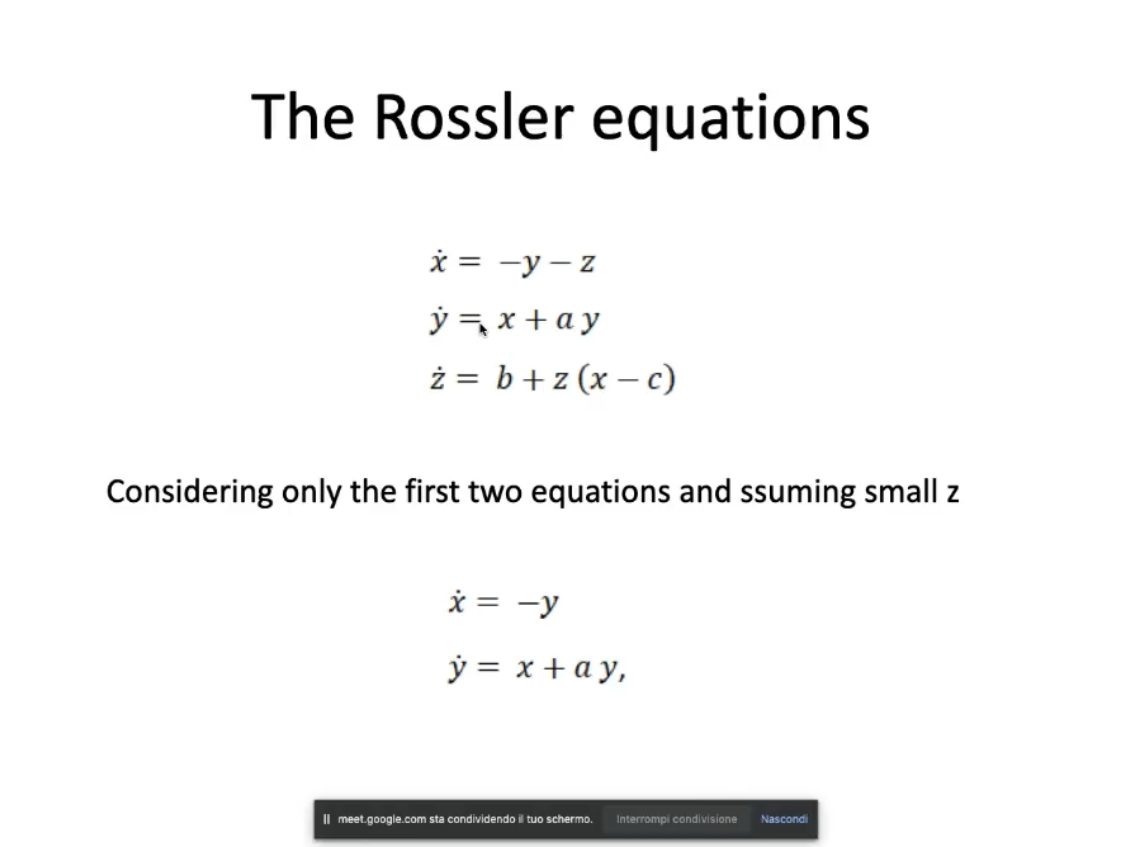
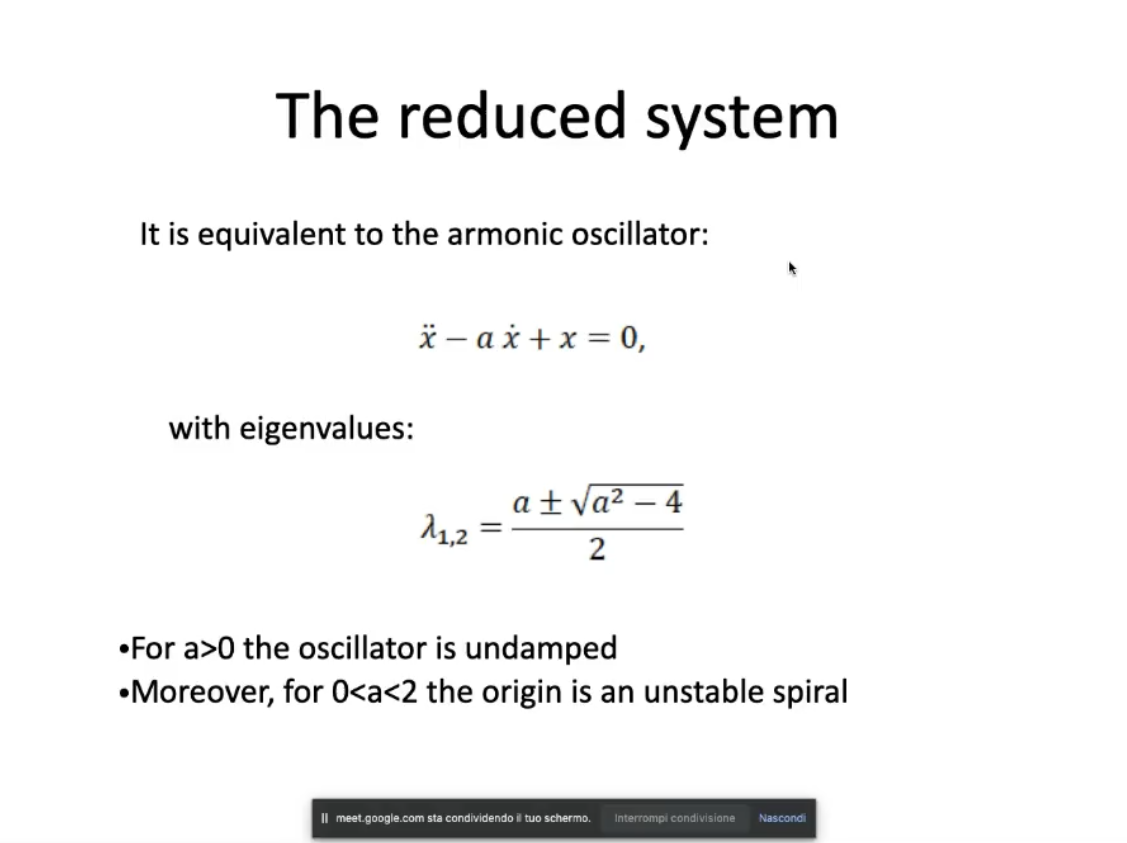
- “undamped” = unstable
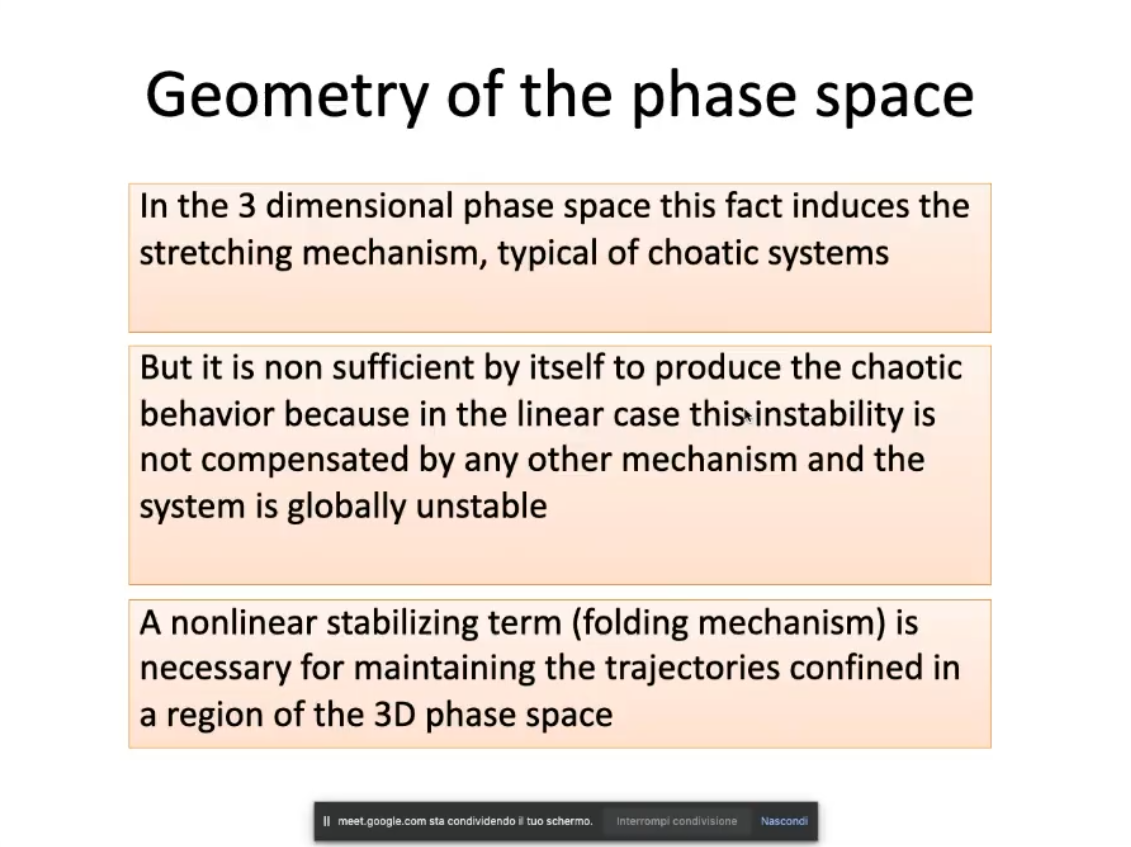
- First idea about chaos.
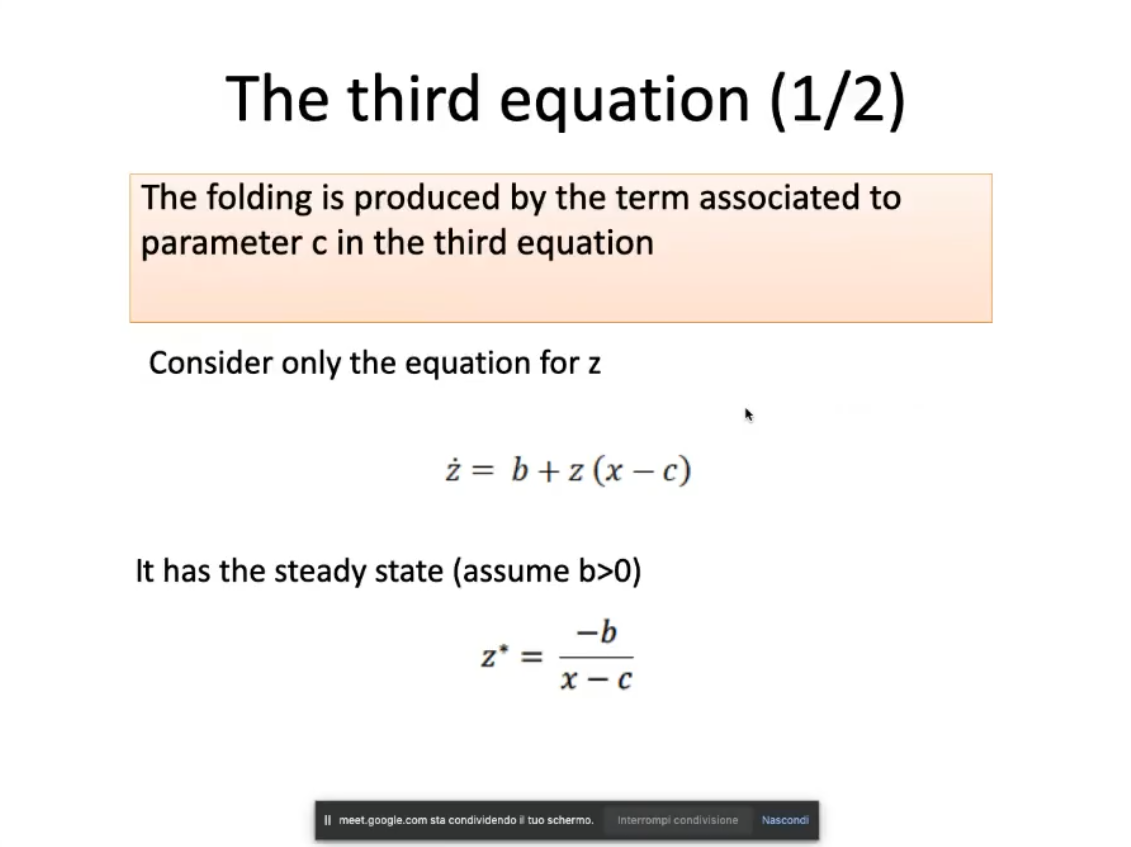
- Fix the sign of , for simplicity.
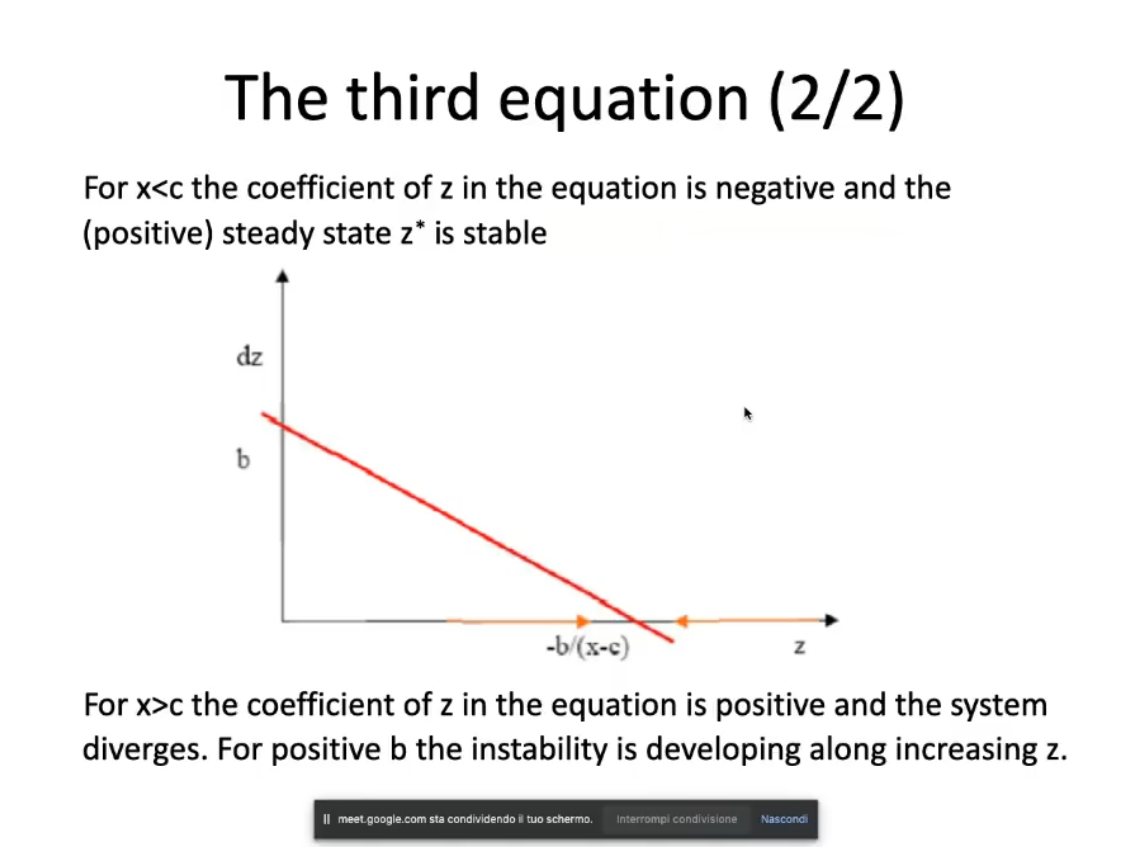
- So the ss is an attractor.not-sure-about-this is it always an attractor???
- So the third equations acts as a stabilizer depending if .
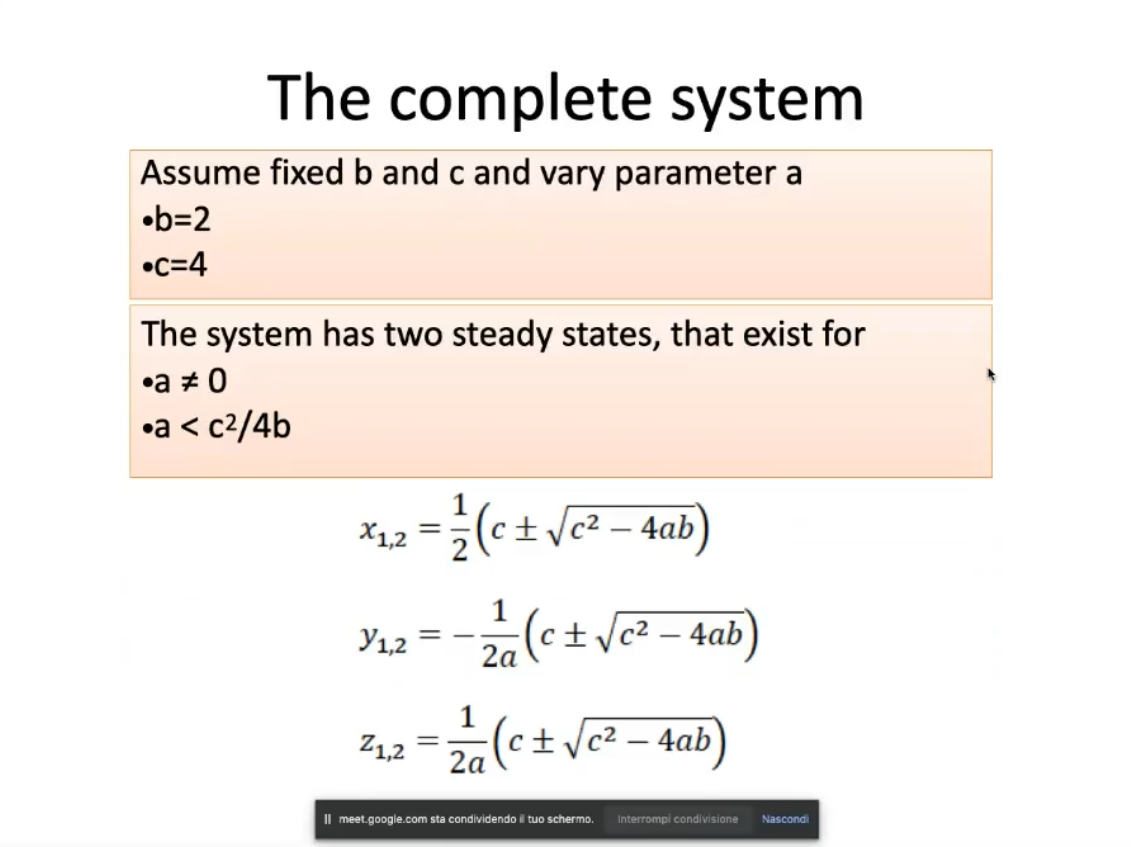
- If or , then the ss will be imaginary.
Also, for the two ss will coincide.
⇒ Then we can say that this is a saddle-node bifurcation.
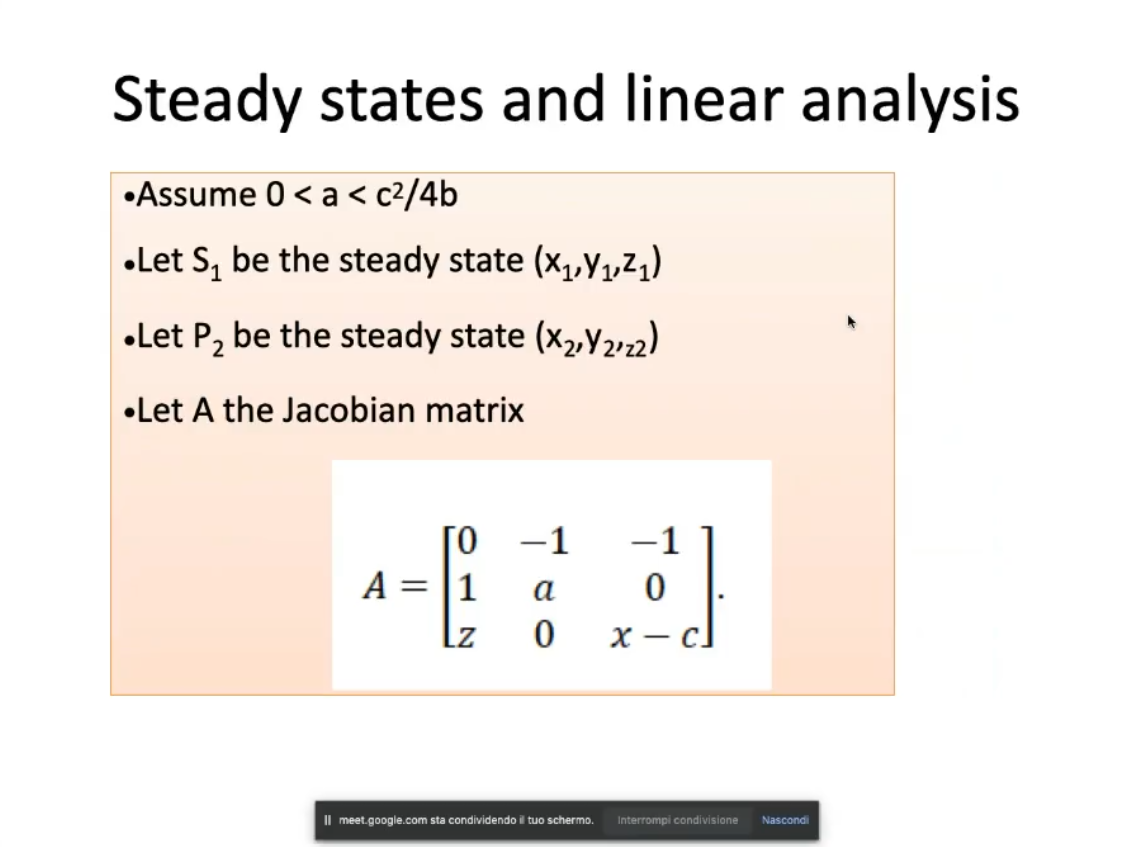
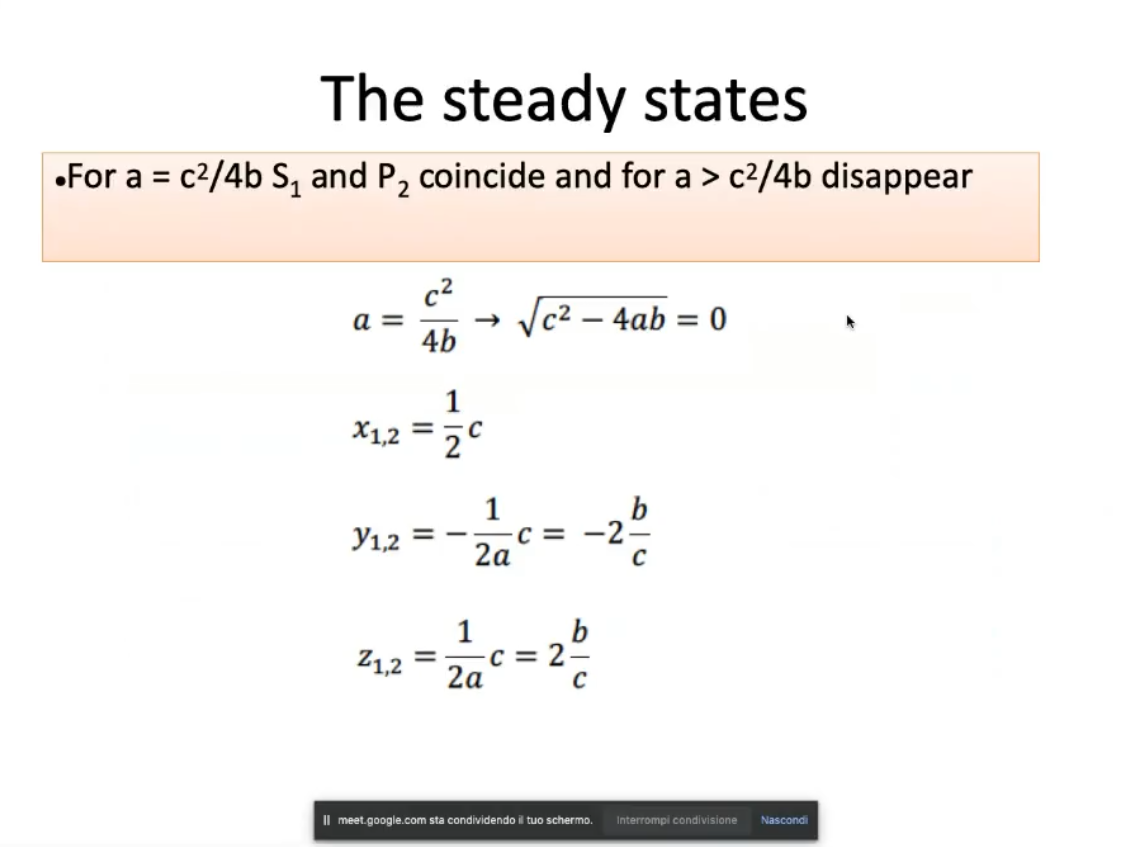
- Here we can see, like we already said that for the two ss will coincide.
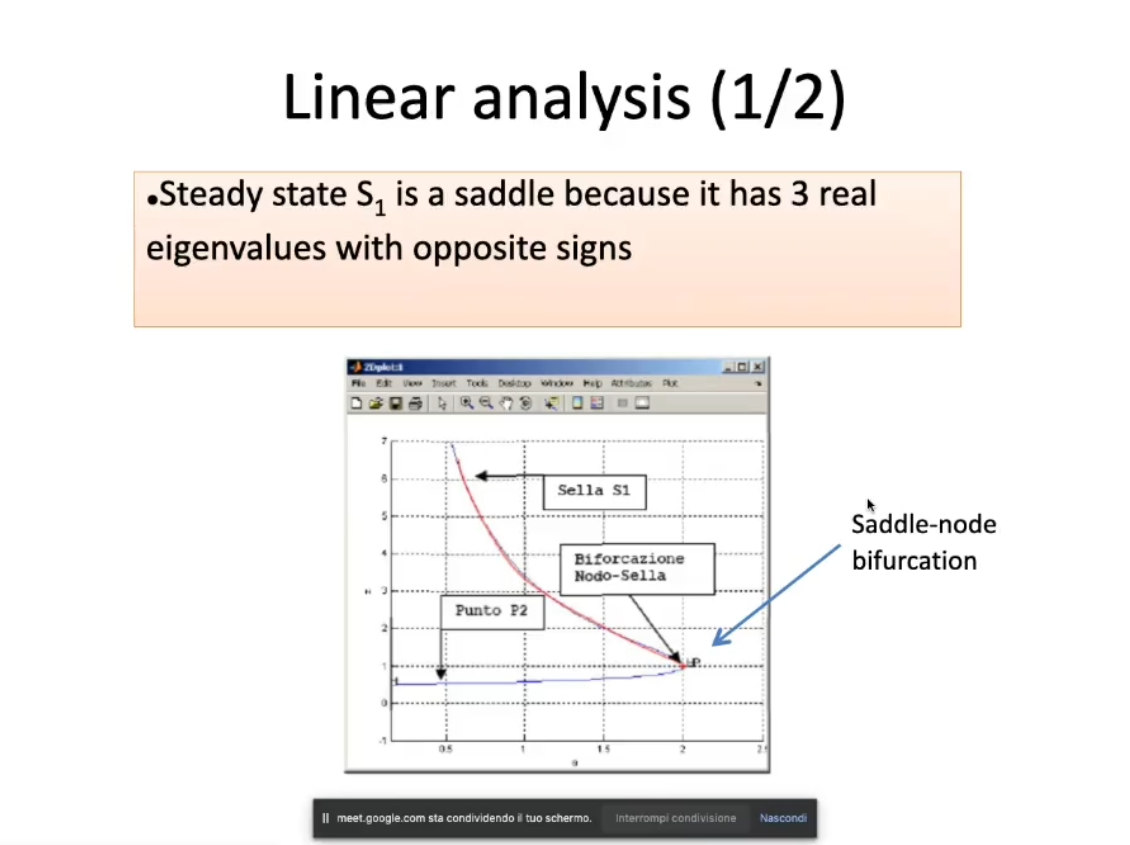
- And like we said previously this is a saddle-node bifurcation.
- As we move the numerical values of the steady states will vary, this graph represents this movement/variation, remember that , and are fixed.
Just to be more clear, in this graph the x-axis represents the values of .
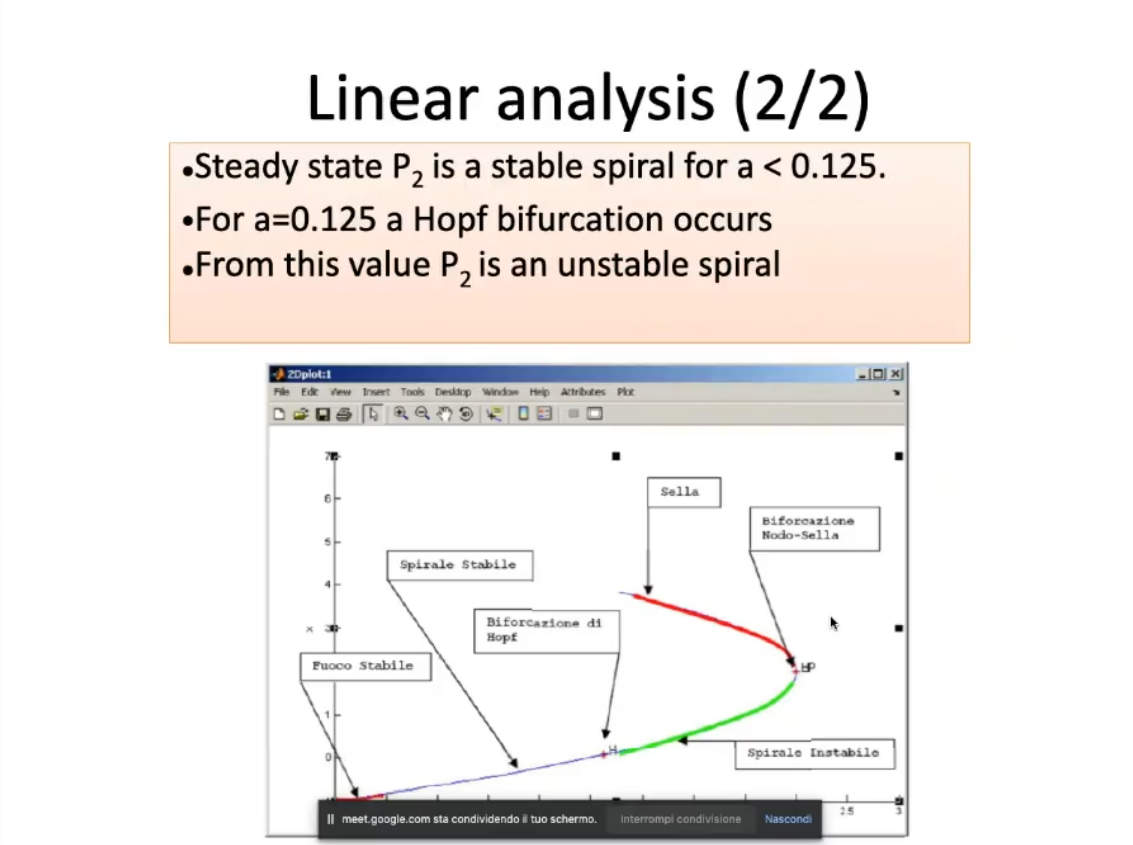
- This is a zoom of the previous graph.
- This will give rise to a supercritical hopf bifurcation (in 3D)
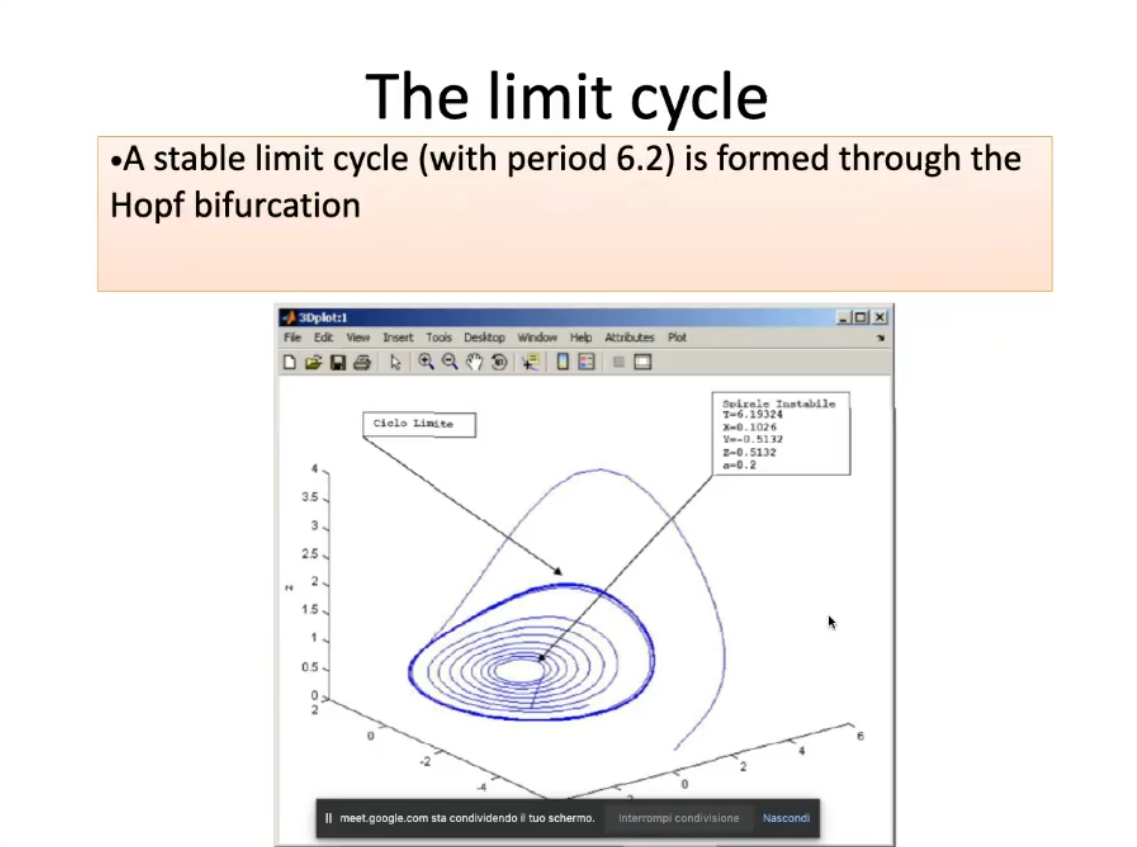
- Here’s the limit cycle in 3D.
- This is calculated via simulation.
- NOTE: in 3D the limit cycle can be curved.
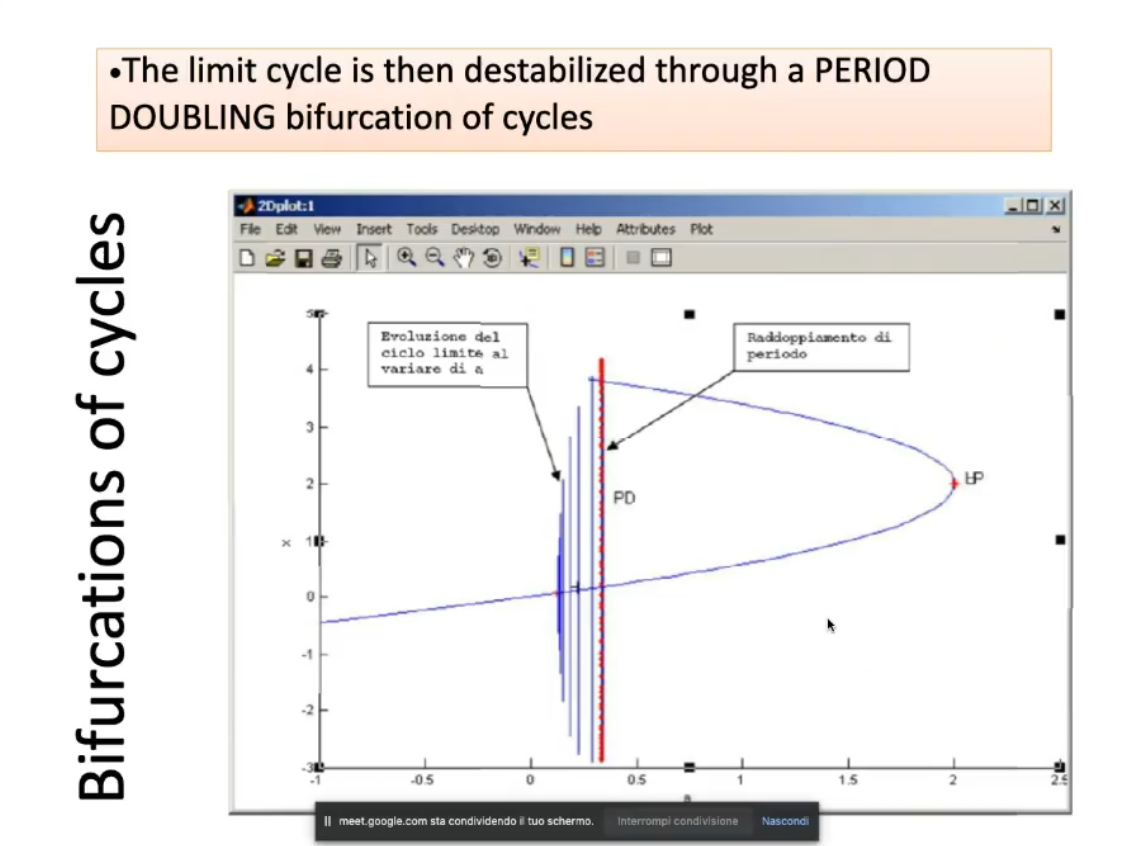
- Since as we have seen before, the limit cycle will increase its radius based on the parameter , then in this case it will intersect the saddle, we will see what happens.
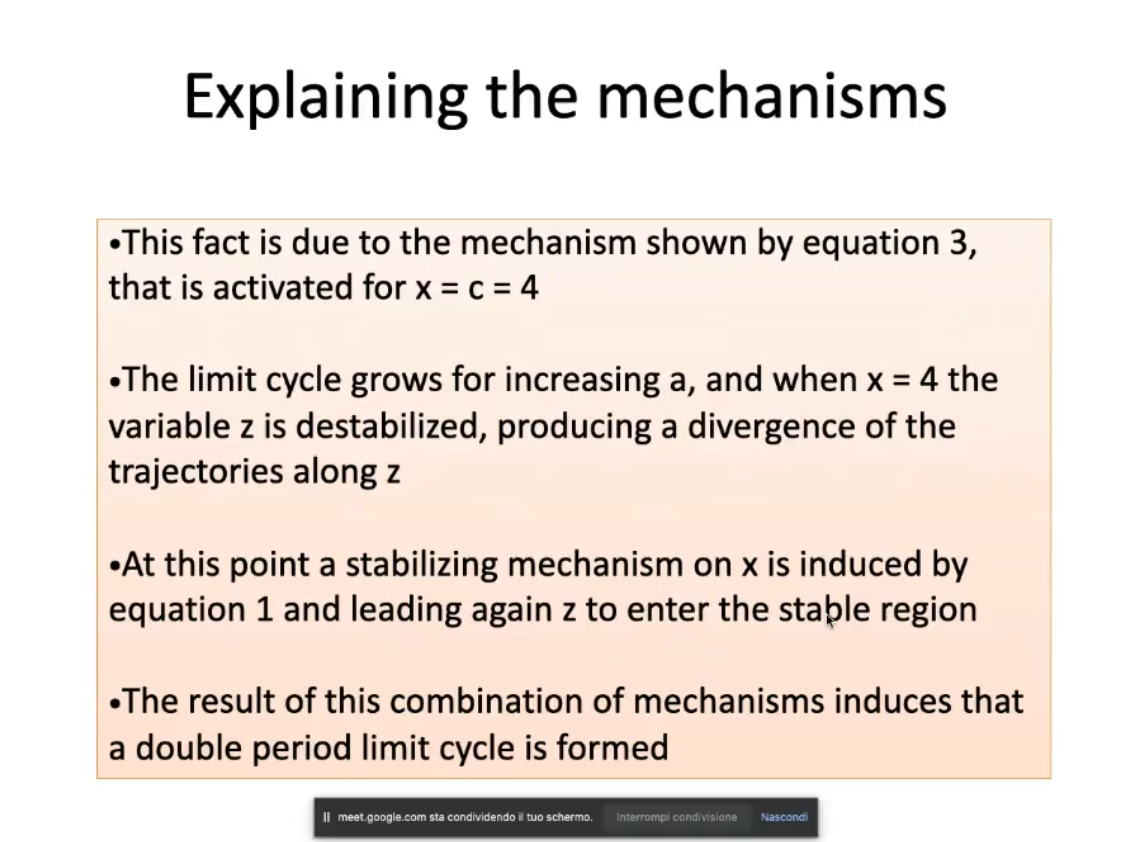
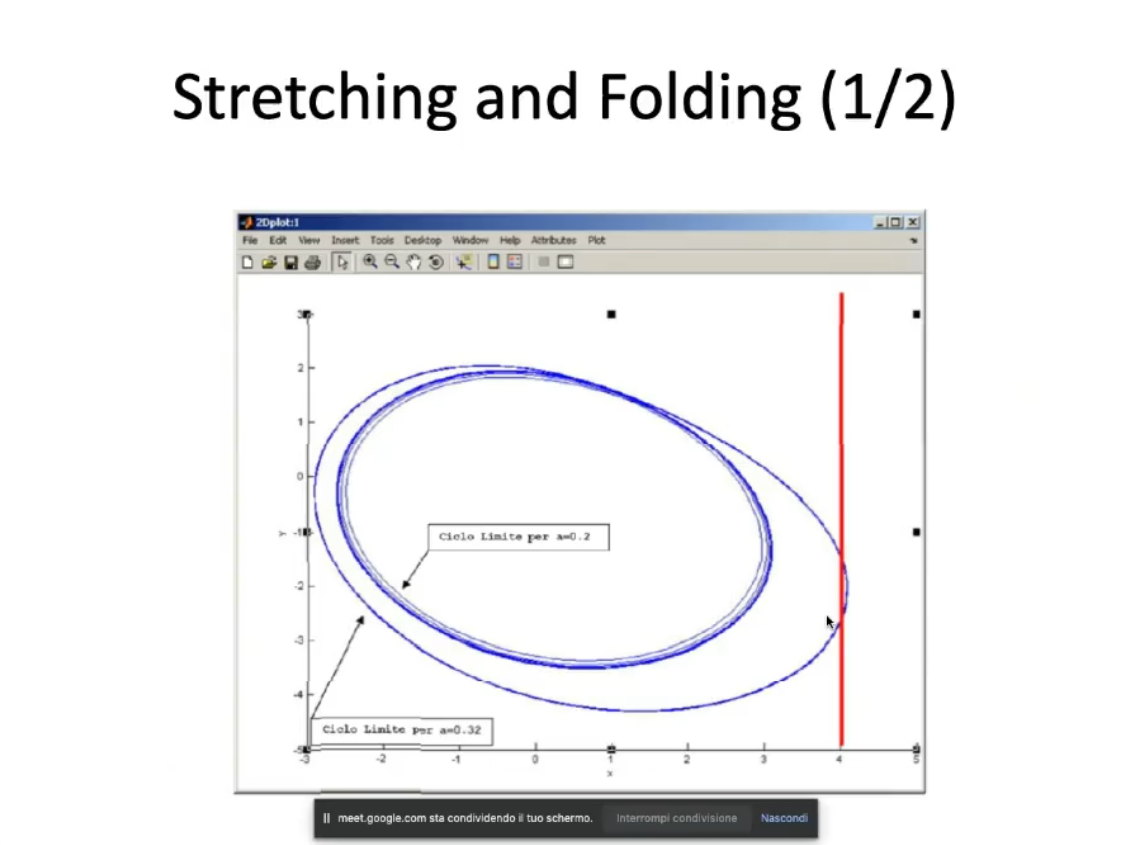
- When it reaches “a certain point” (the red bar), the it will “activate the mechanism” and “double itself”not-sure-about-this I understood this like i understood modern day yu-gi-oh.
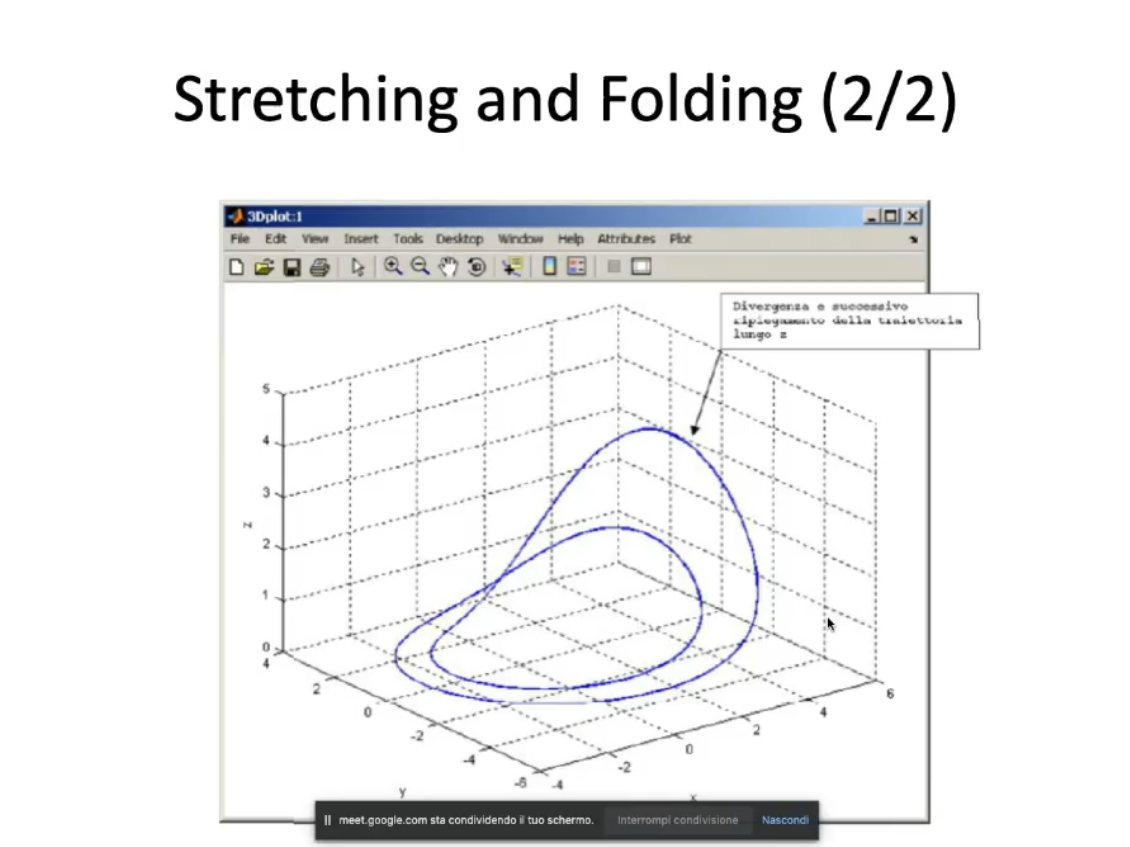
- This is the “doubled limit cycle” after “the mechanism” “was activated”.
This is formaly called a “2 period limit cycle”. - This “mechanism” will be repeated many times, and every time the limit cycle “will double itself”.
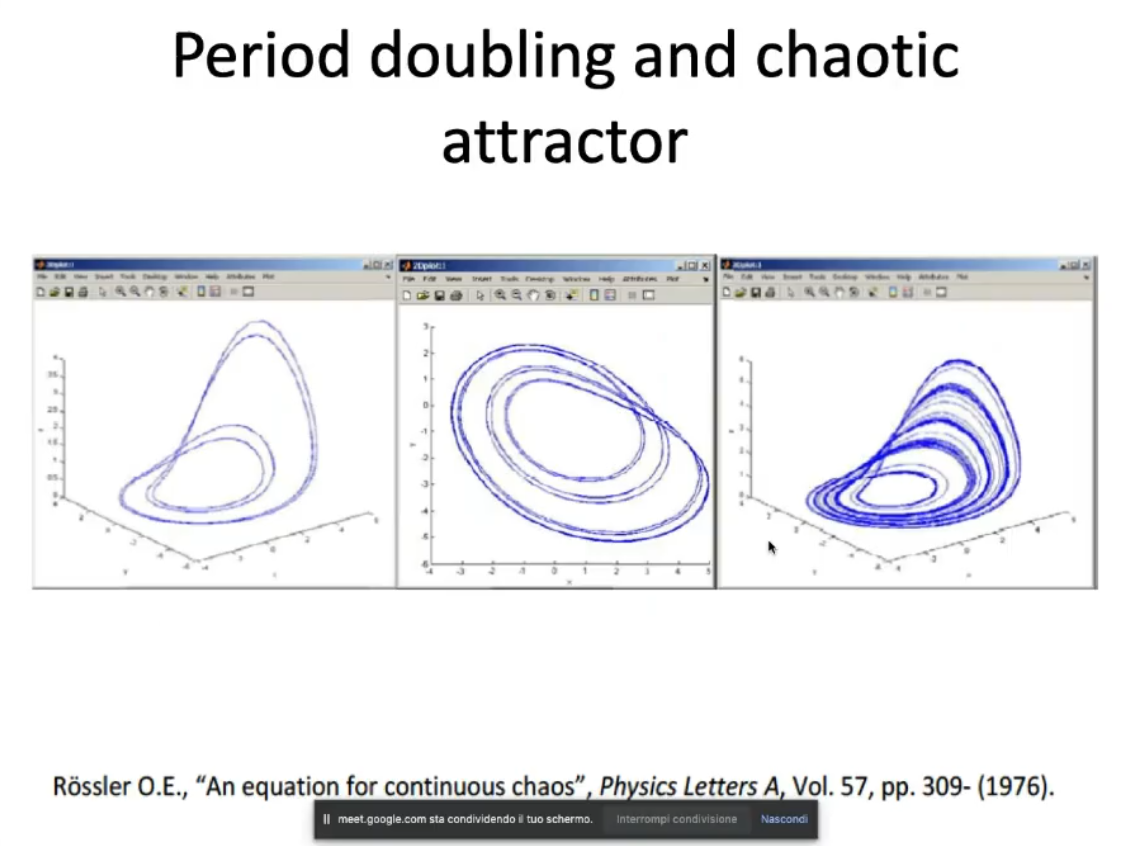
- First figure: period 4 limit cycle
- First figure: period 8 limit cycle
- First figure: chaos.
In this case no value of the phase space will be visited two times (remember that we are in 3D), so there will be no intersections in the phase space. - The shape of the chaotic case in not compleatelly irregular as you can see, it is “similar” to the other ones, but it does not have a period, it is aperiod (or chaotic).
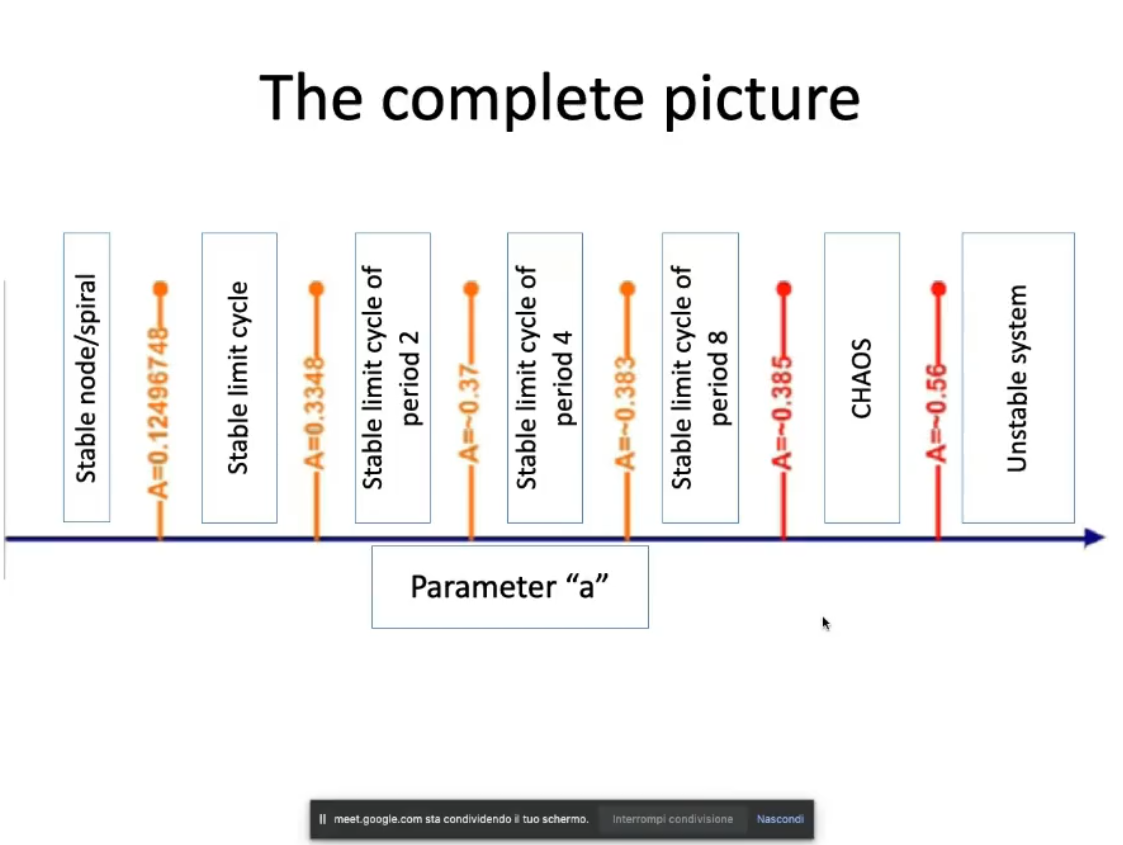
For less then a certain value we have a 1-period limit cycle: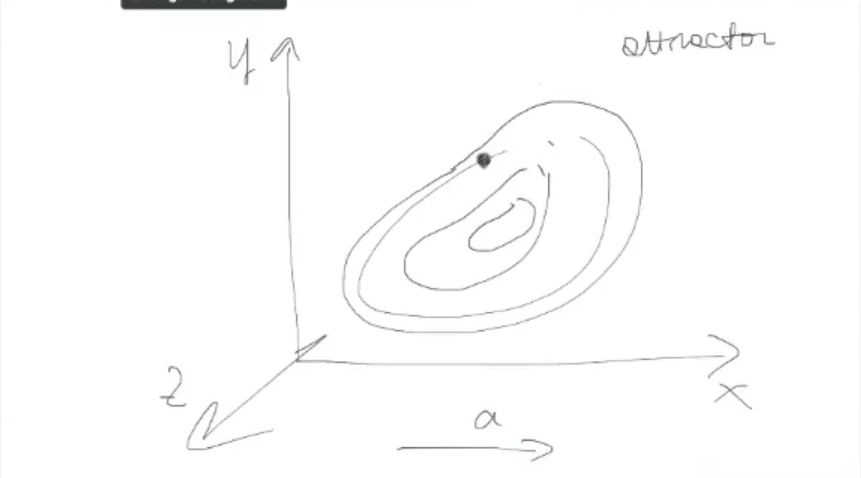
If we increase , then at a cartain point we will find a 2-period limit cycle: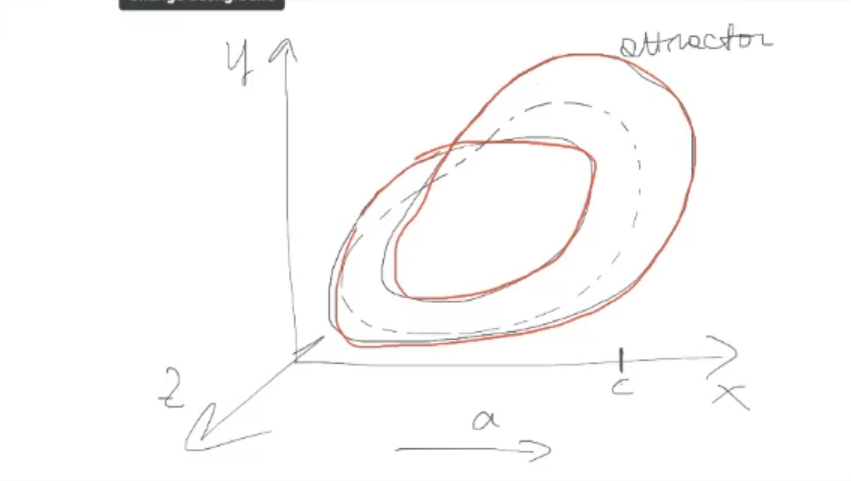
- It remains in the same “region” as the previous 1-period limit cycle.
- The old 1-period limit cycle still exists, but now, it is unstable.
This is the dynamics representation of the 1-period limit cycle: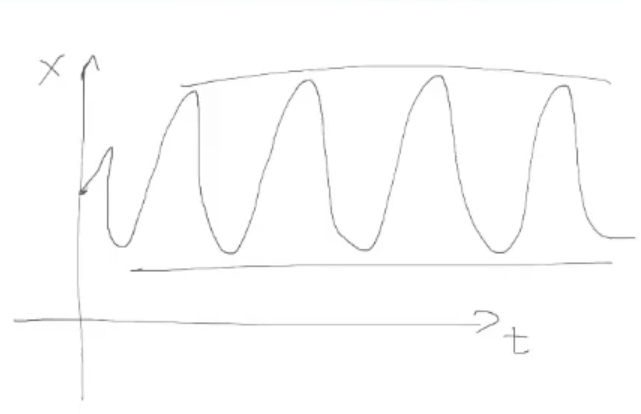
This is the dynamics representation of the 2-period limit cycle (in red):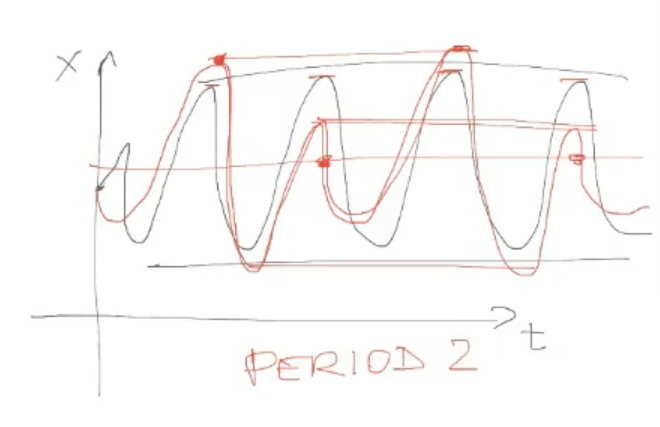
If we increase again, then at a cartain point we will find a 4-period limit cycle: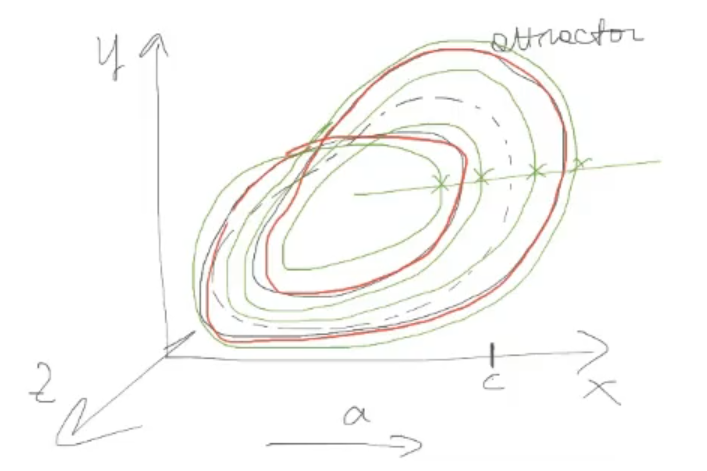
- The green straight line is there to count the intersection it has with the limit cycle.
If we count the intersections of the green-straight-line with the 1-period LC and 2-period LC: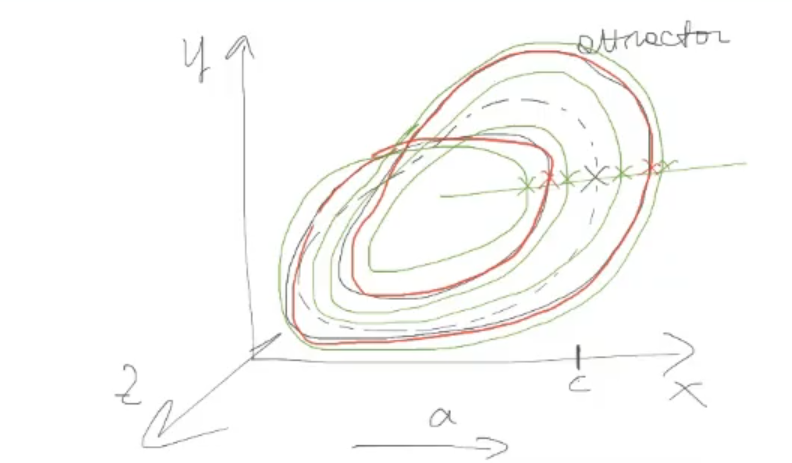
- 1 intersection with the 1-PLC (1-period limit cycle).
- 2 intersection with the 2-PLC.
Again remember that when is great enough to have a 4-PLC, then the previous 2-PLC and 1-PLC still exist, but now are unstable, similar to before: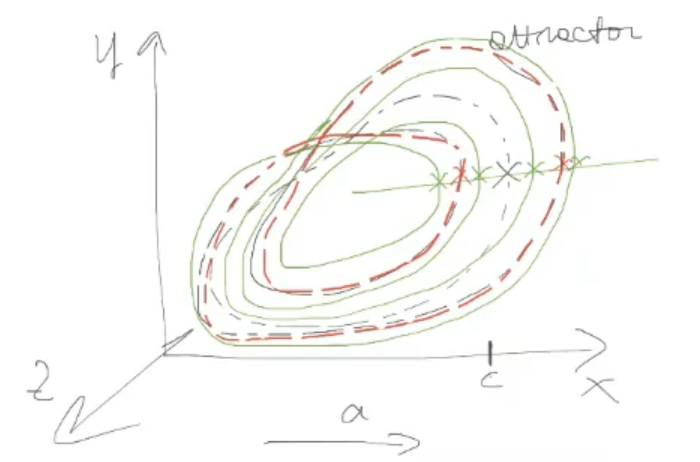
Then, If we increase again, we will have an 8-period limit cycle.
Then, If we increase again, we will have a chatic/aperiodic behaviour.
If we represent the chaotic dynamics: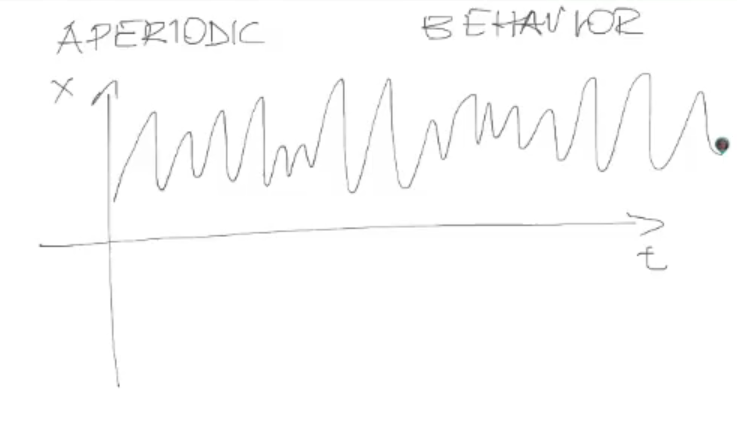
- It does not diverge, but it has NO period (aperiodic).
Now, consider another inital point, very very near the one we considered before, notice how, after a little time, the two trajectories are compleately different from one another: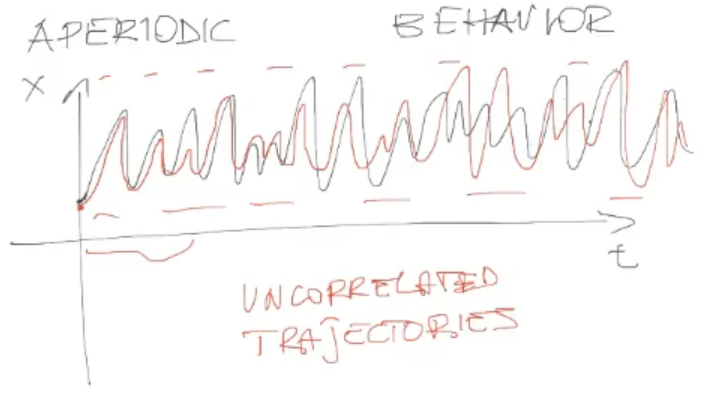
- However all trajectories will be confined in the same “region”.
Even if you start very far away: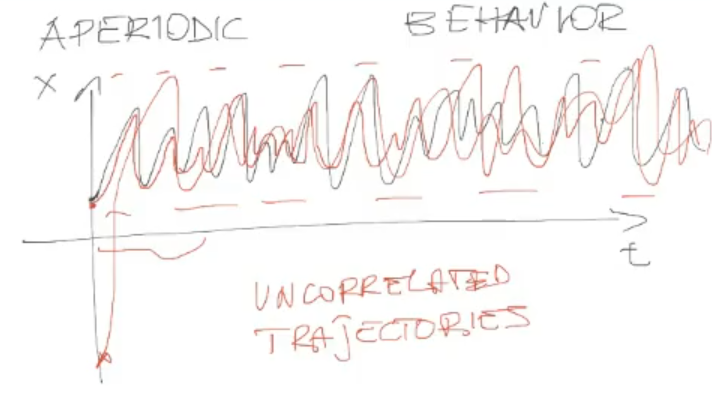
- That’s way we still talk about attractors, since the trajectors will be attracted to this region.
The fact that two almost-identical initial condictions will have very different trajectories, is defined/called “sensitivity to inital conditions” A more formal definition: “Changing by a very tiny amount the inital condition, then you will not be able to predict the future value of the trajectory”. The two trajectories will be similar only for a small time.
Finally if we increase again , we will have instability.
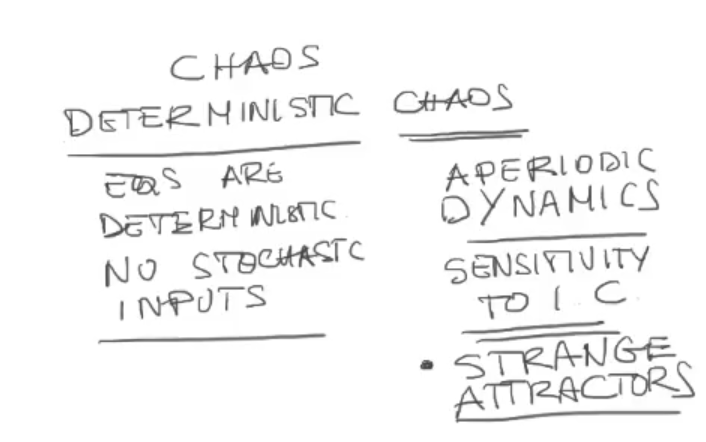
What is deterministic chaos?IMPORTANT
- Deterministic means that the equations are deterministic, there are no stochastic inputs or variables in these equations.
- Chaos is an aperiodic dynamics/behaviour, that also shows sensitivity to intial conditions, and it characterized by what are called “strange attractors”.
Chaos is possible only in non-linear systems.