Remember:
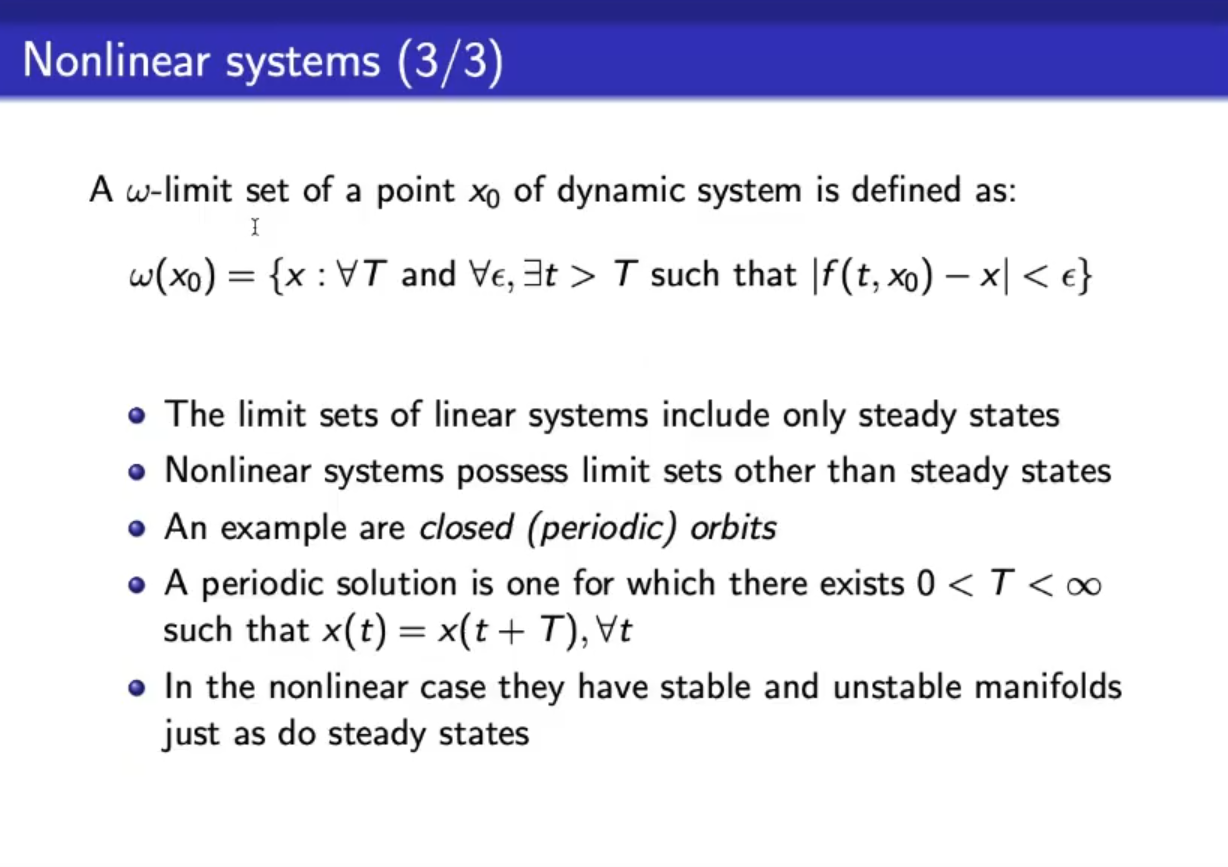
Given a non-linear system:We need to introduce the -limit set, to better define the attracting steady state and lyapunov stability, so the -limit set of a point of a dynamic system is defined as:An example are closed (periodic) orbits, a periodic solution is one for witch there exists such that: . Non-linear systems possess limit sets other than steady state (for example limit cycles), in the non-linear case they have stable and unstable manifolds jast as do steady states.
- In non-linear system we will observe that non only points can act as attractors (in linear case the stable steady state act as actractors).
In non-linear systems there can be closed curves in the phase space that can act as actrators. #IMPORTANT
And there can also be closed curves that do the opposite (like for unstable ss in linear systems)- You can imagine that in non-linear sytems the steady state can also be closed curves.
This is a possible phase space of a non-linear system:
- The red circle acts as an actractor.
- This phase space is impossible to be obtained in a linear system.
- And its representation in the dynamics graph:
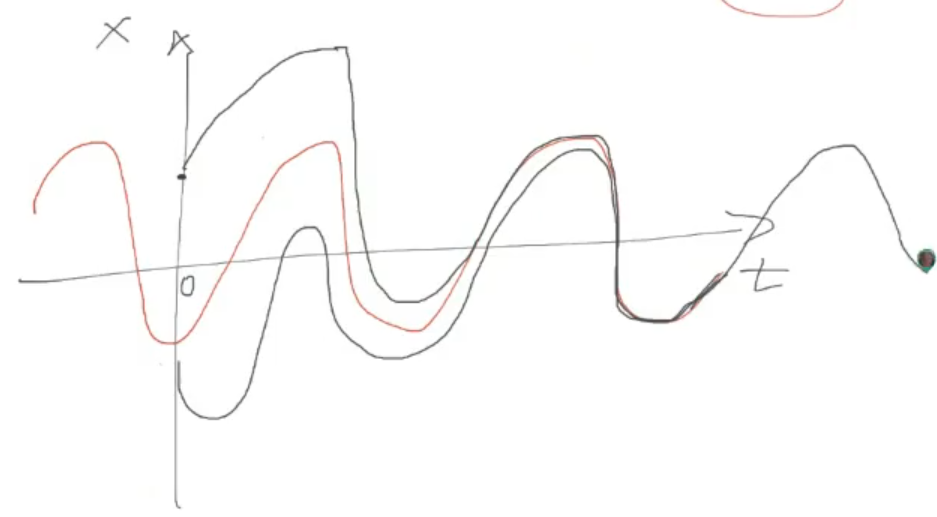
- Actracting curve, robust oscillation.
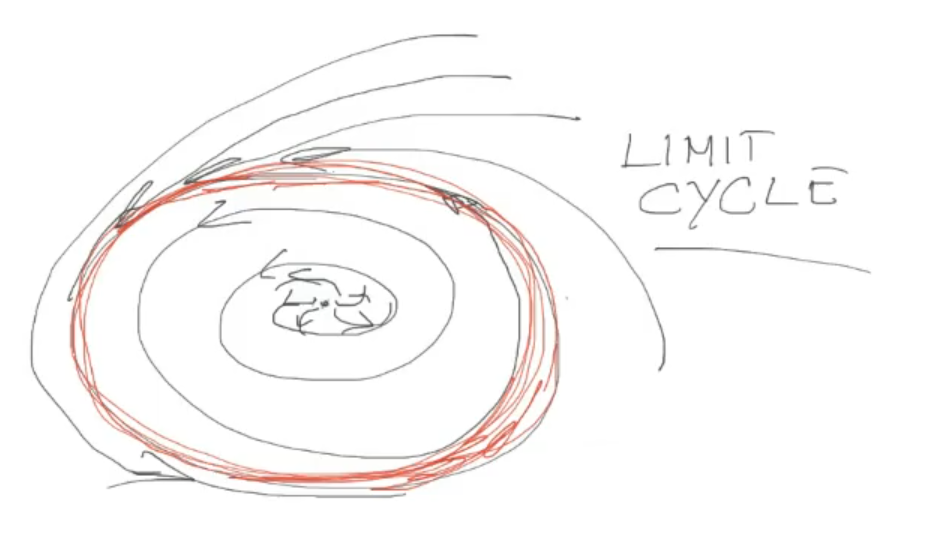
- If we focus on the actractive circle, from an initial condition INSIDE this curve:
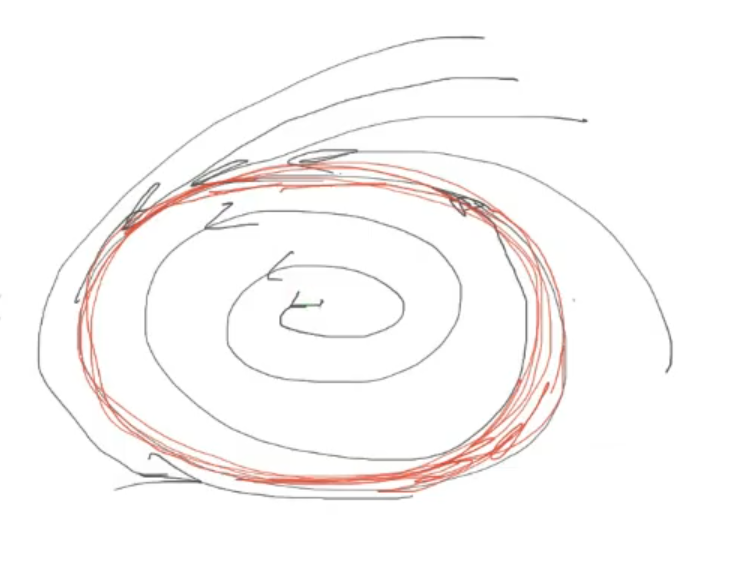
- In red the attractive circle.
- This means that at the center of the circle we need to have a **repulsive steady state **.
- This actractive curve/circle is called “limit cycle”
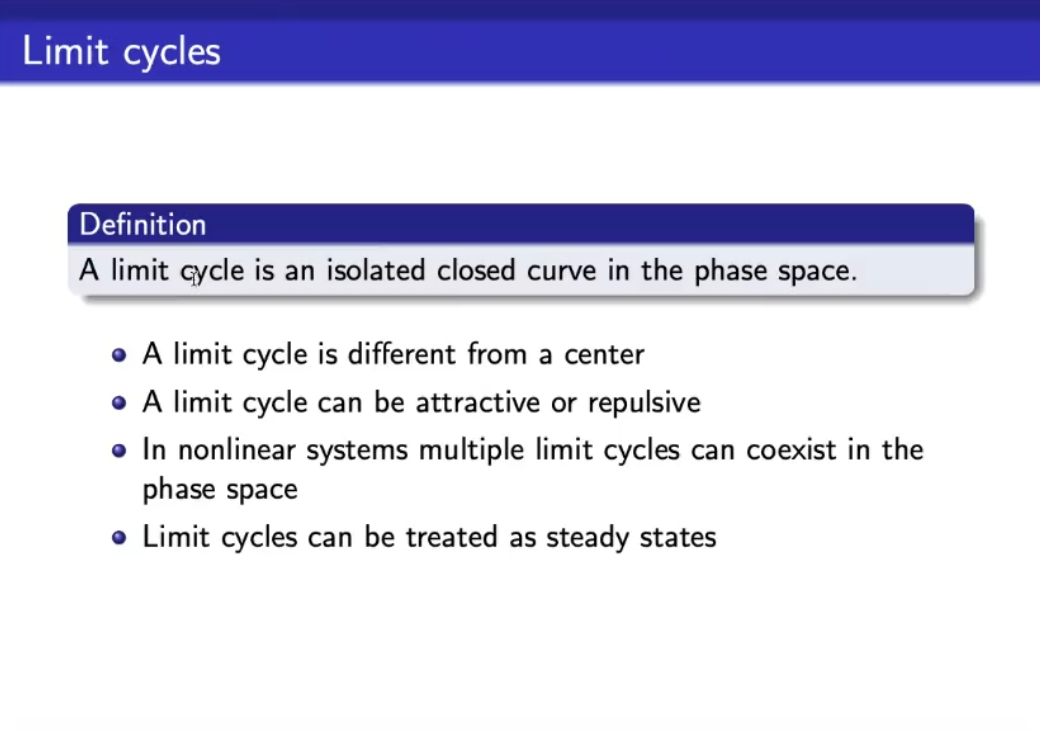
Definition ‘limit cycle’: A limit cycle is an isoltated closed curve in the phase space.
- A limit cycle is different from a center.
- A limit cycle can be attractive or repulsive.
- In the non-linear case multiple limit cycles can coexist in the phase space.
- Limit cycles can be treated as steady states.
- In the supercritical hopf bifurcation we found an attractive limit cycle.
- In the subcritical hopf bifurcation we found a repuslive limit cycle.
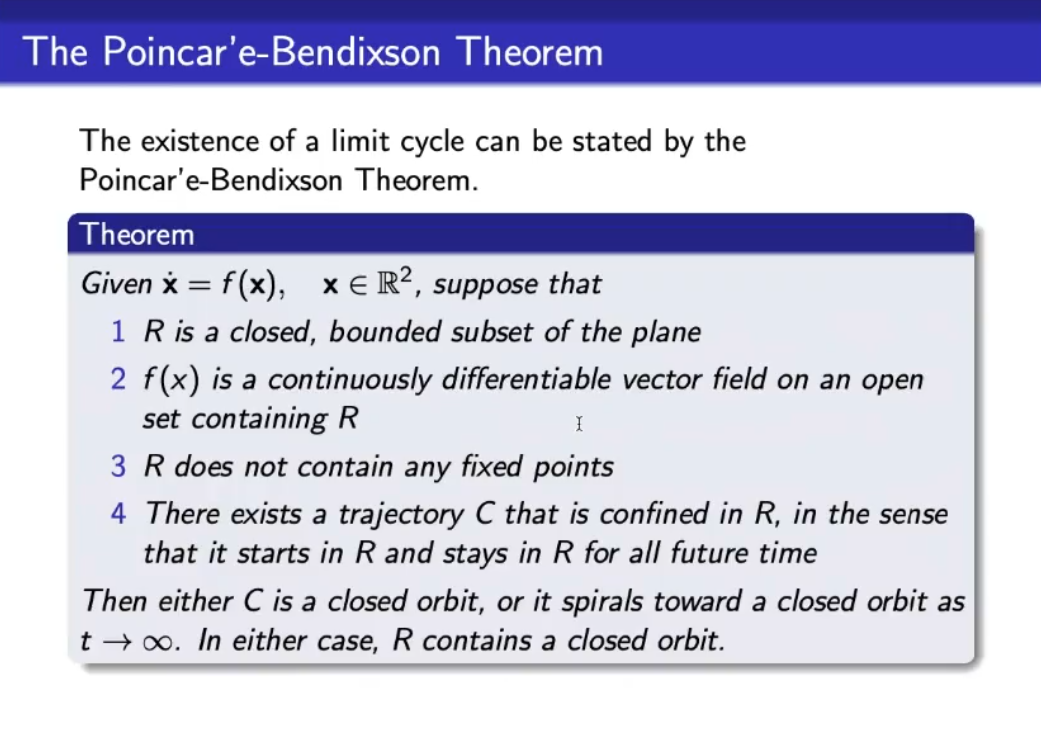
Theorem ‘Poincaré-Bendixon’: Given , and , suppose that:
- is a closed, bounded subset of the plane.
- is a continuosly differentiable vector field on an open set containing .
- does not contain any fixed points.
- There exist a trajectory that is confined in , in the sense that it starts in and stays in for all future time.
Then either is a closed orbit, or it spirals toward a closed orbit as . In either case, contains a closed orbit.
Meaning that if for the trajectory drawned in the phase space does not diverge then we are in the presence of a limit cycle.not-sure-about-this Could we be also in the presence of a chaotic system?, maybe not because for a choatic system we would need .
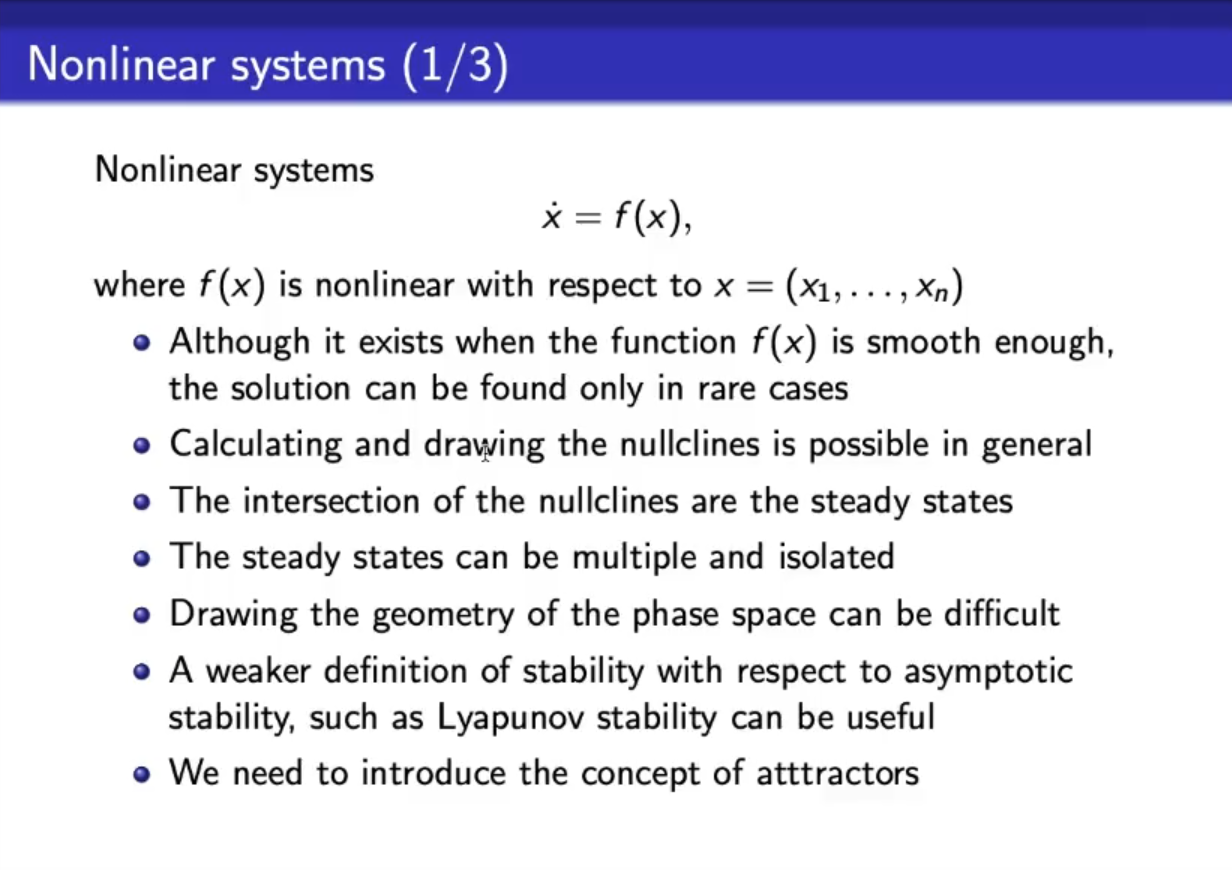
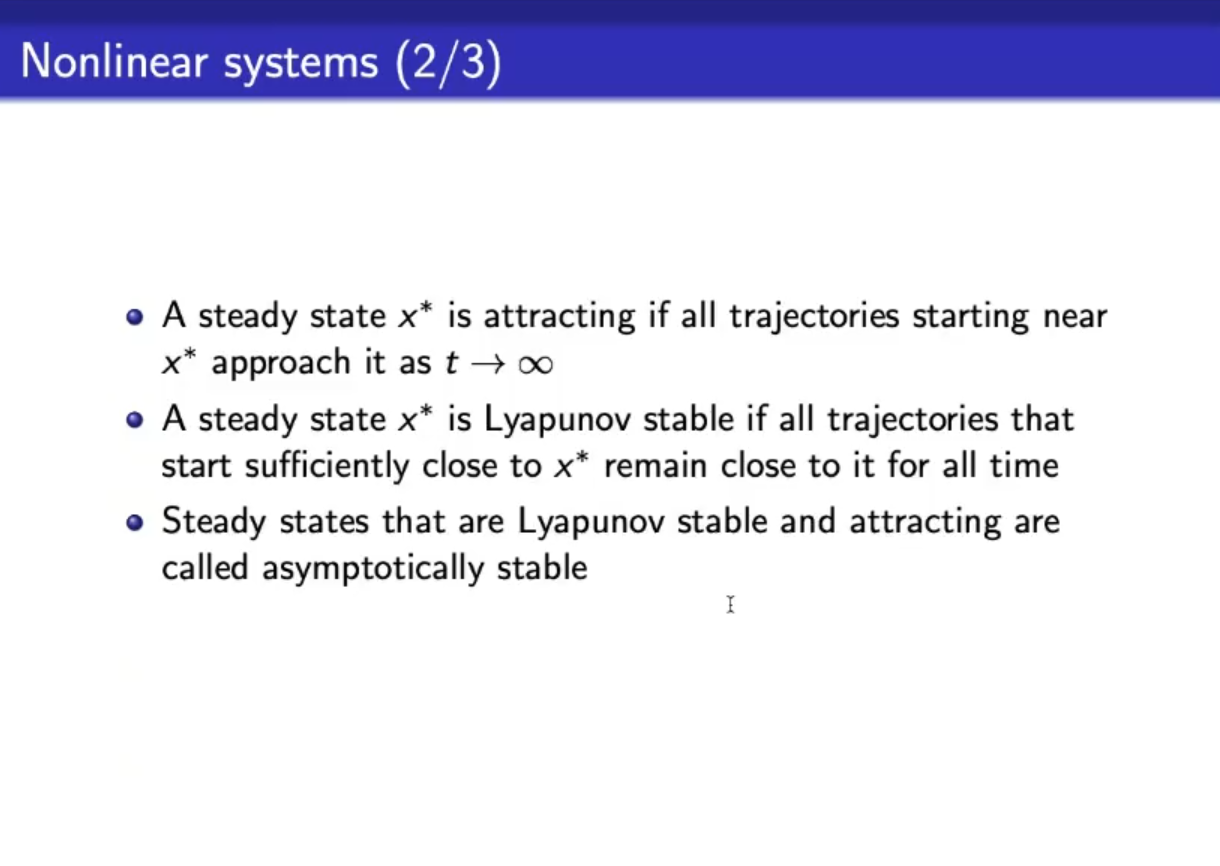
- In non-linear system we will observe that non only points can act as attractors (in linear case the stbale ss act as actractors).
In non-linear systems there can be closed curves in the phase space that can act as actrators.IMPORTANT
And there can also be closed curves that do the opposite (like for unstable ss in linear systems) - You can imagine that in non-linear sytems the steady state can also be closed curves.
This is a possible phase space of a non-linear system: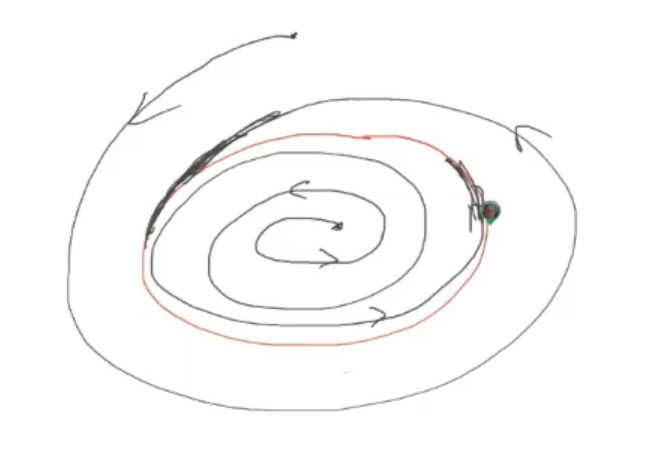
- The red circle acts as an actractor.
- This phase space is impossible to be obtained in a linear system.
And its dynamics representation:
- Actracting curve, robust oscillation.
If we focus on the actractive circle, from an initial condition inside this curve:
- In red the actractive circle.
- This means that at the center of the circle we need to have a repulsive ss.
- This actractive curve/circle is called “limit cycle”:
- In the supercritical hopf bifurcation we found an attractive limit cycle.
- In the subcritical hopf bifurcation we found a repuslive limit cycle.
Let’s try with an example: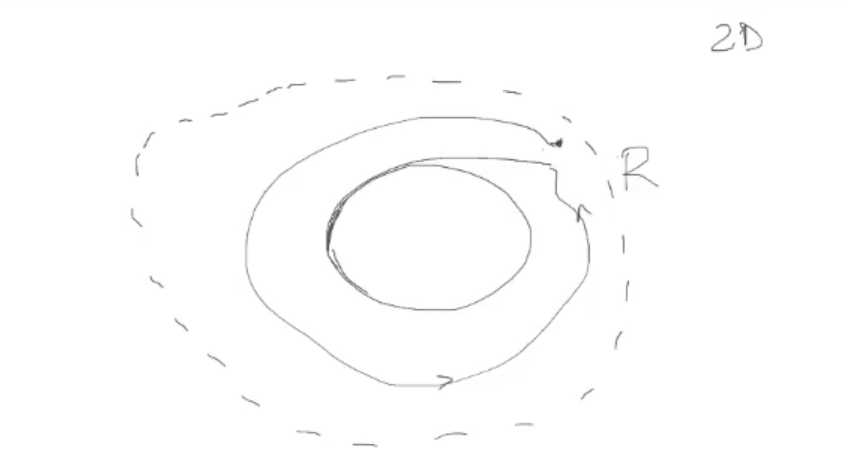
- Suppose we have an initial condition that given infinite time always stays in a substet , and in this subset there are NO steadys states, then the Poincar’è-Bandixosn Theorem assures us that the system will converge to a limit cycle.
- NOTE: the hopf bifurcations both presents steady states (in ), however for those cases we can still use this theorem, we just “remove” a closed curve near the ss, like so:
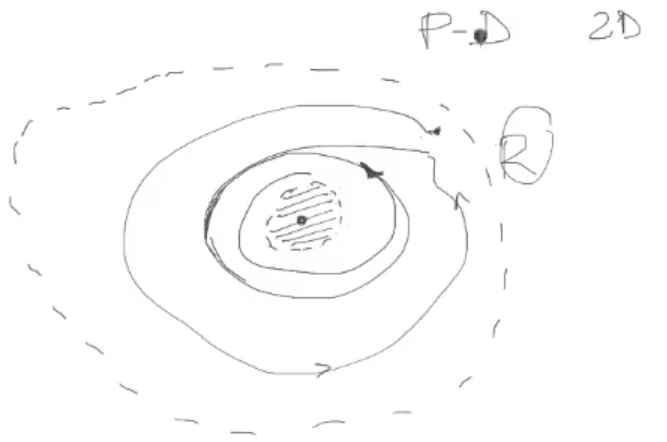
- But now is an open subset ????not-sure-about-this