Remember:
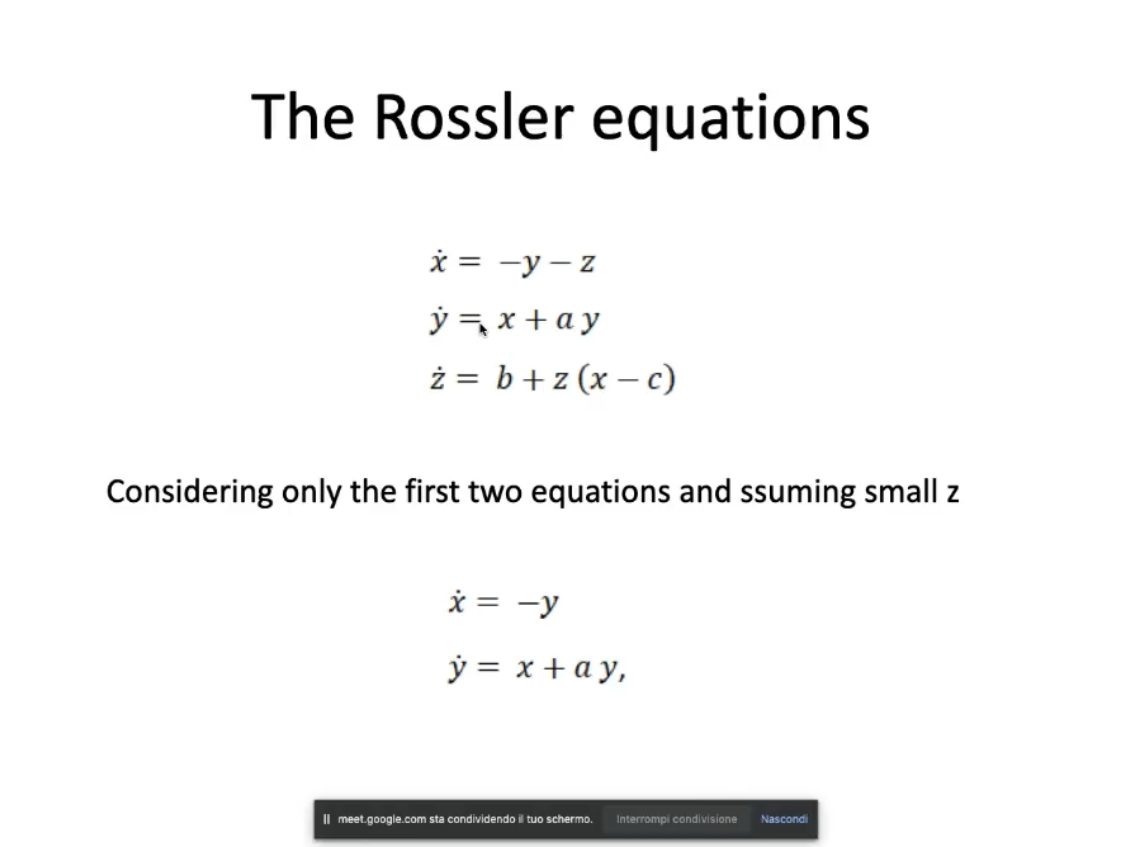
The Rossler Syttem:
We first study the reduced system:Where we consider is really small. Which is similar to what we have seen in the pendulum example. With eigenvalues:We have that:
- For the oscillator is unstable.
- Morover the orgin is an unstable spiral.
In 3 dimensional space, this reduced system induces the “strethcing mechanism”, typical of chaotic system. But to introduce proper chaos we need also a “folding mechanism”, this mechanism is introduced by the third equation.
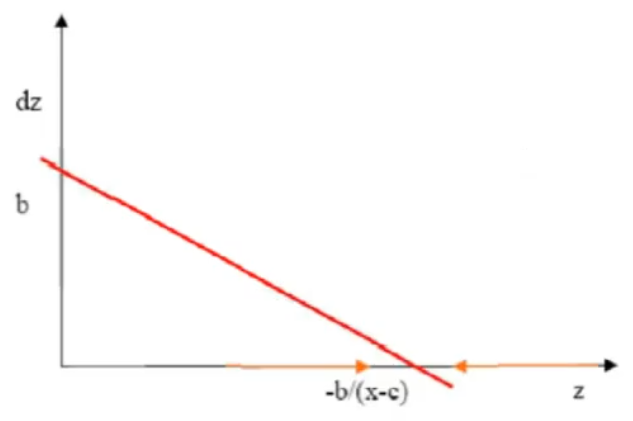
The folding is produced by the term associeted to parameter in the third equation. Consider only the equation for : If we analyze its vector field:
- The steady state is stable. (if it exists, so for )
Then we can analyze the whole system and say:not-sure-about-this
- For : the coefficient of in the equation is negative.
- For : the coefficient of in the equation is positive and the system diverges.
Assume now the complete Rossler system as mentioned before, and let’s fix and , then the system will have 2 steady states:If or , then the steady states will be imaginary (they disappear).
Also, for the two steady states will coincide.
⇒ Then we can say that this is a saddle-node bifurcation.
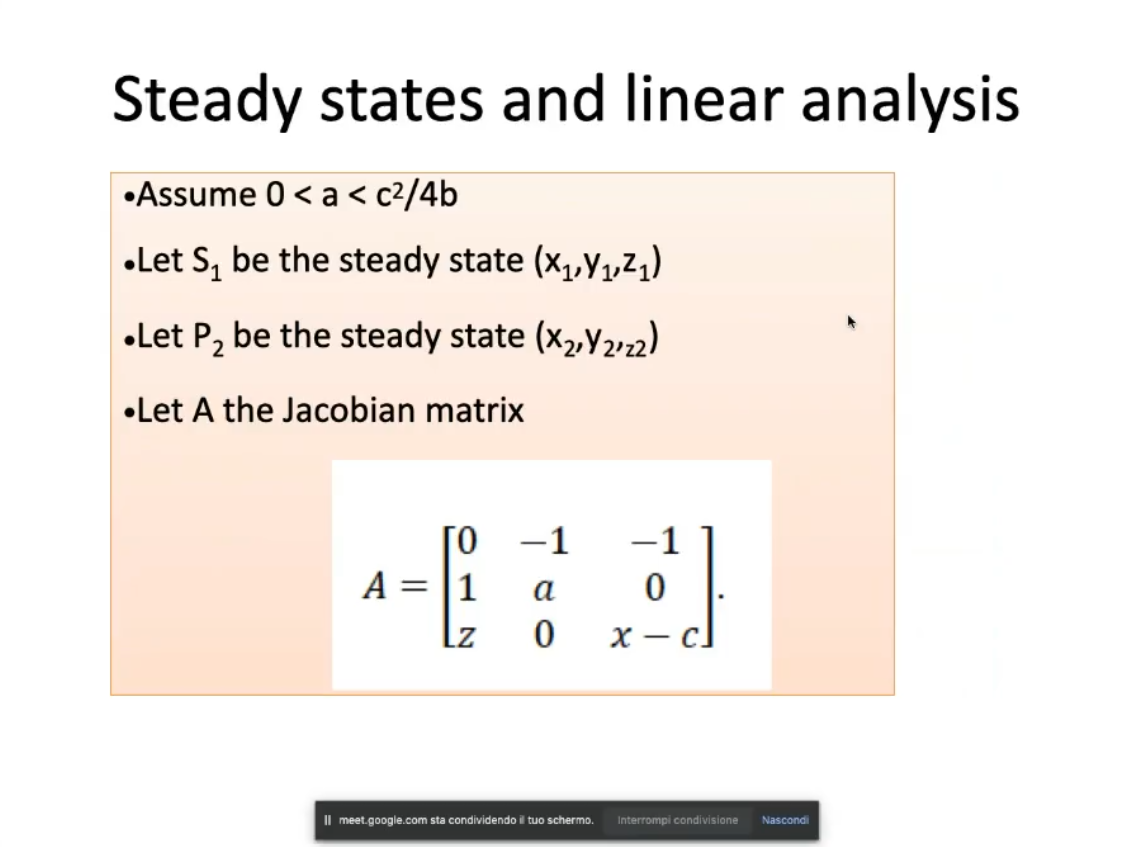
If we perform the linearization, we will find the follwing Jacobian MatrixIf we draw the bifurcation diagram:
Where:
- (this steady state is a saddle since it has 3 real eigenvalues with opposite signs)
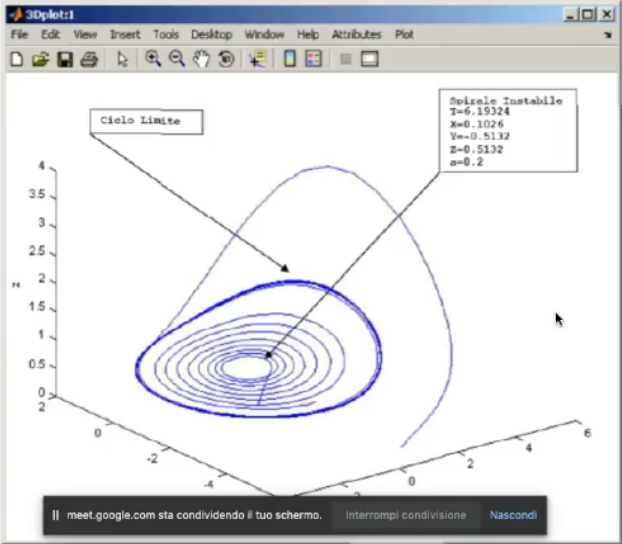
The steady state is a stable spiral for and becomes an unstable spiral for . For an supercritical hopf bifurcation occurs:
A stable limit cycle is formed through the Hopf bifurcation:
Now, if we increase again the limit cycle will then distabilize and go through a period doubling bifurcation:
The limit cycle will increase its radius based on the parameter .
Then in this case it will “intersect the saddle”, and it will double its period, meaning:
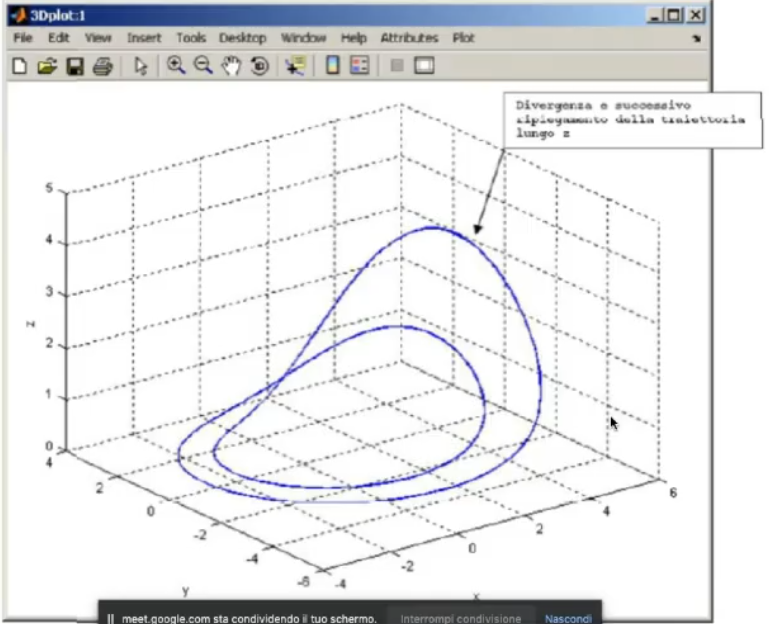
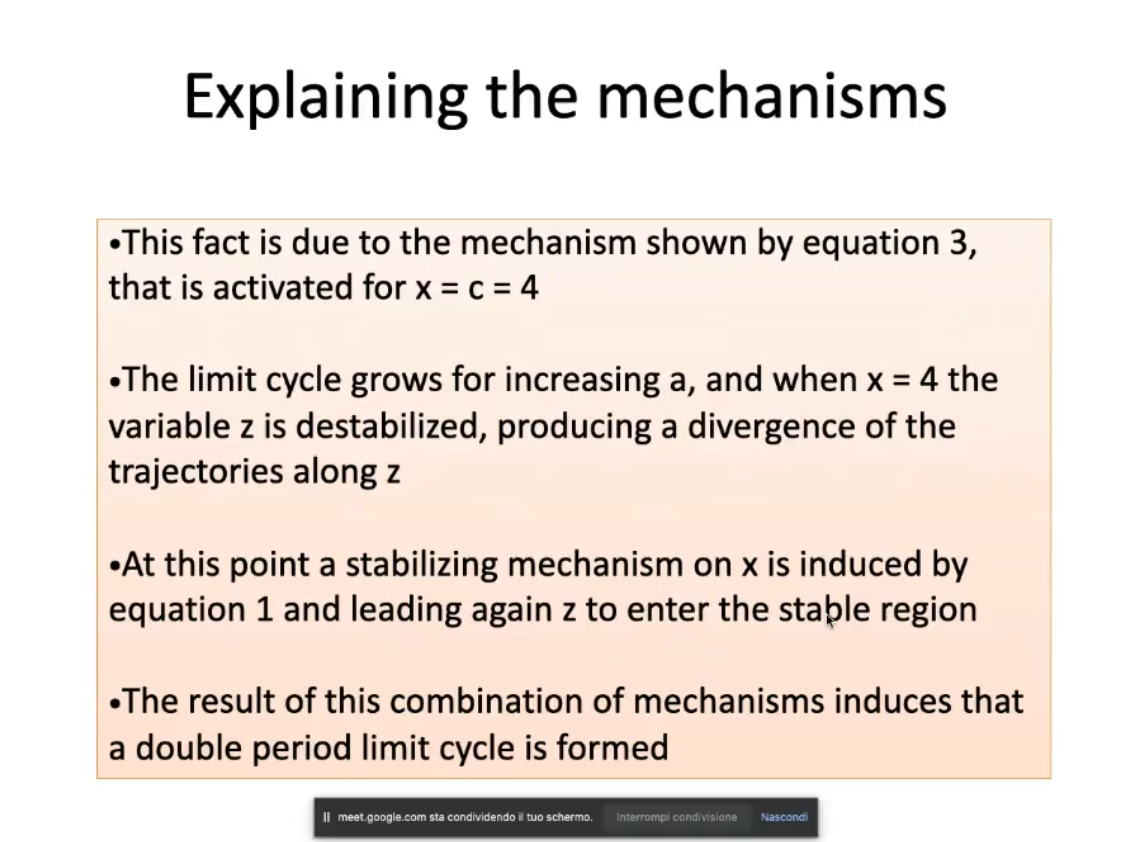
Explaining the mechanism:
- Due to the mechanism shown by the 3rd equation, that is activated for , (in this case we have fixed ), we will have that the variable will be destablezied, remember that the steady state from the 3rd equation is:
- At this point a stabilizeing mechanism on is induced by the 1st equation and leading again to enther the stable region.
- The result is that the combination of these mechanisms will induce a double period limit cycle.
This “doubling period mechanism” will be repeated many times, and every time the limit cycle “will double itself”:
- First figure: period 4 limit cycle
- Second figure: period 8 limit cycle
- Third figure: chaos.
In this case no value of the phase space will be visited two times (remember that we are in 3D), so there will be no intersections in the phase space.
The shape of the chaotic case in not compleatelly irregular as you can see, it is “similar” to the other ones, but it does not have a period, it is aperiod (or chaotic).
Rember also that after a period doubling the previos limit cycle does not disappear, instead becomes unstable: After the first period doubling:
After the second period doubling:
If we consider the dynamics: 1-period limit cycle:
2-period limit cycle:
Chaos:
We will see a better definition for “sensitivity to initial conditions”, but know this, for this system, when it is in chaotic regime, if we take two EXTREAMLY close initial conditions, this will be their dynamics:
The fact that two almost-identical initial condictions will have very different trajectories, is defined/called “sensitivity to inital conditions” A more formal definition: “Changing by a very tiny amount the inital condition, then you will not be able to predict the future value of the trajectory”. The two trajectories will be similar only for a small time.
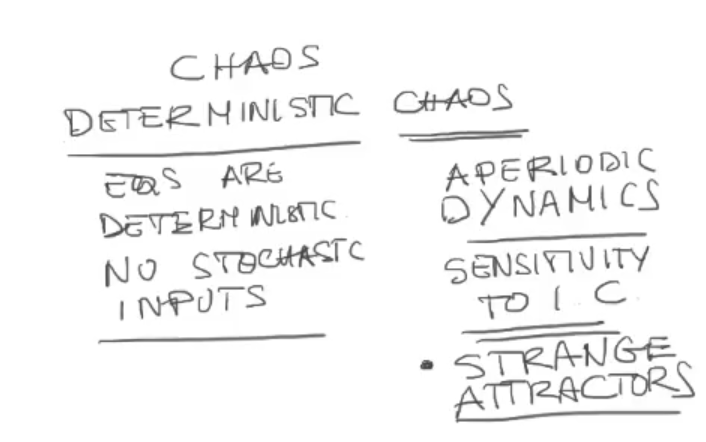
What is deterministic chaos?IMPORTANT
- Deterministic means that the equations are deterministic, there are no stochastic inputs or variables in these equations.
- Chaos is an aperiodic dynamics/behaviour, that also shows sensitivity to intial conditions, and it characterized by what are called “strange attractors”.
- Also remember that chaos is possible only in non-linear systems.
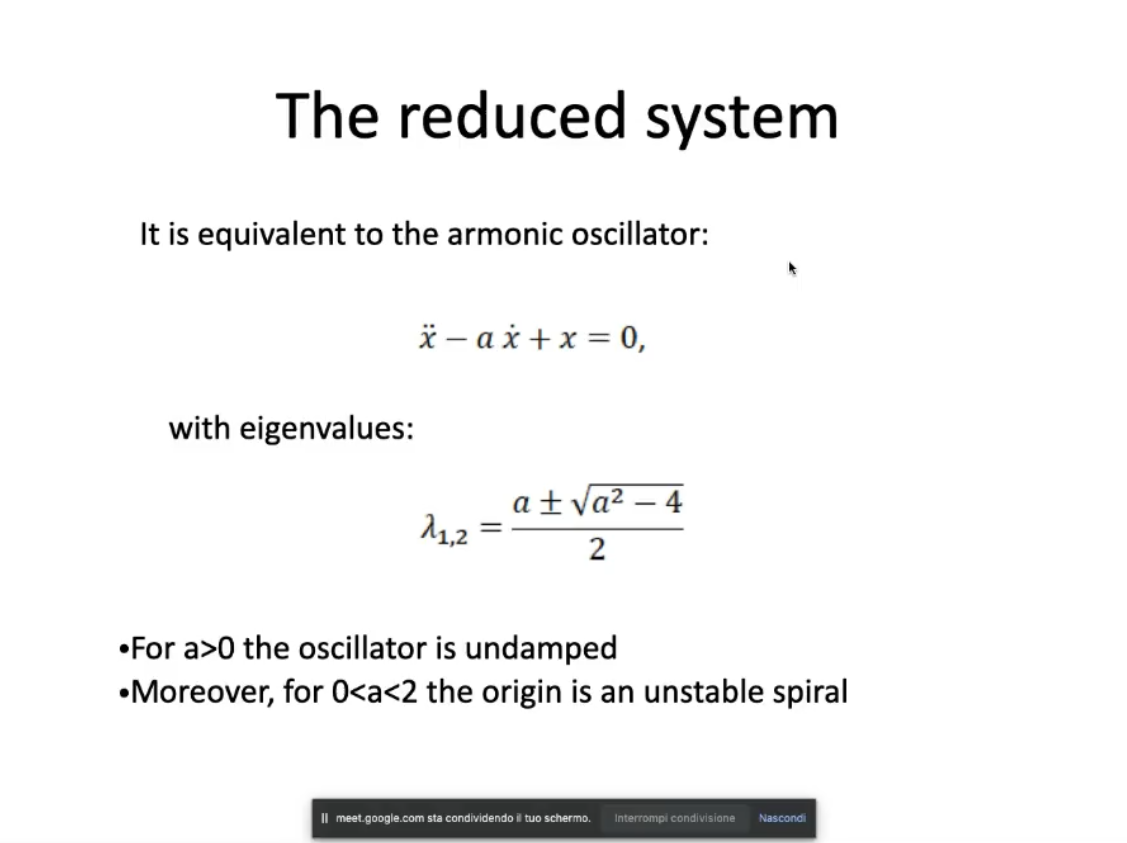
- “undamped” = unstable
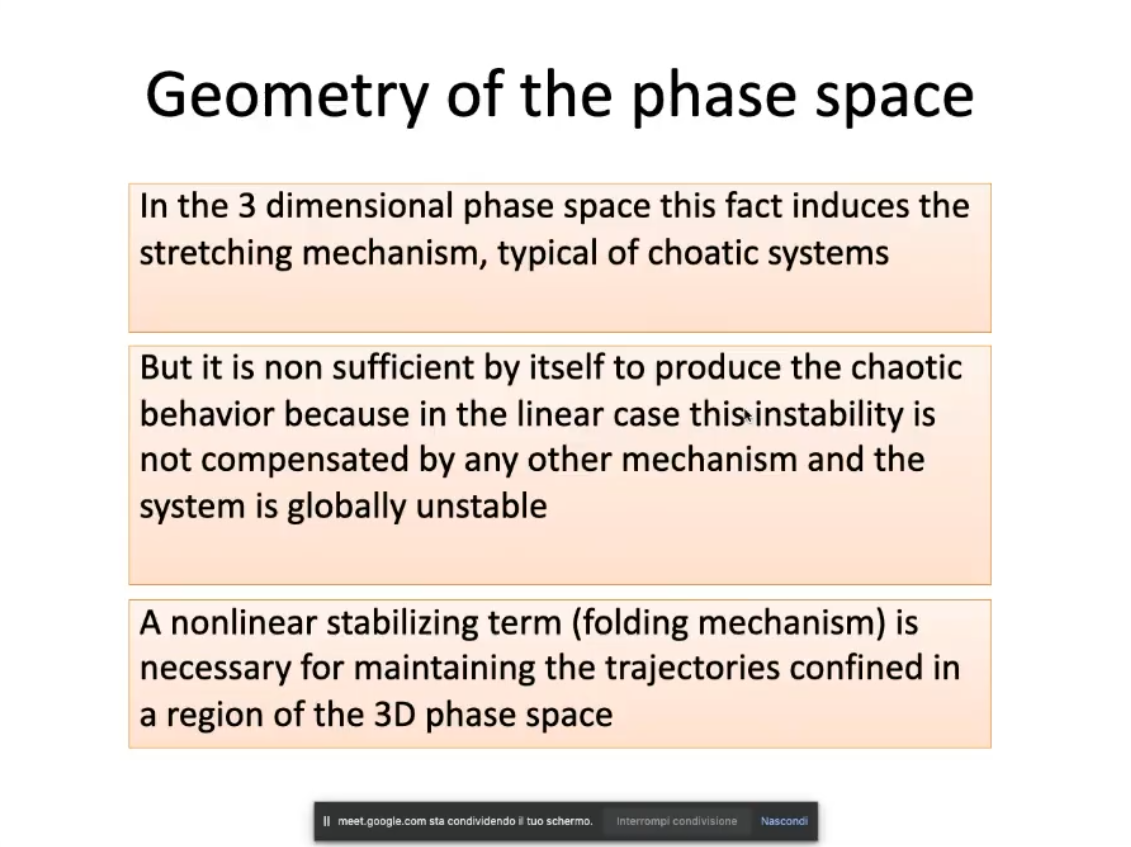
- First idea about chaos.
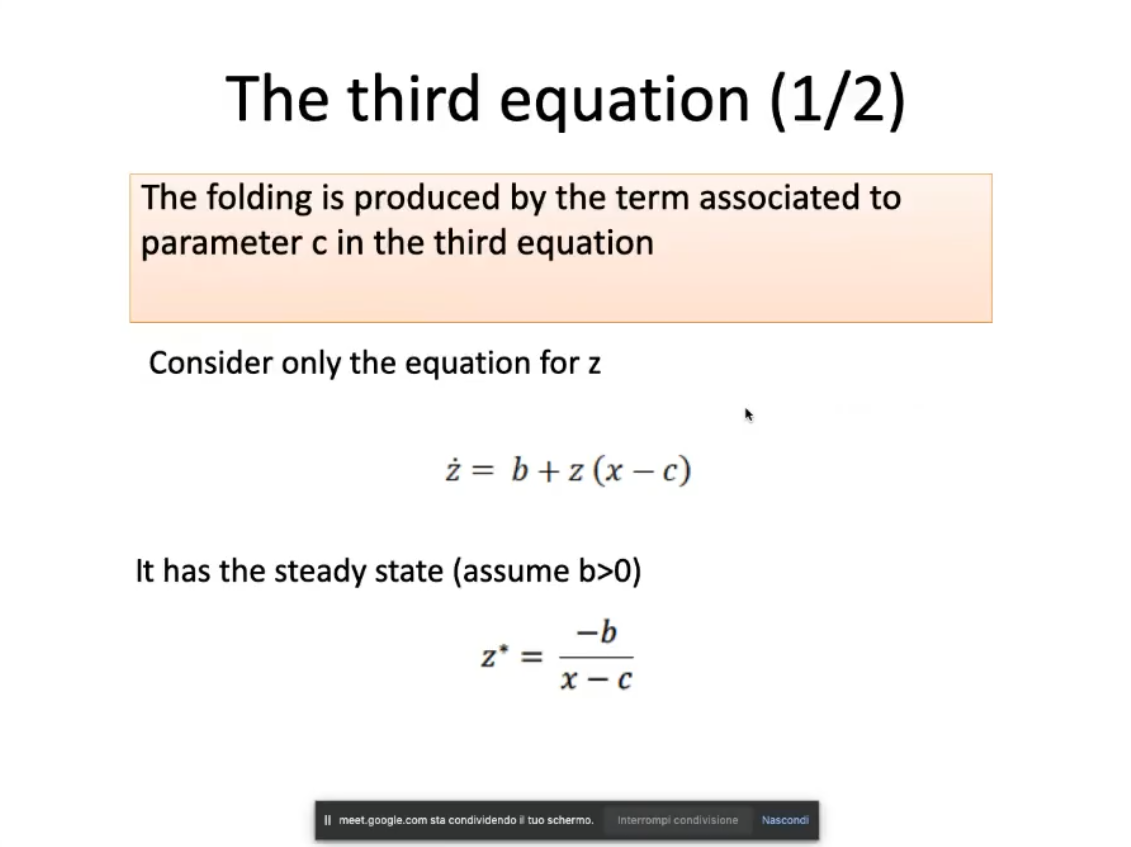
- Fix the sign of , for simplicity.
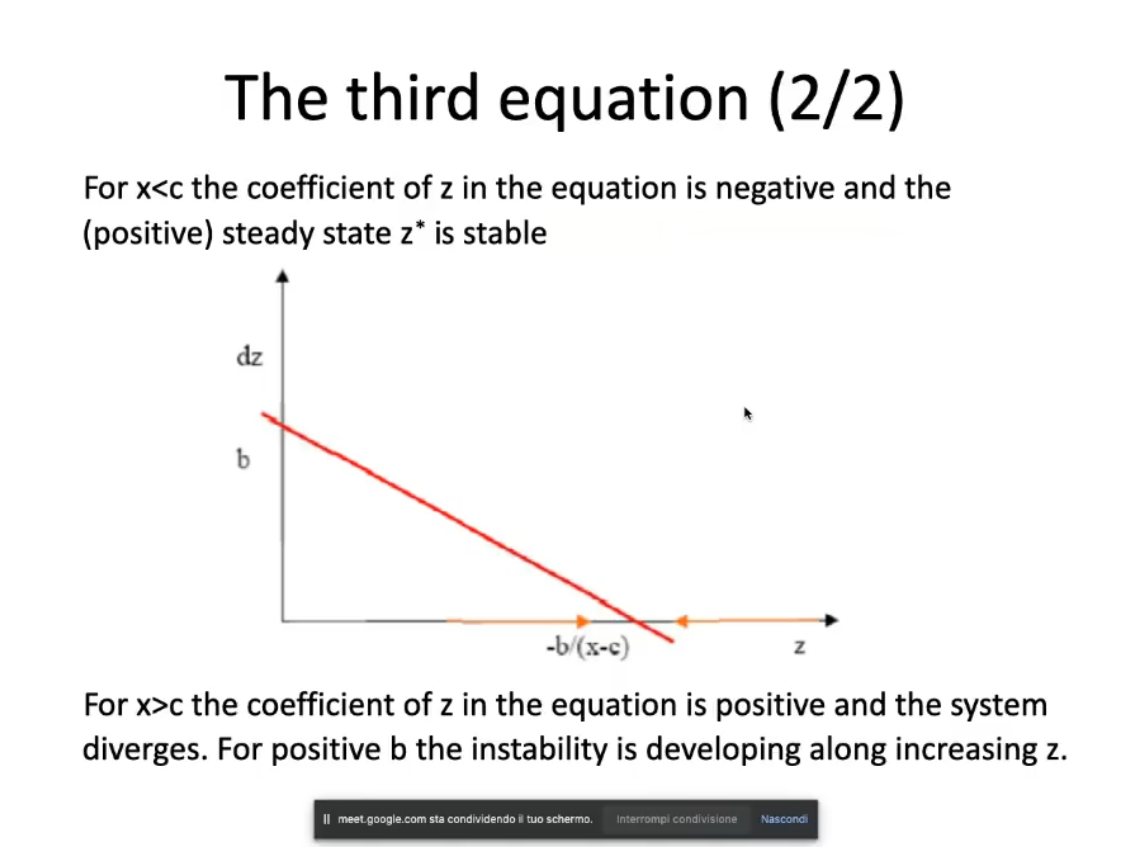
- So the ss is an attractor.not-sure-about-this is it always an attractor???
- So the third equations acts as a stabilizer depending if .
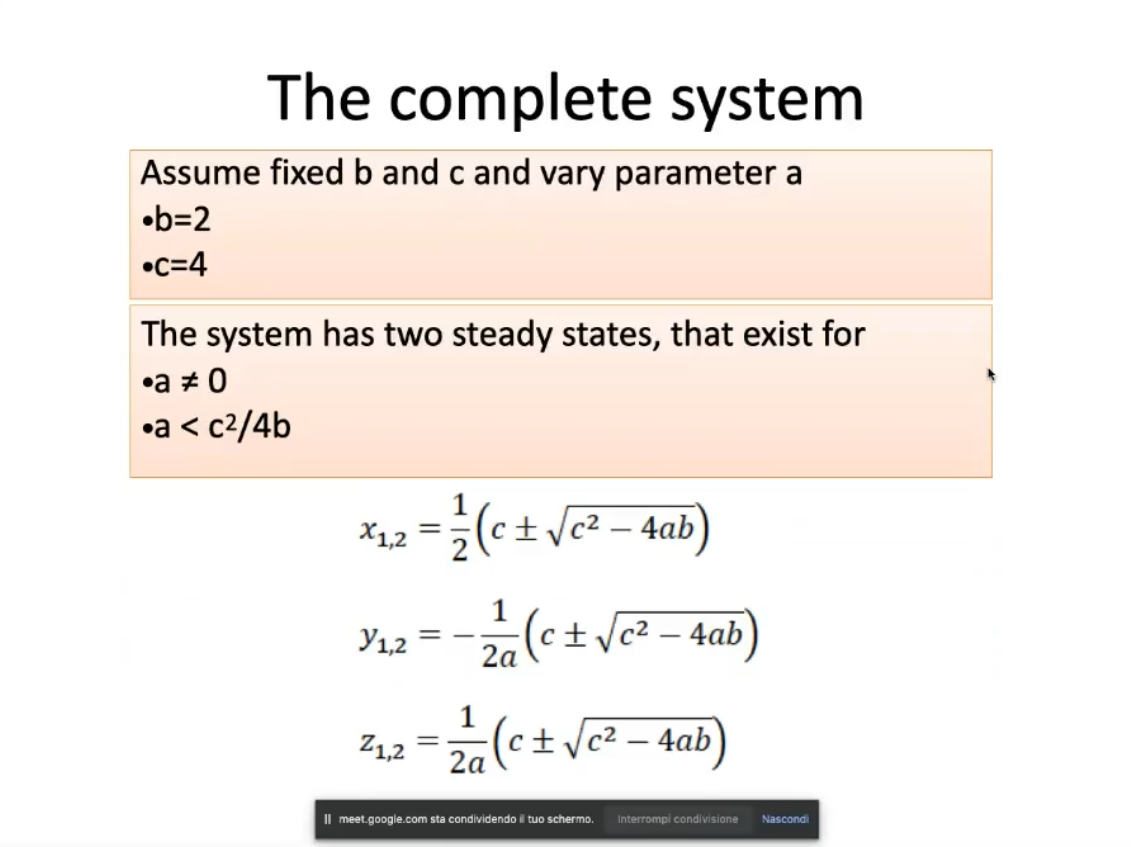
- If or , then the ss will be imaginary.
Also, for the two ss will coincide.
⇒ Then we can say that this is a saddle-node bifurcation.
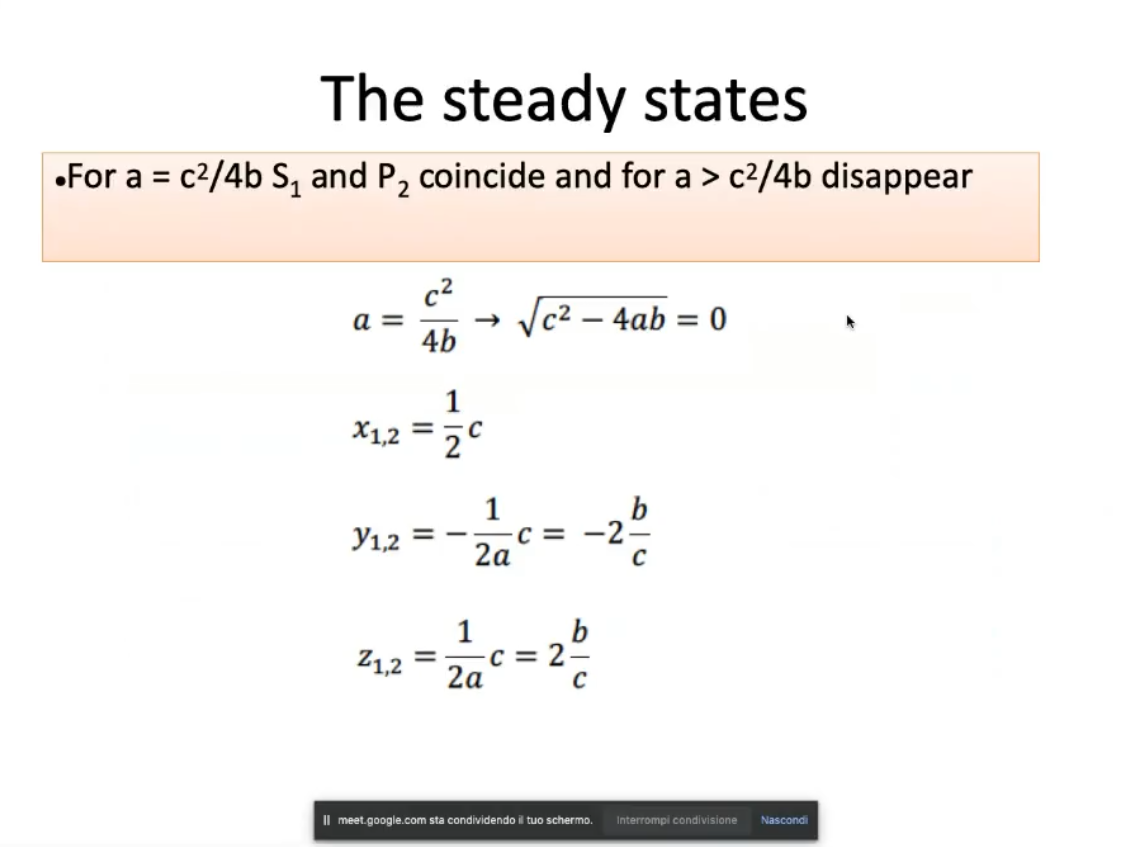
- Here we can see, like we already said that for the two ss will coincide.
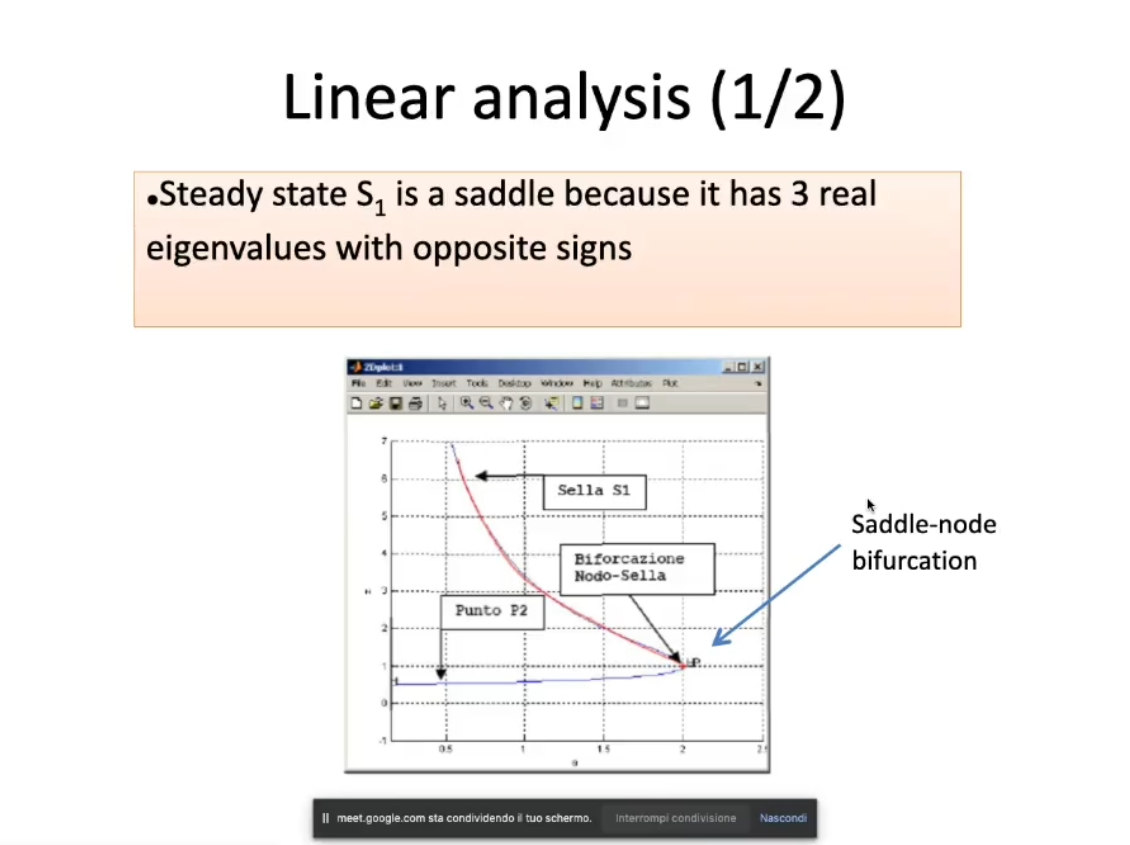
- And like we said previously this is a saddle-node bifurcation.
- As we move the numerical values of the steady states will vary, this graph represents this movement/variation, remember that , and are fixed.
Just to be more clear, in this graph the x-axis represents the values of .
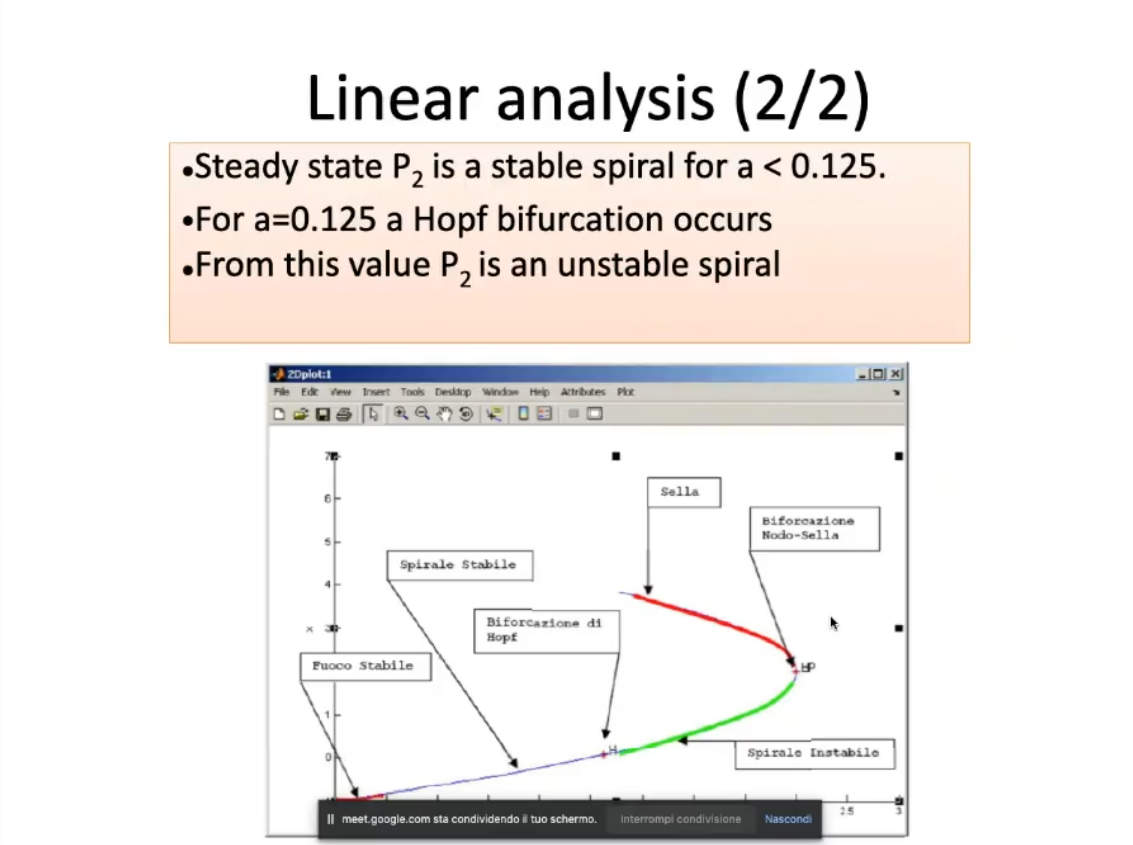
- This is a zoom of the previous graph.
- This will give rise to a supercritical hopf bifurcation (in 3D)
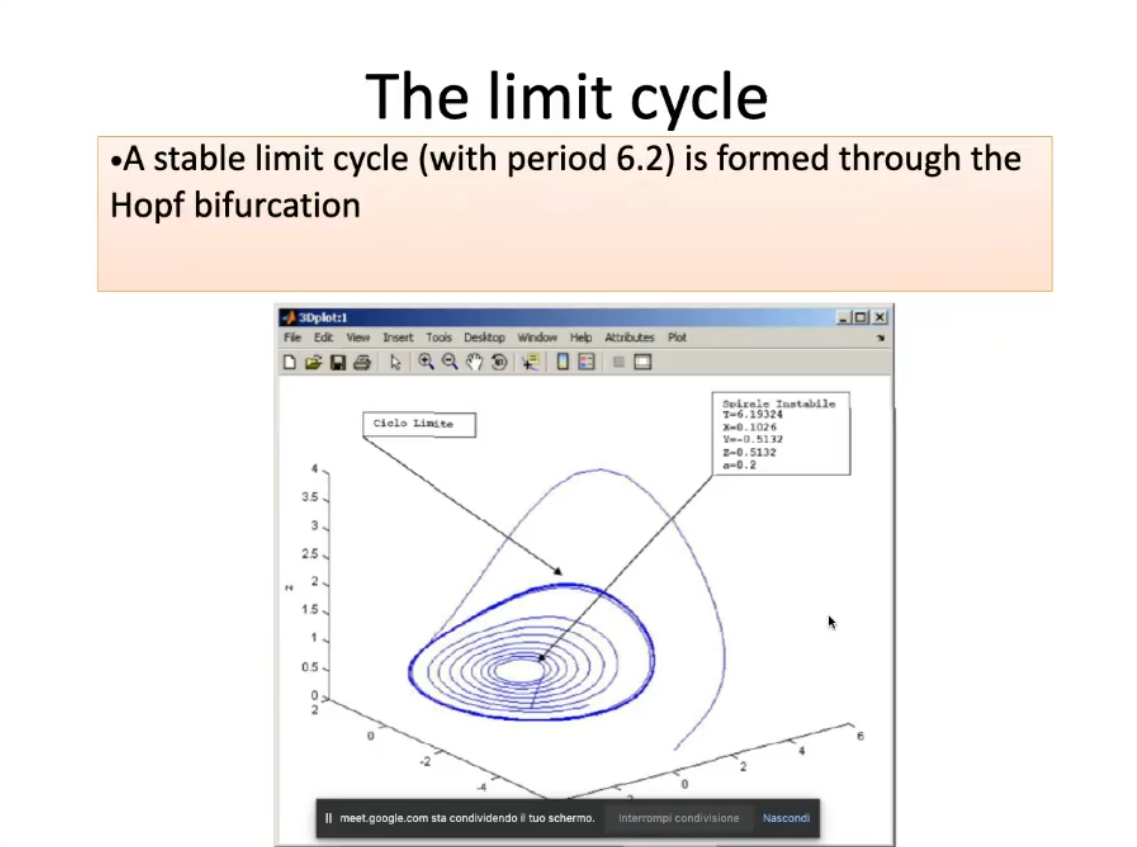
- Here’s the limit cycle in 3D.
- This is calculated via simulation.
- NOTE: in 3D the limit cycle can be curved.
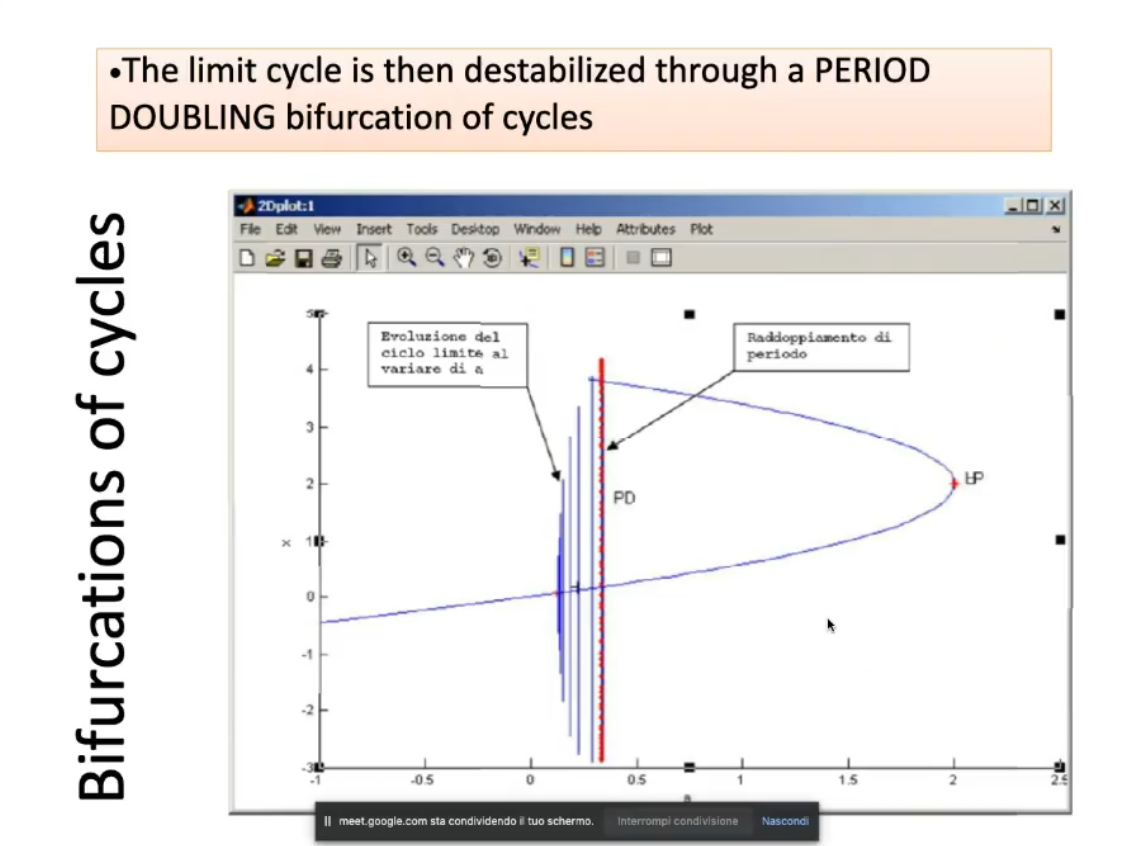
- Since as we have seen before, the limit cycle will increase its radius based on the parameter , then in this case it will intersect the saddle, we will see what happens.
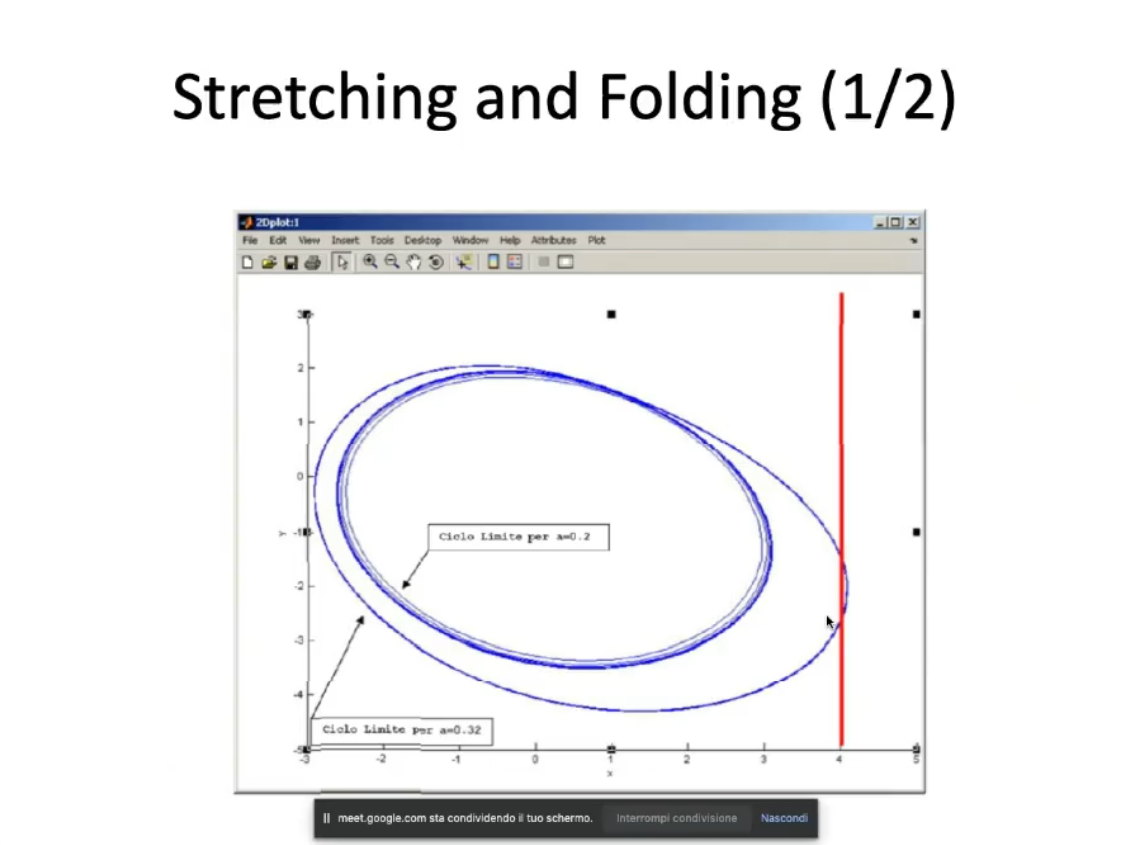
- When it reaches “a certain point” (the red bar), the it will “activate the mechanism” and “double itself”not-sure-about-this I understood this like i understood modern day yu-gi-oh.
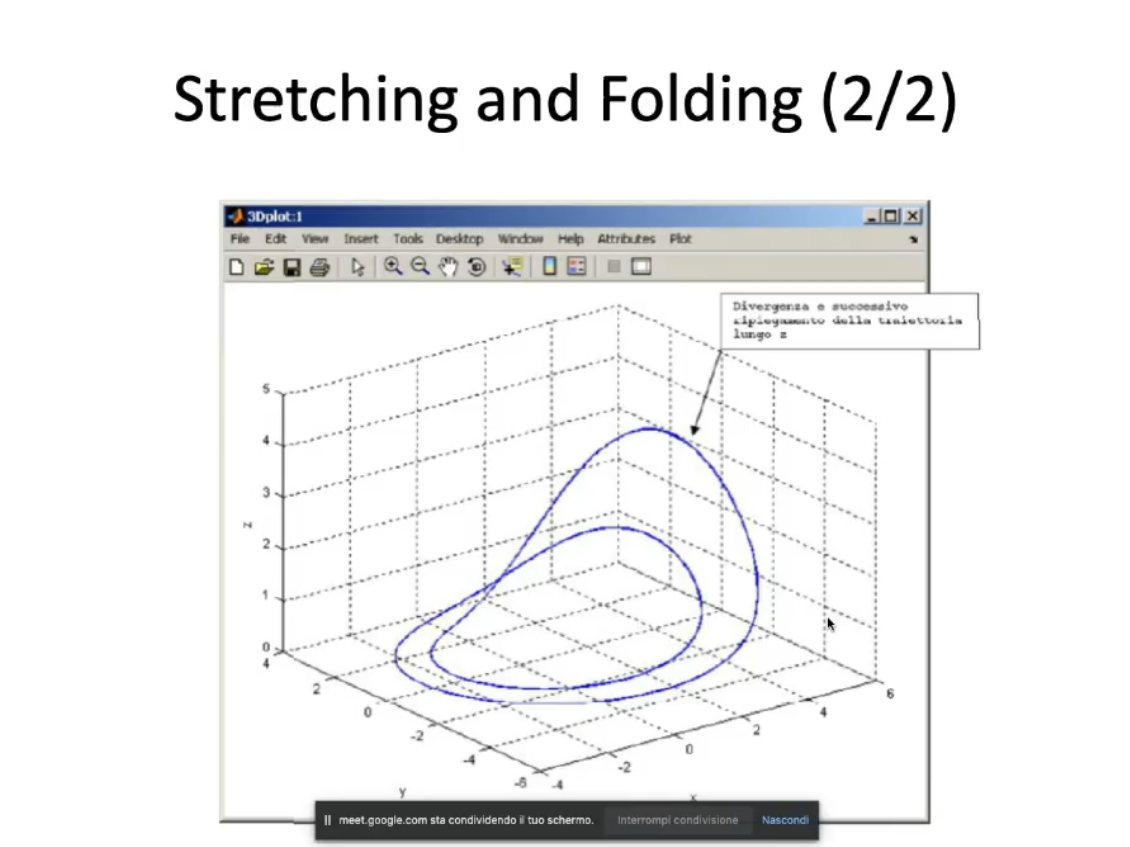
- This is the “doubled limit cycle” after “the mechanism” “was activated”.
This is formaly called a “2 period limit cycle”. - This “mechanism” will be repeated many times, and every time the limit cycle “will double itself”.
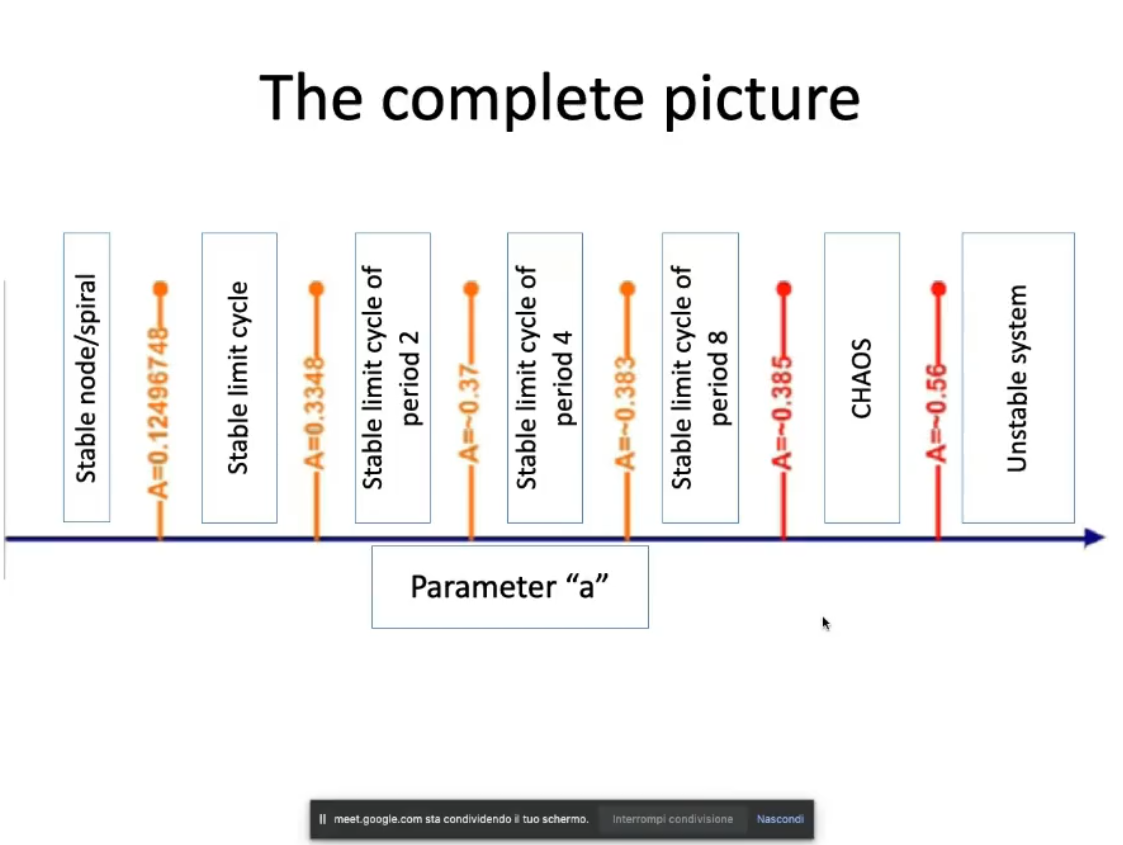
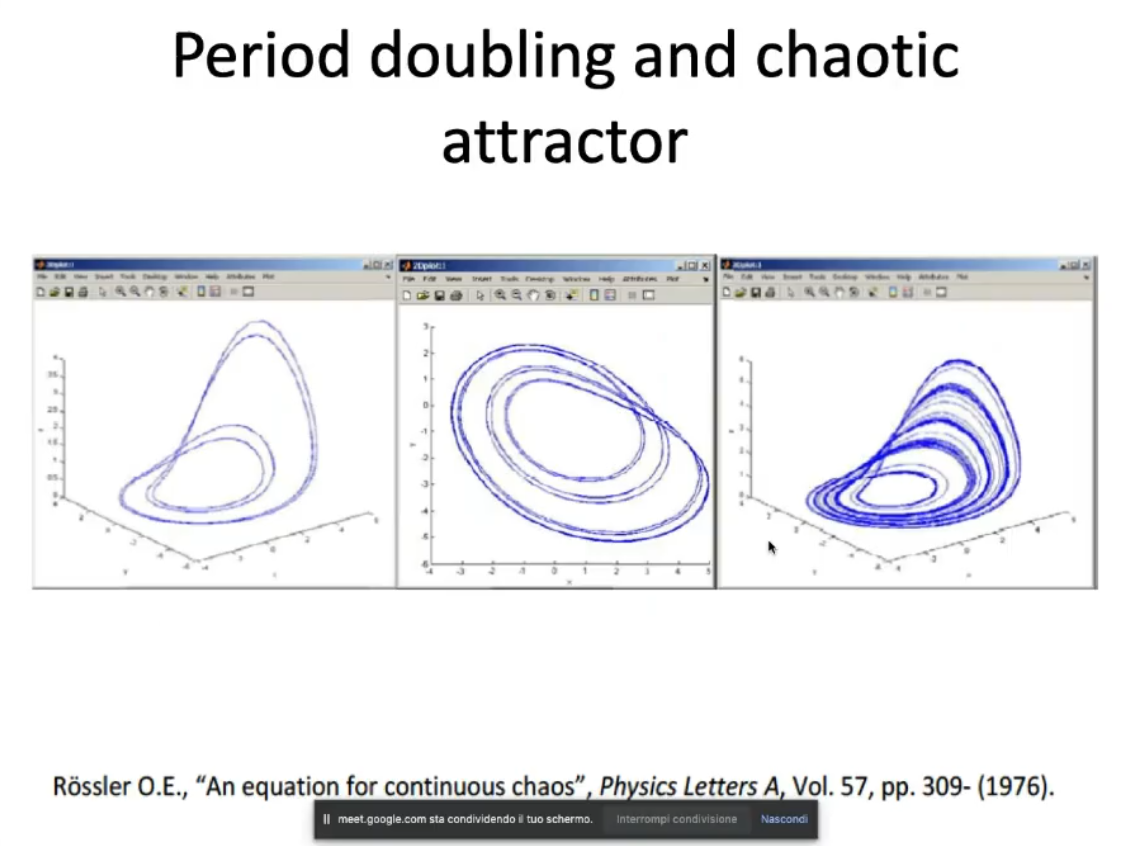
- First figure: period 4 limit cycle
- Second figure: period 8 limit cycle
- Third figure: chaos.
In this case no value of the phase space will be visited two times (remember that we are in 3D), so there will be no intersections in the phase space. - The shape of the chaotic case in not compleatelly irregular as you can see, it is “similar” to the other ones, but it does not have a period, it is aperiod (or chaotic).
For less then a certain value we have a 1-period limit cycle: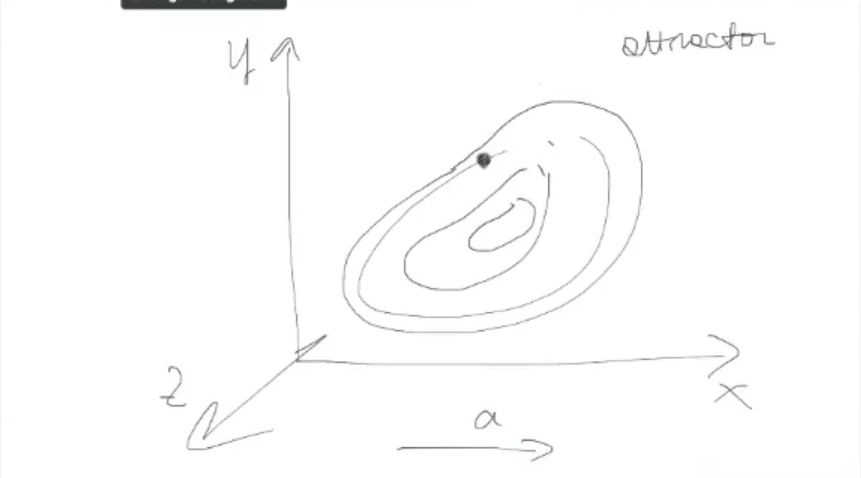
If we increase , then at a cartain point we will find a 2-period limit cycle: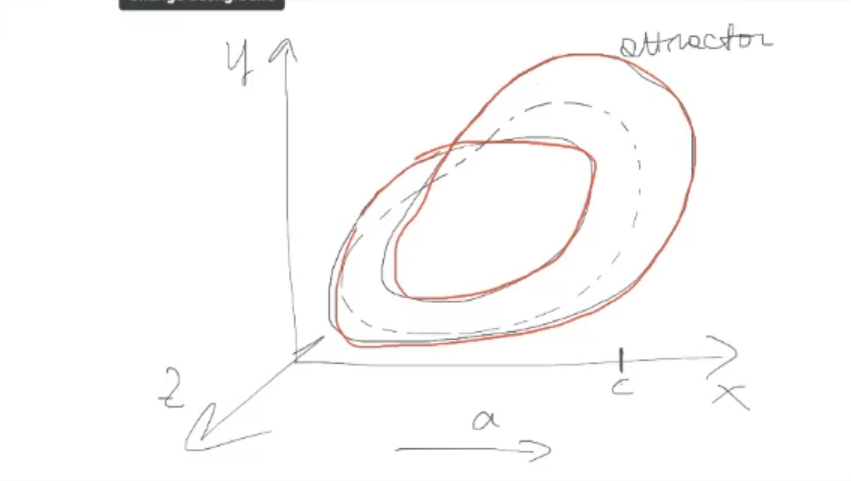
- It remains in the same “region” as the previous 1-period limit cycle.
- The old 1-period limit cycle still exists, but now, it is unstable.
This is the dynamics representation of the 1-period limit cycle:
This is the dynamics representation of the 2-period limit cycle (in red):
If we increase again, then at a cartain point we will find a 4-period limit cycle: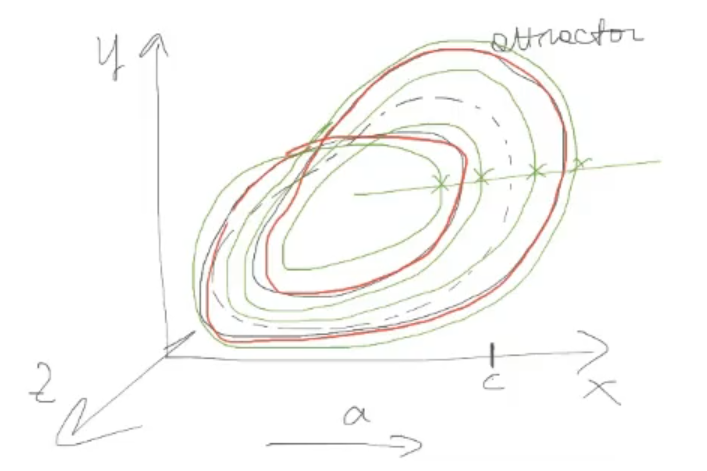
- The green straight line is there to count the intersection it has with the limit cycle.
If we count the intersections of the green-straight-line with the 1-period LC and 2-period LC: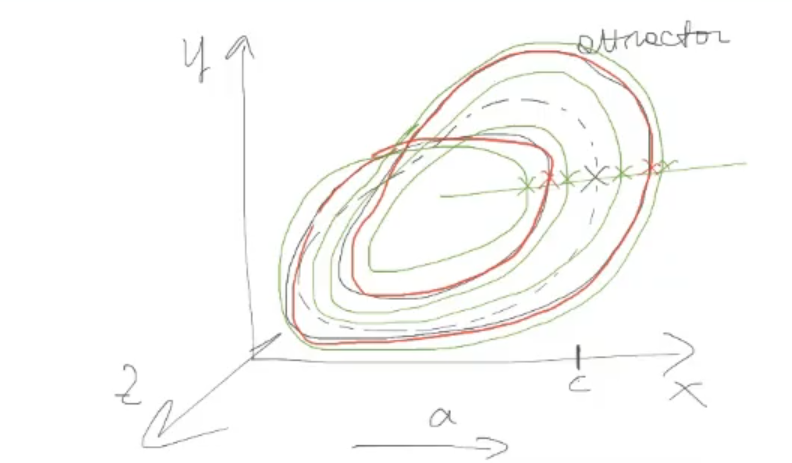
- 1 intersection with the 1-PLC (1-period limit cycle).
- 2 intersection with the 2-PLC.
Again remember that when is great enough to have a 4-PLC, then the previous 2-PLC and 1-PLC still exist, but now are unstable, similar to before: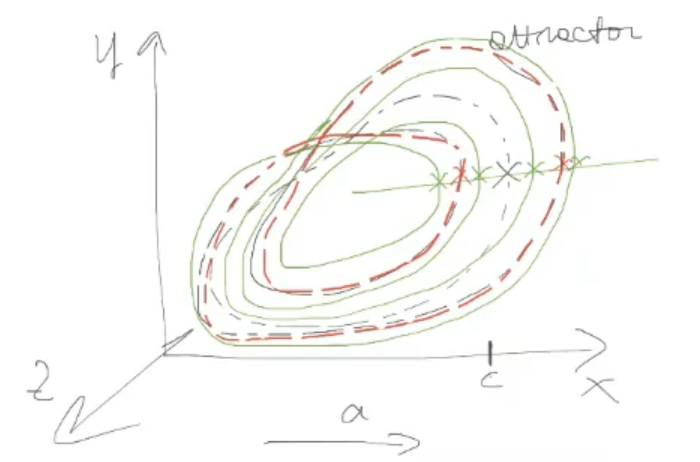
Then, If we increase again, we will have an 8-period limit cycle.
Then, If we increase again, we will have a chatic/aperiodic behaviour.
If we represent the chaotic behaviour in the dynamics graph: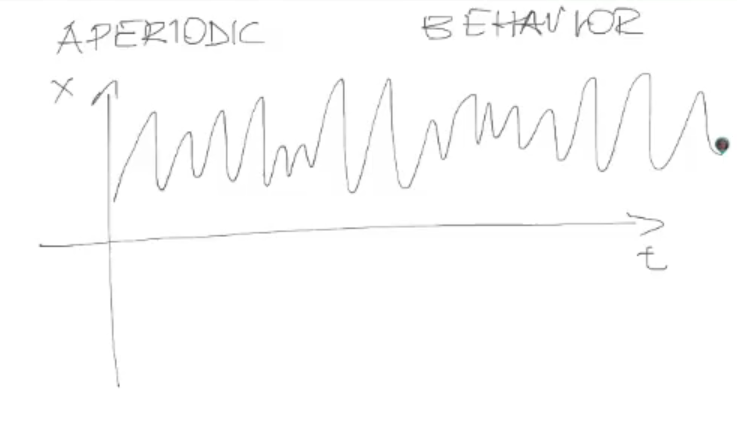
- It does not diverge, but it has NO period (aperiodic).
Now, consider another inital point, very very near the one we considered before, notice how, after a little time, the two trajectories are compleately different from one another: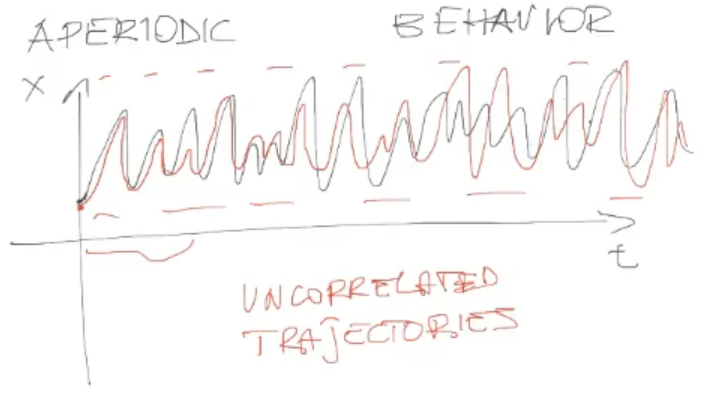
- However all trajectories will be confined in the same “region”.
Even if you start very far away: - That’s way we still talk about attractors, since the trajectors will be attracted to this region.
The fact that two almost-identical initial condictions will have very different trajectories, is defined/called “sensitivity to inital conditions” A more formal definition: “Changing by a very tiny amount the inital condition, then you will not be able to predict the future value of the trajectory”. The two trajectories will be similar only for a small time.
Finally if we increase again , we will have instability.
What is deterministic chaos?IMPORTANT
- Deterministic means that the equations are deterministic, there are no stochastic inputs or variables in these equations.
- Chaos is an aperiodic dynamics/behaviour, that also shows sensitivity to intial conditions, and it characterized by what are called “strange attractors”.
Chaos is possible only in non-linear systems.