Remember:
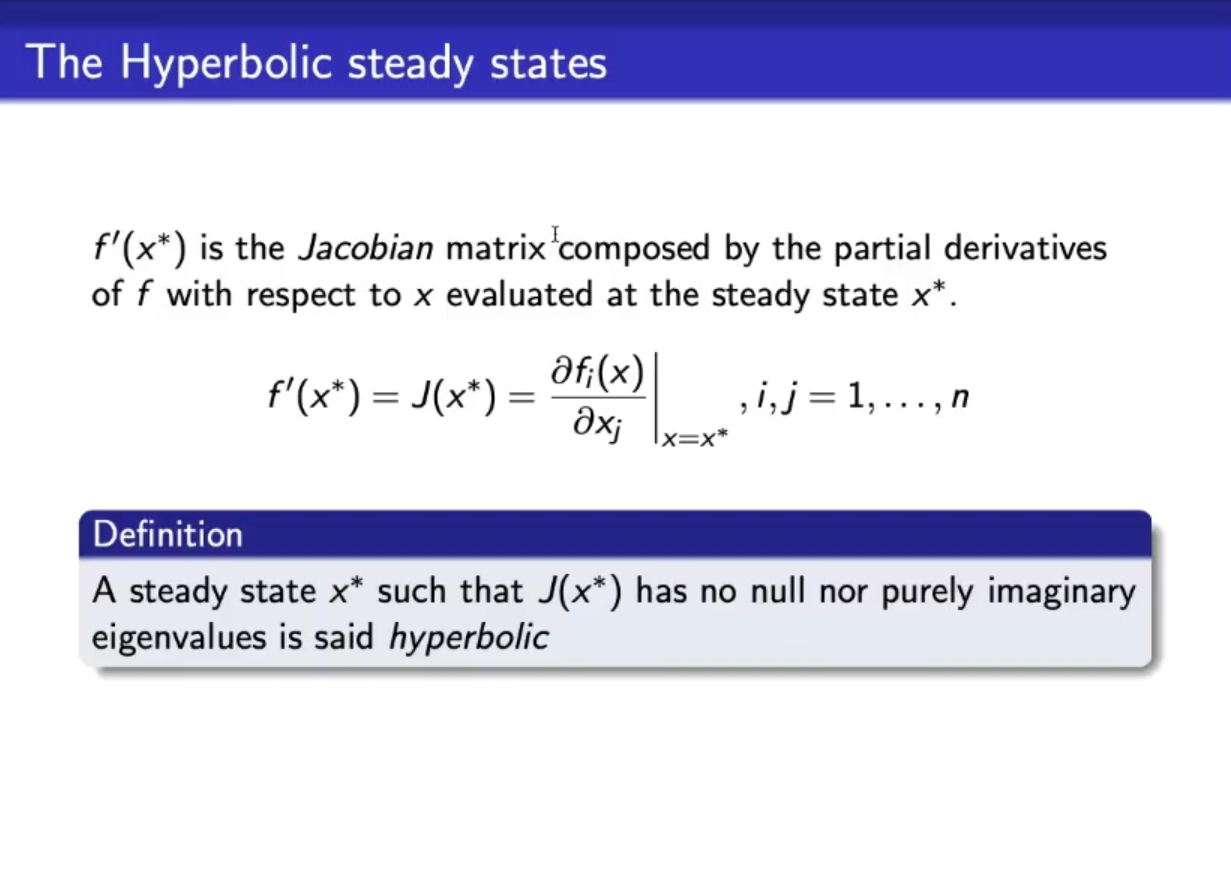
Definition ‘Hyperbolic Steady State’: A steady state such that (the Jacobian Matrix) has no null nor purely imaginary eigenvalues is said hyperbolic.
Jabobian Matrix: Given the Jacobian matrix composed by the partial derivatives of with respect to , evaluated at (the steady state), so:In matrix form:
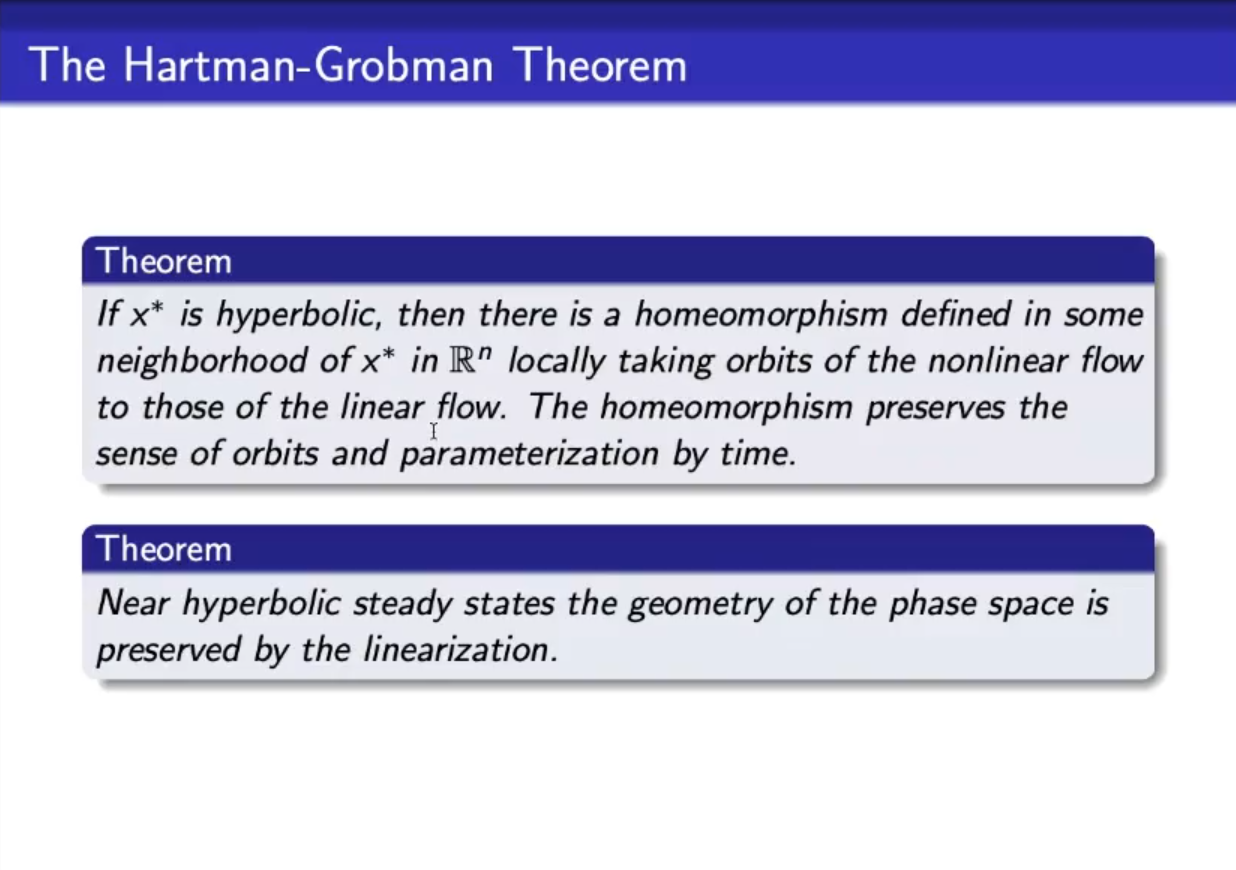
Theorem ‘Hartman-Grobman’: If is hyperbolic, then there is a homeomorphism defined in some neighborhood of in locally taking orbits of the nonlinear flow to those of the linear flow. The homeomorphism preserves the sense of orbits and parametrization by time.
Also near an hyperbolic steady state the geometry of the phase space is preseved by the linearization.
From the Hartman-Grobman Theorem we can say:
- If the eigenvalues are hyperbolic, then the linearization is “succeful”, mening that both stability and flow are qualitativly the same.
- Non-hyperbolic steady states may produce dynamics that are not predicted by the linearized system, so we cannot analyze them via linearization.
- If all eigenvalues are different from , just looking at the eigenvalues is sufficient to conclude about the stability of the steady states, and also about the geometry of the phase space near the steady state
But, ==if there is at least one -eigenvale, then we cannot predict the geometry of the phase space near the steady state by analyzing the linearized system, we need to use other tools==.- ==The presence of -eigenvalues may produce a very complicated dynamic, including limit cycles, and also the strange actractors==, so we need to study really well the system if this is the case.
- If the eigenvalues are hyperbolic, then the linearization is “succeful”, mening that both stability and flow are qualitativly the same.
- Non-hyperbolic ss may produce dynamics that are not predicted by the linearized system, so we cannot analyze them via linearization.
- If all eigenvalues are different from , just looking at the eigenvalues is sufficient to conclude about the stability of the steady states, and also about the geometry of the phase space near the ss
But if there is at least one -eigenvale, then we cannot predict the geometry of the phase space, near the ss by analyzing the linearized system, we need to use other tools. - The presence of -eigenvalues may produce a very complicated dynamic, including limit cycles, and also the strange actractors, so we need to study really well the system if this is the case.