Fast Recap:
- Bayes Theorem
- Decision Boundary or Decision Rule
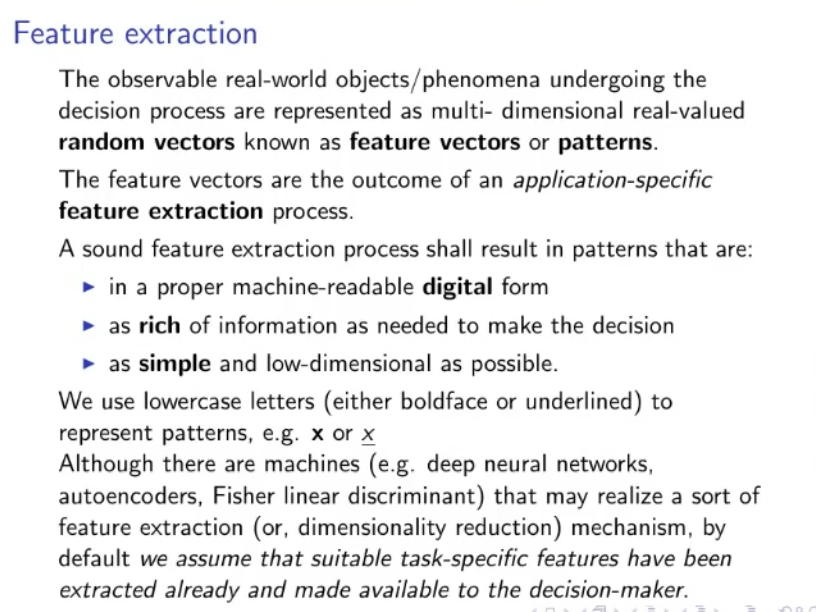
- Bayes Decision Rule
- Bayes Decision Rule with Discriminant Functions
- Maximum Likelihood
- First X Principal Components
Recap:
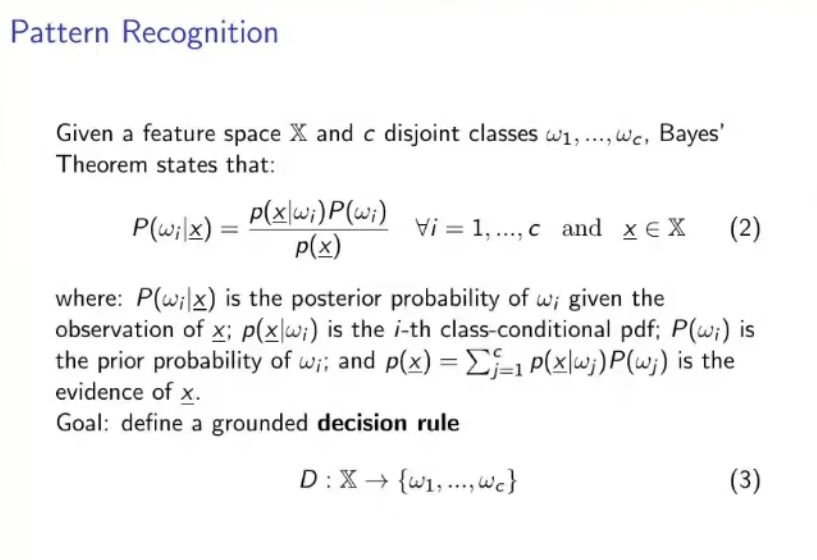
Bayes Theorem:
Where:
- is the conditional probability (a pdf) of the event happening in case of being in the condition of , for example: probability of picking a girl in a crowd being in a engineering university (we consider the more general case, in the world the percentage of female is and of males is ) (in an engineering course the percentage of females is around )
Decision Boundary or Decision Rule:
Knowing the pdfs and conditional pdfs of different events, for example we can create those pdfs on the basis of data we have gathered, we define the decision rule as the major probability of all the events, given some information.
For example, we take data on the distribution of males and females at different ours in an apartments for a month, we create many different conditional pdfs given all the information, and then we define the decision boundary as follows:
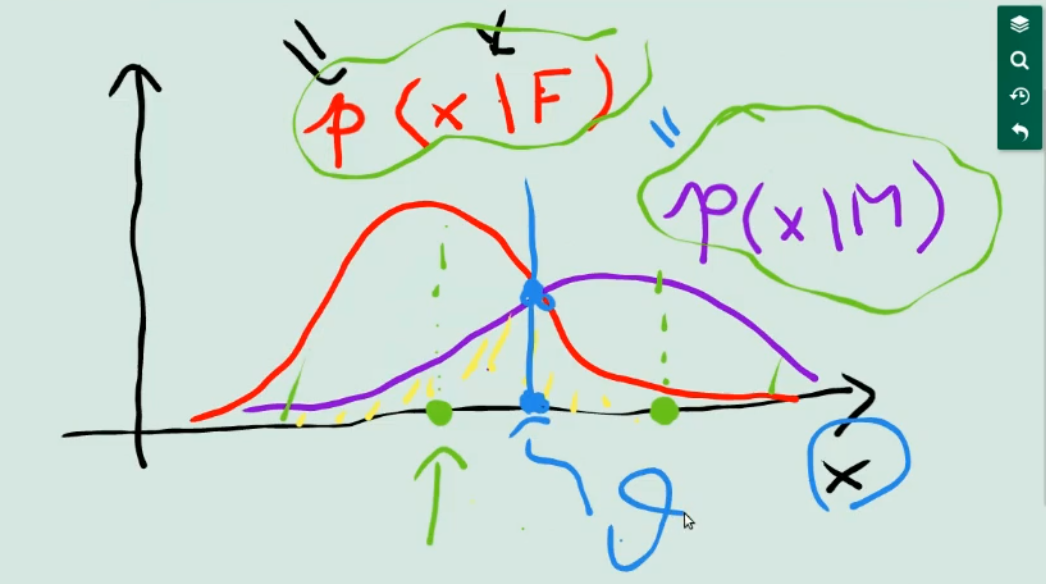
- in this case is the time variable.
- and are the condition of being female or male.
- is the decision boundary.
NOTE: is a function, this is a particular case of it being a constant.
Original Files:
~Ex.:
- : Probability that (the person knocking on our door) is female.
- : Probability that is male.
- : decision boundary.