Summary
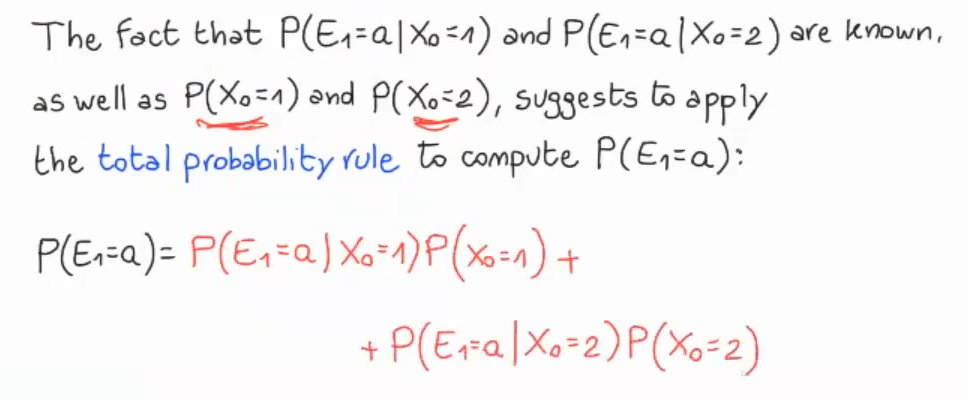
The probability that we are at state is equal to the sum of all probabilities that the events brings us to state multiplied by the probability that event has to happen.
Total Probability Rule
Let be the set of all possible outcomes of a random experiment (also called the sample space) Let be an event (i.e., a subset of ), and be a partition of :
- are events
- :
- ; for all
Then:
If is another event, we also have:
Observation:
Usually we use this theorem because computing the probability of the sum is much easier than directly computing or directly. Practically we get to use the additional information provided by
~Example: