Arguments:
DES - Definition of ‘State Holding Time’ DES - Definition of ‘Poisson Clock Structure’ DES - Exponential Distribution DES - Definition of a ‘Poisson Process’
Objective:
Calculate the distribution of the State Holding Time for a Stochastic Timed Automata with Poisson Clock Structure
Summary:
Starting from:
Where:
- : cdf of the state holding time of state
- : state holding time of state
We want to arrive at:
Useful to know:
Demonstration:
Recalling that:
we start from computing , for .
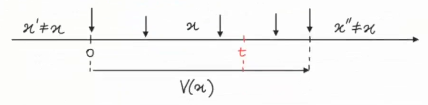
Considering this small system as an example:
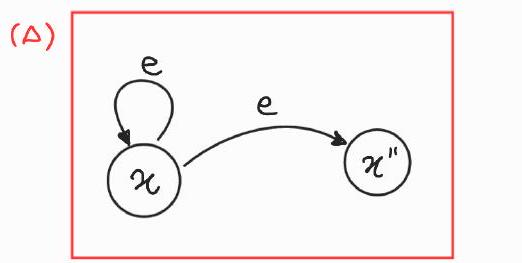
- In the mini-system above the is referring to the probability that from the event occurs and the state remain .
- When we say does NOT trigger state transition than that means that the “riccioli” are to only events to be considered.
“Ricciolo”:
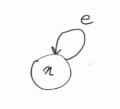
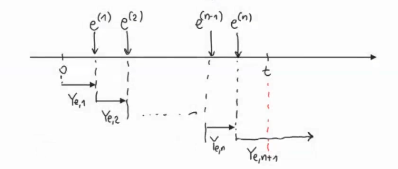
Where is the -th occurrence of event , and its lifetime. So:
Now lets consider instead:
So now we have that:
And we can calculate:
So:
We have thus shown that has an exponential distribution with rate:
Knowing that:
We can say that the rate is equal to:
Knowing this we can also say that the average state holding time is:
More Generally:
We have considered for the example only 2 states, and only two possible events, where 1 changes state and the other doesn’t, so we can say:
Then
So:
Now instead of considering only a single event that keeps me from changing state consider more events (an undefined number). So, if we want to say the general probability of remaining in the same state, we can change:
Note that are all the events possible Also that if for example the event would change state than .
For the opposite instead, we are using two different states and , so the general probability for changing state can be rewritten as:
(Old result):
(General result):