Summary
The more general case of Timed Automata, where we change from deterministic time and event to stochastic (random) ones.
We define the probability of being in each state at the beginning ()
- Es.:
We define the probability transition function ()
- Es.: : probability of going from state to state after event has occurred is equal to .
We define the distribution function of the events ()
- : Uniform distribution ()
NOTE: Not all changes have to be made, the system can be better described by a Mixed Stochastic Timed Automata, where some part of the system are still deterministic, while other are considered as stochastic
Stochastic Timed Automata
Stochastic means that we will have to use random variables, define by specific probability distribution functions (pdf), cumulative distribution functions (cdf) and probability mass functions.
As we will see this stochastic variables can be integrated with the Timed Automata, specifically we can change the clock structure to describe the randomness that the events can have (we denote a stochastic clock structure with , while a deterministic one as we have seen previously with ), this also applies to initial state, and the transition function.
| Deterministic | Stochastic | |
|---|---|---|
| Clock Structure | ||
| Transition Function | ||
| Initial Condition |
To understand what means let’s look at an example:
\begin{align} &p_{x_0} = \left[ \frac{1}{3}, \ \frac{2}{3} \right] \\ \\ &\left. \begin{array}[] \ F_a \sim \operatorname{U}(0,4) \ s \ \\ \ F_b \sim \operatorname{Exp}(\frac{1}{2}) \ s \ \end{array} \right\} \ F= [F_a, \ F_b] \\ \\ & p(2 \mid 1, \ a) = 1 \\ & p(1 \mid 2, \ b) = 1 - q \\ & p(2 \mid 2, \ b) = q \end{align}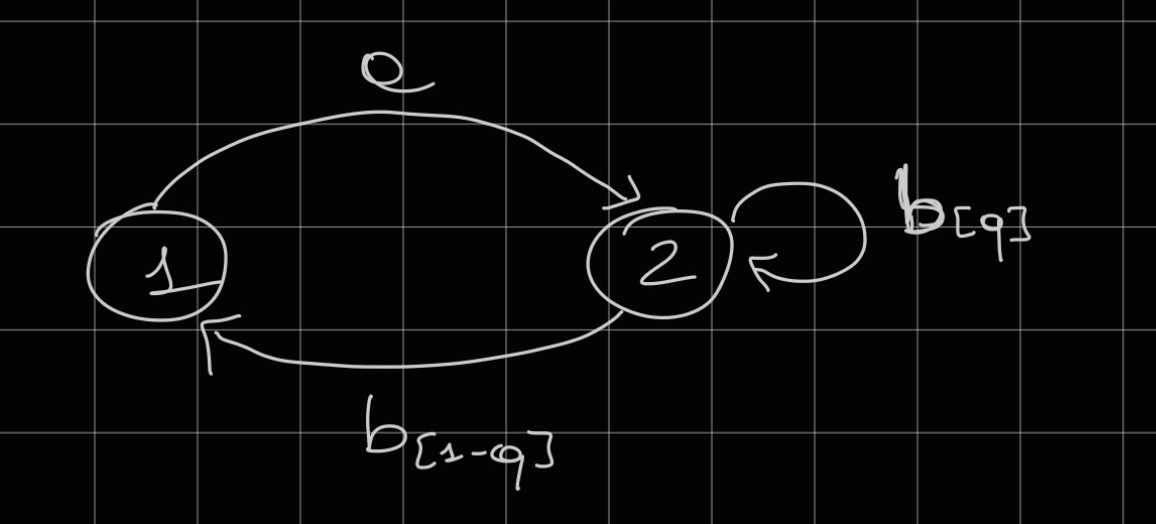
Where:
- : means that there is a 33% chance () of starting in state and a 66% chance of starting is state .
- : means that the event is described by a Uniform distribution () in the interval .
- : means that the event is described by an Exponential distribution () with rate (~ex.: in this case the rate is described as 2 events over 1 second, is an exponential distribution so this is the average value).
- : means that the probability of going from state to state after event has occurred is equal to .
Definition of ‘Stochastic Timed Automata’
This brings us to how we can define the stochastic time automata:
- DES - Definition of ‘Stochastic Timed Automata’ Notice the differences with the DES - Definition of ‘Timed Automata’, like how they were described before:
- →
- →
- →
Mixed Timed Automata
Any combination of Stochastic Timed Automata and Timed Automata
Total Probability Rule:
Very important theorem that will be useful in the future demonstrations.
The important formulas are:
And: