Original Source - Palisade Alternative Source - Investopedia Wikipedia
Monte Carlo Simulation
The Monte Carlo simulation is a computerized mathematical technique that allows people to account for risk in quantitative analysis and decision making.
Monte Carlo simulation furnishes the decision-maker with a range of possible outcomes and the probabilities they will occur for any choice of action.
History
The technique was first used by scientists working on the atom bomb; it was named for Monte Carlo, the Monaco resort town renowned for its casinos. Since its introduction in World War II, Monte Carlo simulation has been used to model a variety of physical and conceptual systems
How Monte Carlo Simulation Works:
Monte Carlo simulation performs risk analysis by building models of possible results by substituting a range of values (a probability distribution) for any factor that has inherent uncertainty.
It then calculates results over and over, each time using a different set of random values from the probability functions.
Depending upon the number of uncertainties and the ranges specified for them, a Monte Carlo simulation could involve thousands or tens of thousands of recalculations before it is complete.
Monte Carlo simulation produces distributions of possible outcome values.
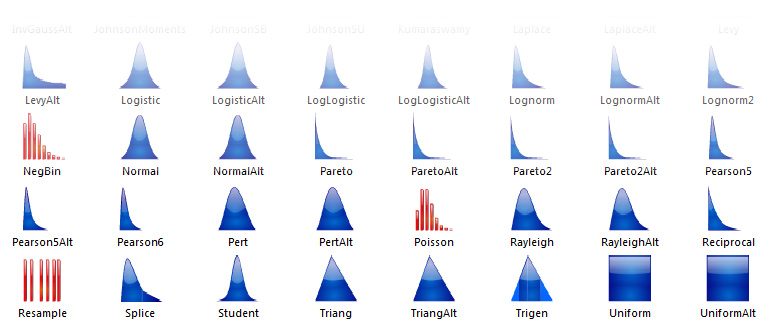
By using probability distributions, variables can have different probabilities of different outcomes occurring. Probability distributions are a much more realistic way of describing uncertainty in variables of a risk analysis.
Common probability distributions include: