Steady-State Analysis:
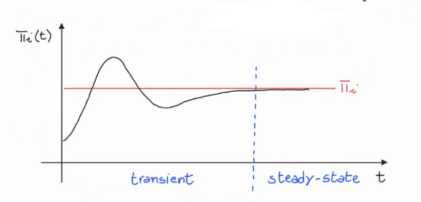
In transient analysis we compute the probabilities:
Next we will address the computation of the limits of these probabilities for :
This is the topic of steady-state analysis
Motivation
Drop the dependence of state probabilities on the time , and work with constant probabilities (the limits) instead of time-varying ones.
Classification of the States
For the purpose of steady-state analysis, we first need to introduce the classification of the states of a CTHMC.
Recurrent Time of State ():
Then, we introduce the following random variable
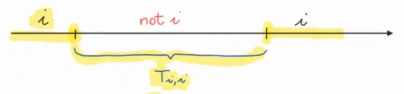
is called recurrent time of state . is a continuous random variable, described by:
Limit of the CDF:
Let:
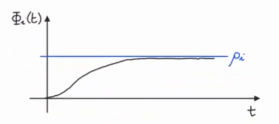
Where is the probability that the system returns to the state in the future. is the probability that the system does not return to the state in the future.
It turns out that:
Now assume is the cdf of .
Let:
Then: is the pdf of
Expected Value of :
Now if we compute expected value of :
- If , state is positive recurrent
- If , state is null recurrent
Where for positive recurrent state , we expect While for null recurrent state , we expect
~Example:
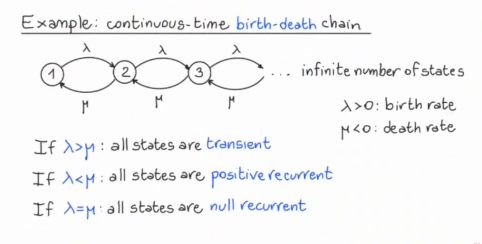
- If then the state number goes to infinity as time goes on.
- If then the most visited state is the first, the second has been visited less the the first, and so on, assume defined values.
- If as the time increases at infinity all the states could have been visited the same number of times, is a vector of all zeros.
Results:
- If is finite, then at least one state is recurrent.
- If is positive recurrent, and is reachable from , then also is positive recurrent.
- If is closed and irreducible, then one of the following holds:
- all states in are positive recurrent
- all states in are null recurrent
- all states in are transient
This means that it is sufficient to classify a single state from the system, then the others are classified accordingly.
- If is closed and irreducible and finite, then all states in are positive recurrent