Summary
Given a set of independent, events all described by the same exponential distribution, we have that the probability of exactly events occurring during the interval is:
Where can be seen as the probability mass function of the Poisson distribution with parameter . (From here the formula).
While the average number of said events occurring in an interval is:
NOTE: Both formulas do NOT depend on time.
Poisson Process:
A Poisson process is the counting process of an event which is always possible, and characterized by interval times (interval between one event and the next) that are:
- Independent
- Identically distributed with an exponential distribution.
Observations:
The rate of the exponential distribution is also called the rate of the Poisson process.
A Poisson process can be viewed as a stochastic timed automaton with Poisson clock structure:
- Where
- , the state counts the number of occurrences of event
- The transition diagram is given by:

- and with .
NOTE: The transition diagram and the state are infinite.
Observation:
Lets declare now a random variable as:
number of occurrences of event over the interval
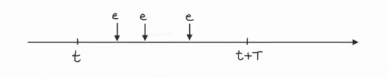
is a discrete random variable taking values in . It can be shown that the pmf of has the following form:
Which is also the pmf of Poisson Distribution with parameter
: Probability that exactly events occurs in the interval
- Demonstration for so:
Expected Value of Poisson Process
The expected value of is:
Notice that the above formula does not depend on the time instant , but only on the length T of the interval. It is a consequence of the memory-less property of the exponential distribution
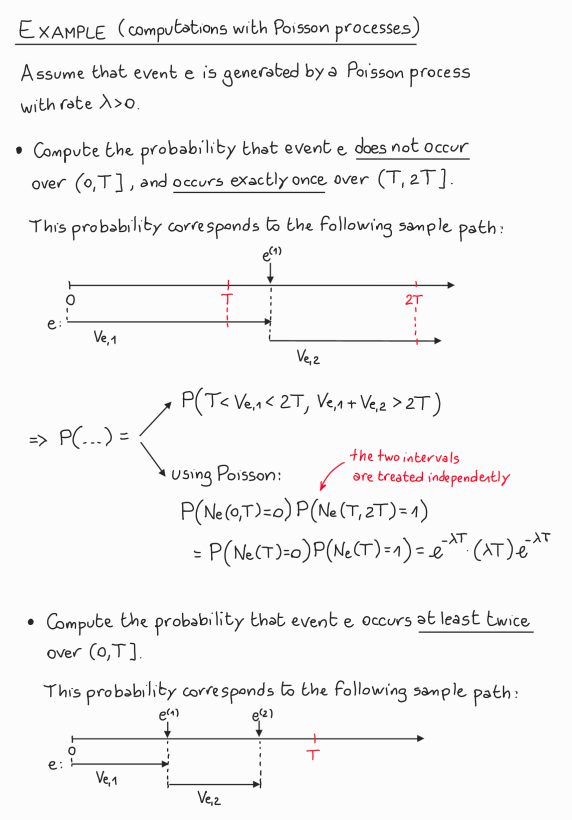
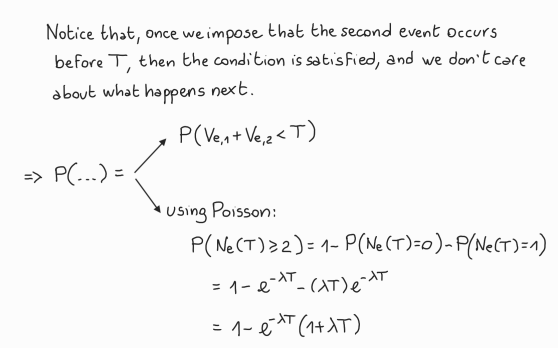
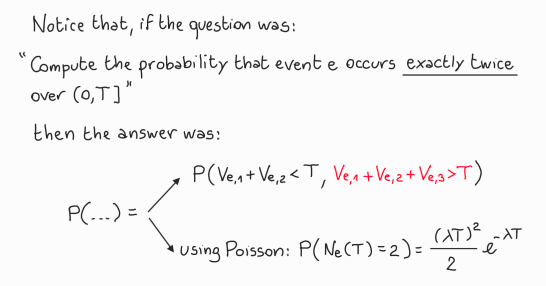
~Example: